

Policy Outreach at J-PAL Africa
Governments across Africa and around the world face real questions about how to allocate limited resources and design programs that improve the lives of people living in poverty. Many of these questions come down to program delivery. For example: how can we cost-effectively reach families with life-saving clean water? What are tested strategies to increase rates of immunization? How can we keep children learning in school?
J-PAL Africa works with governments, researchers, implementers, and other partners to generate, share, and apply rigorous evidence to answer questions like these and improve the lives of people living in poverty across sub-Saharan Africa. Our policy team focuses primarily on fostering long-lasting partnerships with governments centered around their priorities. Together, we collaborate on a wide range of activities from ideation to implementation, such as co-identifying policy questions, developing research collaborations, interpreting relevant evidence, and integrating learning into the design, implementation, and scale-up of programs and policies.
With staff based in Benin, Ghana, Guinea, Kenya, Madagascar, Nigeria, Senegal, South Africa, and Tanzania, we leverage evidence from randomized evaluations conducted across Africa and globally to inform policymaking.
Explore our policy work
Education
We partner with governments to strengthen education systems and improve learning, with a strong emphasis on gender equity in education and girls empowerment. Our work combines evidence generation, policy advice, technical assistance, and implementation support across the policy lifecycle.Through our Learning at Scale Accelerator, we build embedded partnerships that support evidence-based reforms, integrate learning and adaptation into implementation, and design explicitly for institutionalisation from day one,working with governments on specific priorities such as girls’ scholarships, school financing, structured pedagogy, and menstrual health. We also run the Evidence Champions Network, which offers a select group of senior education policymakers sustained, hands-on engagement focused on institutionalizing evidence use in decision-making. Learn more »
Health
We work with governments and other health sector partners to apply evidence to health system priorities and integrate proven interventions into routine public delivery systems. Through Scaling Access to Safe Water in Africa (SASWA), we support governments to embed subsidized chlorine for household water treatment within maternal and child health services. SASWA combines evidence synthesis, government-led adaptation, piloting, rapid monitoring, and implementation support to determine how the approach can be integrated into national systems. We’re currently collaborating with the governments of Rwanda, Guinea, and Madagascar, with additional partnerships being developed across the region. Learn more »
Jobs & Livelihoods
We work with governments, businesses, and development partners to embed evidence in strategies for job creation, firm growth, industrial development, and more resilient livelihoods. This work focuses on engaging governments early in the design and reform of major public programs, rather than evaluating isolated interventions. Current partnerships span export promotion, trade policy, SME support, supplier development, quality upgrading, digital infrastructure, and youth employment. Learn more »
Cross-cutting partnerships
Along with the aforementioned sector-specific partnerships, we also maintain cross-cutting partnerships with the governments of Benin and South Africa that work across education, health and other sectors.
Benin
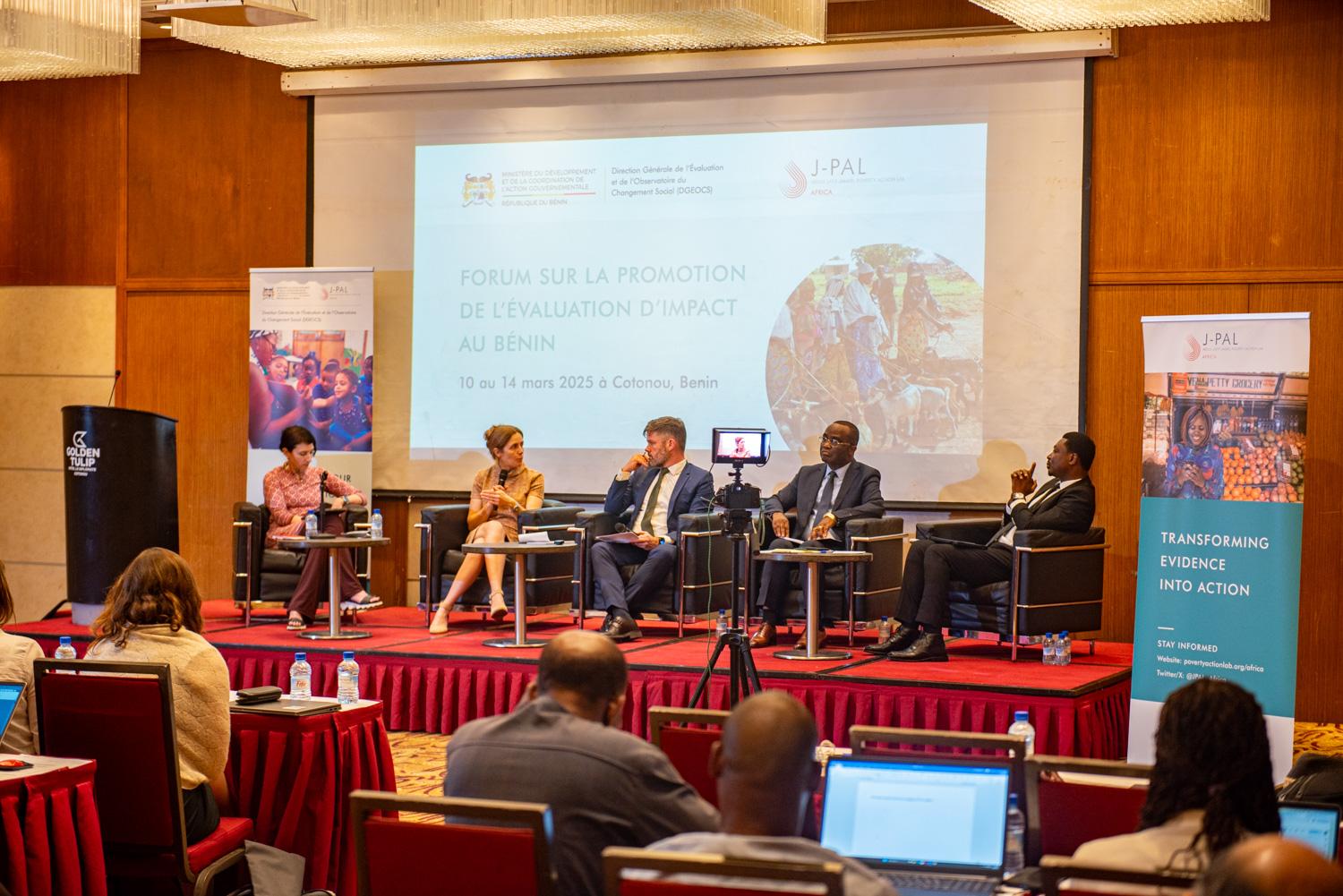
Our partnership with the Government of Benin spans education, health, jobs, and industrial development. Together, we develop policy-relevant research, support evidence use across ministries, and strengthen local capacity for rigorous evaluation. Recent work includes reforms to girls’ secondary education, school feeding programs, malaria vaccination, and nutrition supplementation. The partnership has also made Benin a hub for J-PAL flagship training, convening researchers and policymakers from across the continent. Learn more »
South Africa
We partner with government departments, researchers, and implementing organizations in South Africa to develop policy-relevant evaluations and support the application of evidence to public policy. We work closely with the Department of Planning, Monitoring and Evaluation (DPME), supporting policy analysis on social assistance, developing evaluations of business incentive and employment programs, and facilitating research using the National Treasury Secure Data Facility on how trade policy and broadband access affect firms, workers, and communities. Learn more »
Initiatives
Digital Identification and Finance Initiative in Africa (DigiFI)
The Digital Identification and Finance Initiative in Africa (DigiFI) supports governments and other partners across the continent to generate and apply evidence on digital identification, digital payments, financial inclusion, and women’s economic empowerment. Since 2019, DigiFI has supported 47 studies across sub-Saharan Africa, more than sixty percent of them led by African researchers. Alongside funding research, the initiative works with governments, funders, and private sector partners to inform major digital reforms and translate emerging findings for policymakers. Learn more »
How we work
We develop long-term partnerships grounded in the priorities of policymakers and implementing organizations. We work with partners to understand the challenges they face, assess what existing evidence can contribute, and identify where new research is needed.
Depending on the needs of a partnership, our support may focus on one area or combine several of the following:
1. Generate policy-relevant research
We work with partners before and during program design to identify questions where evidence can improve targeting, delivery, and learning. This may include convening policymakers and researchers, assessing programs for evaluation potential, matching research teams with government and implementing partners, supporting project development and fundraising, and embedding learning into major reforms.
2. Translate evidence for policy and practice
We synthesize evidence from Africa and around the world and interpret its relevance for specific policy contexts. Through policy insights, evaluation summaries, policy memos, briefings, workshops, and direct technical engagement, we help decision-makers understand what the evidence shows, where uncertainty remains, and how findings can inform program and policy design.
3. Adapt and test promising approaches
When evidence suggests that an approach is promising, we help partners determine whether and how it can be adapted, integrated into existing systems, and expanded responsibly. This can include piloting new delivery models, connecting partners with researchers and original implementers, sharing implementation resources, coordinating stakeholders, and strengthening monitoring and rapid feedback during scale-up. In some cases, this involves adapting a specific intervention; in others, it means embedding evidence within a broader reform, financing mechanism, delivery platform, or government program.
4. Strengthening systems for evidence use
In collaboration with our Education and Training (E&T) team, we support policymakers and practitioners to build the skills, relationships, data systems, and institutional processes needed to generate, interpret, and apply evidence over time. This includes embedded technical support, government training, research matchmaking, communities of practice, and sustained partnerships designed to strengthen evidence use beyond a single project.
5. Take evidence to scale
We support governments to move from clear research findings to effective and cost-effective delivery at scale. Examples include supporting Teaching at the Right Level across African education systems, integrating subsidized chlorine into maternal and child health services through SASWA, and helping governments incorporate evidence into national education, social protection, digital infrastructure, industrial, and employment strategies.