

How digital financial services and e-commerce can help curb the impact of COVID-19 on people's livelihoods
Read this post in Bahasa Indonesian.
Countries across the world have imposed unprecedented restrictions on mobility and social interaction to combat the spread of COVID-19. Indonesia is no exception.
In April, the government of Indonesia announced the enactment of large-scale social distancing regulations (Pembatasan Sosial Berskala Besar, PSBB) and banned travel for the upcoming Eid holiday, when tens of millions of Indonesians typically return to their home villages to celebrate with family.
Other restrictions include instruction to work from home, closures of public spaces and transport, and even travel bans to and from specific locations. These measures have profoundly impacted many aspects of people’s lives—from the way people communicate, work, obtain goods, and transact.
In the midst of this, there is a growing push to accelerate e-commerce and adoption of digital financial services (DFS). Anecdotal data from J-PAL Southeast Asia’s Inclusive Financial Innovation team’s conversations with e-commerce platforms in Indonesia suggests an increase in both the number of transactions and the number of new users. Specifically, there has been an increase in demand for purchases such as staple foods, health products, and school supplies.
Instructions to practice social distancing and to avoid public places have encouraged individuals to shift from procuring daily necessities offline to using online sources. In addition, digital payment may play an increasingly important role as it facilitates e-commerce transactions and remittances to far-away family members.
How can DFS and e-commerce help curb the impact of Covid-19?
For those with access to mobile phones and digital literacy, e-commerce and DFS may help people to maintain their livelihoods. Not only does DFS offer a fast and contactless means of payment and transfer, but evidence from around the world has found other benefits.
For example, there is strong evidence that mobile savings and remittances can be used to improve risk-sharing between individual's social networks and smooth consumption. In Rwanda, during a time of crisis, remittances through mobile airtime accounts were used by less impacted individuals to help relieve the pressure of income loss for people who were affected the most.
E-commerce can be a valuable way for people to locate and purchase scarce resources, especially in remote areas or localities experiencing shortages. However, an important concern during the COVID-19 crisis is price gouging, or exorbitant price increases for items in high demand. Currently major Indonesian e-commerce firms are launching initiatives to limit this practice.
But who will enjoy these benefits? Despite its promises, DFS and e-commerce are still inaccessible to most people. To shed light on Indonesians’ access to DFS, we turned to the latest round of the Financial Inclusion Insights Survey, conducted by SNKI (Sekretariat Nasional Keuangan Inklusif, or National Council for Financial Inclusion) and Kantar. These data were collected between March and May of 2019 and are nationally representative: thus, they give us a relatively up to date picture of digital inclusion across the country.
The first thing to note is that the vast majority of Indonesians have no experience with e-money.
Overall, just 6.8 percent of people reported having ever used e-money in 2019.
Use is strongly correlated with education: while just 5.2 percent of people with junior high school education use e-money, 27.3 percent of university graduates use the service. Still, the vast majority of even the most educated individuals lack exposure.
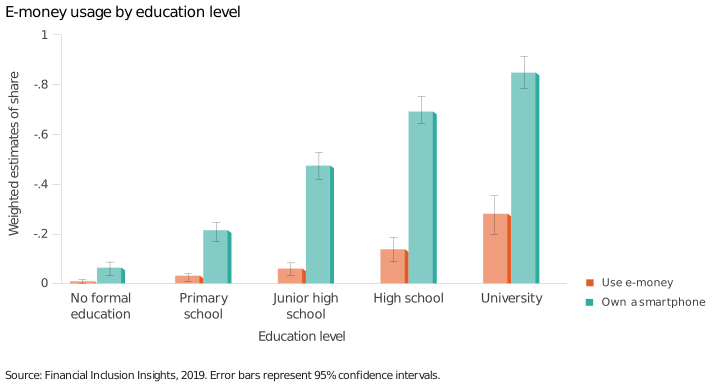
There is a bright spot, however: the survey suggests many more Indonesians are capable of adopting DFS.
Smartphone ownership is an especially important proxy to measure potential access to e-money and e-commerce. While smartphone ownership is also strongly correlated with education, the graph makes it clear that many non-users of e-money have the tools to adopt. Other analysis from SNKI’s report on the survey shows that smartphone skill levels are also high. Thus, there is an opportunity to onboard a sizable amount of the smartphone owners to DFS and e-commerce in the near term.
Potential for greater DFS and e-commerce adoption
There are at least two major opportunities that providers can leverage to boost digital financial inclusion.
First, the government has started to expand the channels of some of its government-to-people transfer programs to include e-money platforms, which may activate inactive e-money users or create new ones.
Second, the demand for digital remittances may continue to rise especially as the religious festival, Eid, is approaching. It is central to the Eid tradition that people across socioeconomic groups give out allowance money to family members. With the travel restriction in place, a digital alternative to remitting funds will be in demand.
However, onboarding a broader segment of people into the DFS and e-commerce ecosystem will rely on providers’ ability to appeal to them.
A big part of this effort may include easing the onboarding process and making these services more accessible. For example, DFS platforms could make the registration and verification (“Know Your Customer”) process less complicated or prepare easy-to-understand introductory materials for new e-money users.
To improve accessibility, existing e-commerce or DFS agents can be leveraged to disseminate introductory messages and information campaigns more broadly, in addition to helping more people access DFS and e-commerce products or services. Of course, ensuring that this approach also supports good social distancing practices is important.
J-PAL Southeast Asia’s Inclusive Financial Innovation Initiative (IFII) is working alongside governments, private sector firms, and nonprofits to explore how DFS and e-commerce can further support people’s livelihoods during this COVID-19 crisis.
This blog post draws on background research conducted as part of these effort funded by the Bill & Melinda Gates Foundation. The findings and conclusions contained within are those of the authors and do not necessarily reflect positions or policies of the Bill & Melinda Gates Foundation. The mission of IFII is to ensure that digital financial services can drive economic development while lifting up women, low-income groups, and marginalized communities.
For more information about IFII, contact Aliyyah Rusdinar.
The digital financial services (DFS) sector is among the fastest-growing: the number of financial technology (“fintech”) companies in Indonesia more than doubled from 130 in 2017 to more than 320 in 2019. In addition to this rapid growth in the private sector, the Indonesian government is increasingly moving towards digital delivery of social assistance programs in the public sector. J-PAL Southeast Asia, based at the Faculty of Business and Management at the University of Indonesia, is launching the Inclusive Financial Innovation Initiative to answer important policy questions now at the forefront of the region’s economic growth.
Indonesia’s digital economy has quadrupled since 2015—reaching an approximate value of USD$40 billion in 2019. Much of this growth is driven by the country’s e-commerce sector, which recorded 88 percent growth from $1.7 billion in 2015 to $21 billion in 2019.
The digital financial services (DFS) sector is among the fastest-growing: the number of financial technology (“fintech”) companies in Indonesia more than doubled from 130 in 2017 to more than 320 in 2019. In addition to this rapid growth in the private sector, the Indonesian government is increasingly moving towards digital delivery of social assistance programs in the public sector.
J-PAL Southeast Asia, based at the Faculty of Business and Management at the University of Indonesia, is launching the Inclusive Financial Innovation Initiative to answer important policy questions now at the forefront of the region’s economic growth. With the support of the Bill and Melinda Gates Foundation, the three-year initiative aims to ensure that digital financial services can drive economic development while lifting up women, low-income groups, and marginalized communities.
While growth in e-commerce and DFS represents a promising opportunity to advance financial inclusion, use of DFS is currently concentrated among young, urban, and higher-income populations. As digital technologies continue to improve and costs of service provision decline, there is a growing opportunity to expand the reach of DFS and leverage it as a tool for broad-based financial inclusion.
The Inclusive Financial Innovation Initiative will build on existing global evidence to understand how DFS can be used to accelerate financial inclusion and broad-based economic development within Indonesia and beyond.
The Initiative will include three intersecting workstreams to provide actionable evidence to members of Indonesia’s DFS ecosystem, including policymakers, practitioners, and non-profit organizations:
- Policy research and analysis: Under the Initiative, J-PAL staff and researchers will review the existing global evidence base to offer evidence-based policy recommendations for how to leverage DFS to improve government anti-poverty programs and benefit marginalized groups, and to identify knowledge gaps where new research is needed to answer important questions.
- Creation of a Learning Collaborative: To encourage collaboration, the Initiative will facilitate a learning and communication platform where relevant stakeholders in the financial inclusion and digital finance sector can connect, share knowledge and best practices, and formulate strategies to answer priority research and policy questions.
- Research collaboration: The Initiative will develop innovative pilot studies and randomized evaluations to answer policy-relevant questions. It will build partnerships to ensure that the evidence produced by these studies can directly contribute to policy decisions.
Why focus on financial inclusion?
Financial products and services are designed to help individuals build resilience to unexpected events and take advantage of opportunities, and are often viewed as key tools for improving families’ welfare and economic mobility.
Existing evidence suggests that improving access to savings accounts can have positive effects on household welfare, and that digital financial tools like mobile money may offer users significant benefits. For example, studies in Chile and Kenya have found that access to basic bank accounts allowed households to better manage fluctuations in income, increase business investment, and increase private expenditure levels. Meanwhile, offering mobile phone-based savings accounts to parents in Kenya whose children were about to enter high school increased enrollment by 5 to 6 percentage points.
Digital financial services can also be a tool for boosting women’s economic engagement and empowerment.
For example, a study in India found that linking earnings from a government workfare program to women’s bank accounts (rather than household-level accounts), coupled with a basic account training, led to increased female employment both within the workfare program and the private sector, especially for those women whose husbands expressed the most opposition to women working.
In Niger, disbursing cash transfers via mobile money improved diet diversity during the 2009-2010 food crisis relative to cash-in-hand transfers. Women who received mobile transfers were more likely to travel to weekly markets, be involved in selling household grains, and spend more on children’s clothing than those in the other groups.
Why focus on Indonesia?
Indonesia’s DFS providers are developing tech-based innovations to increase financial inclusion among households that are currently underbanked or unbanked altogether. For example, micro, small, and medium enterprises (MSME) now have access to digital payment services designed to boost transactions, improve bookkeeping, and build better credit scores.
Women’s savings collectives, called arisan, also have opportunities to go digital through MAPAN arisan. Digitized arisan groups can collectively purchase goods online without disrupting their household cash flow.
Finally, online peer-to-peer lending such as Amartha and TaniFund offer access to credit for farmers, fishermen, and micro-merchants who have been largely ignored by formal banking institutions. While these and other innovations are promising, we know little about their real causal impacts on the lives of the poor.
To push the frontier further, we need more evidence on what types of DFS work within the context of Indonesia’s regulatory and business environment, infrastructure, and demographics; why they work; and how they can be deployed to maximize impact.
Working alongside a diverse set of collaborators, the Inclusive Financial Innovation Initiative aims to contribute to an inclusive, impact-driven digital finance ecosystem in Indonesia.
For more information, contact Aliyyah Rusdinar.