


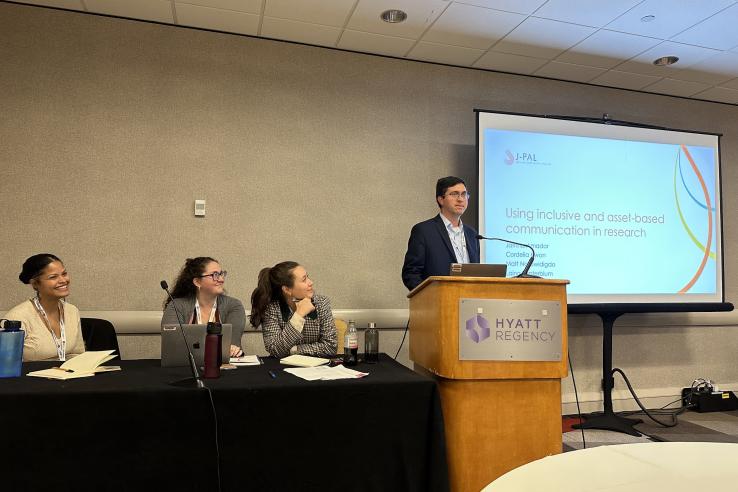
Researching racial equity: Integrating inclusive and asset-based communication throughout the research cycle
In J-PAL North America’s researching racial equity blog series, we discuss how research plays a critical role in identifying structural inequities in systems and policies that disproportionately affect communities of color. In part five, we recapitulate our workshop on inclusive and asset-based communication in research, recently delivered at the Association for Public Policy Analysis and Management’s (APPAM) 2023 annual conference.
The theme for this year’s APPAM conference was “Policy that matters: Making public services work for all.” At J-PAL North America, we believe one critical way to inform policy that matters is by communicating about research in an inclusive and asset-based manner. As such, our staff and Co-Scientific Director Matt Notowidigdo facilitated a workshop on principles of inclusive and asset-based communication and considerations for imbedding these principles throughout the research cycle.
Principles of inclusive and asset-based communication and their value in research
Inclusive and asset-based communication aims to convey both an understanding of and an appreciation for the experiences of all people by a) centering people’s strengths and humanity and b) situating individuals in their larger socio-political contexts. It consists of both inclusive language and asset-based framing. Inclusive language refers to the active process of making intentional choices about language, including what we say (i.e., words) and how we say it (i.e., syntax). J-PAL’s inclusive language principles are described in this blog post.
Asset-based framing refers to centering peoples’ strengths and aspirations before exploring their needs (i.e., deficits). This concept calls on researchers to understand peoples’ full range of experiences and to position those experiences within a larger context. We identify three major principles of asset-based framing:
- Positionality is where one is situated in society based on their identities. Researchers may be familiar with how positionality can influence informed consent if participants feel compelled to comply with what an “expert” is asking. In contrast, some communities may be wary of researchers conducting an evaluation if the researchers do not share common characteristics (e.g., race, socioeconomic status) and experiences (e.g., systemic racial oppression).
- Power dynamics are the formal and informal ways that power is distributed and decisions are made within a society. This principle is closely tied to positionality because where one is positioned in society can impact their perceived power. Decisions about research questions and methodologies are often made among researchers—potentially with input from program administrators—but program recipients are rarely involved. What wisdom and knowledge are missed when these important stakeholders are not included in decision making? A toolkit from Chicago Beyond explores this principle further.
- Historical context refers to socioeconomic and political conditions at a certain time and place, including the present. A number of economic studies ask what interventions can alter the choices people make without accounting for the larger structural contexts that may expand or restrict peoples’ choices. J-PAL affiliated professor Peter Christensen (University of Illinois, Urbana-Champaign) and his co-authors demonstrated effective consideration of historical context in a recent study investigating whether racial discrimination constrains the housing choices people can make.
Inclusive and asset-based communication can enhance research in several ways. First, it can bolster the research and research teams’ credibility among participants and other stakeholders by signaling that researchers respect their humanity and are aware of their context. Most people don’t hold their areas of improvement as key to their identities. Why then would we identify study participants solely by their needs and challenges? Understanding peoples’ experiences holistically—including their strengths—is imperative for forming strong relationships.
Second, they can enhance the accuracy of research results. For example, being specific by describing a primarily Black study population as “primarily Black” may be more accurate than describing the same participants using the umbrella term “people of color,” which could also lead to feelings of erasure. Additionally, situating findings within larger contexts may improve our understanding of underlying mechanisms: outcomes may be due to individual behaviors, but are likely also due to systems and societal constraints (as demonstrated in Peter’s aforementioned study).
Finally, inclusive and asset-based communication can increase a study’s policy relevance by asking human-centered, context-relevant research questions. Working with directly-impacted communities to develop research questions—as demonstrated by J-PAL affiliated professor Marcella Alsan’s (Harvard) racial concordance study—helps ensure that studies are pertinent to participants.
Embedding inclusive and asset-based communication principles into research:
Embedding these principles at each stage of the research process can maximize their impacts. Click the following drop-downs for additional considerations and resources for integrating these principles throughout the research cycle.
Developing a research question
It can feel challenging to frame a research question around assets when theories of change are generally designed to address needs. Asset-based framing does not ignore needs; it merely positions them alongside strengths and within a larger context. Some additional considerations when developing research questions in an inclusive and asset-based manner include:
- Framing questions to investigate how different communities experience economic disparities as a consequence of historic policy choices, rather than how to change peoples’ behaviors in a vacuum. For example, rather than asking “why don’t Black students take AP courses?”, J-PAL affiliated professor Dania Francis (UMass Boston) and her co-authors asked “What exogenous factors influence Black students’ decision to enroll in AP math?” The latter question took the onus off students themselves, subverted racial stereotypes, and enabled the researchers to look at institutional—rather than individual—factors like racialized tracking that may aid or constrain Black students’ academic choices.
- Engaging with directly-impacted communities to incorporate diverse perspectives and lived experiences. (Note that engaging in this work well requires an understanding of power and positionality. It may be useful to engage in a social identity mapping exercise.)
- Collaborating with community organizations to develop theories of change, research questions, and hypotheses. Community members may also offer valuable input into outcomes metrics and the intervention itself, as demonstrated in the Trust Youth Initiative.
Conducting research
Whether or not a research question is asset-based, the methods and tools used to answer that question can encompass inclusive and asset-based communication principles. Some places to consider integrating these principles include:
- Powering and preregistering a study to account for different effects across groups of people. Some programs, for instance, have different impacts on men and women, but these effects can be masked if the sample size is too small to detect them. Before analyzing outcomes across different groups, it is essential to theorize why there might be differences in outcomes across demographic groups. Considering these mechanisms proactively can help avoid reductive conclusions at later stages in the study (e.g., “women experienced the program differently because they are women”).
- Considering stratified (or blocked) randomization, where randomization is done within pre-defined groups of participants. This can ensure equal representation of a group across treatment and comparison groups, enabling effects within these groups to be more precisely estimated. Researchers commonly stratify on characteristics such as race, gender, and employment status.
- Using inclusive surveys and metrics that capture a range of identities. For example, it may be helpful to evaluate whether assessments of gender encompass a range of gender identities or reduce gender to a binary, which may be isolating to respondents and could demonstrate an incomplete understanding of gender.
- Incorporating qualitative data to convey the lived experiences of those impacted by the research.
Analyzing, interpreting, and writing up research results
Regardless of how inclusive and asset-based one’s research questions and evaluation methods are, there may be additional opportunities to utilize inclusive and asset-based communication principles when analyzing and interpreting data. Examples include
- Disaggregating impacts by identities (e.g., race or gender) to understand how outcomes may differ between groups. (Please see note in the “Conducting research” section about disaggregating data with intentionality.)
- Engaging key stakeholders for support with interpreting data, such as by conducting data walks.
- Weaving together qualitative and quantitative results to add nuance and construct a holistic picture of outcomes. For example, the team behind Baby’s First Years used quantitative data to understand how mothers spent their monthly cash gifts and qualitative data to learn why they made those purchases.
A common challenge to using inclusive and asset-based communication when writing up research results is doing so while being concise. For example, “people experiencing homelessness” is both more inclusive and more verbose than “the homeless.” At J-PAL North America, we believe that the benefits of being person-centered merit the extra word count.
Communicating externally about results
A major component of our work at J-PAL North America is disseminating study results to key audiences. This often requires us to “translate” academic materials into non-technical language to be inclusive of our audience while remaining true to the source material. This balance is always a challenge, but the following considerations may be helpful to others engaging in this effort:
- Thoughtfully determining which data to highlight and how to frame it for different audiences (e.g., policymakers, researchers, community members). Being inclusive of audiences by tailoring dissemination to their interests and communication styles may also increase their receptiveness to the material.
- Engaging in open dialogues with communities and partner organizations to share findings through open forums rather than (or in addition to) one-way presentations.
Grounding evidence in inclusive and asset-based communication helps ensure that policies are representative of and responsive to the communities they aim to serve. J-PAL North America’s principles may be a helpful starting point, but these are a work in progress. We welcome and appreciate any feedback. If you would like to discuss these principles or how to embed them throughout the research process, please contact Senior Research Manager Noreen Giga.
The researching racial equity blog series features the contributions of researchers and partners in examining and addressing racial inequities and offers resources and tools for further learning. Part one shares an example of evaluating racial discrimination in employment. Part two features work quantifying housing discrimination. Part three gives an overview of stratification economics in the context of evaluations. Part four discusses how to center lived experiences throughout the research process and in impact evaluations. Part six examines sources of bias in administrative data bias. Lastly, in part seven, Damon Jones and J-PAL staff share progress on researching racial equity and future areas of work.

In part four of J-PAL North America’s researching racial equity blog series, we sit down with Anthony Barrows, Managing partner and founder of the Center for Behavioral Design and Social Justice, to understand how to center lived experiences throughout the research process and in impact evaluations.
In J-PAL North America’s researching racial equity blog series, we discuss how research plays a critical role in identifying structural inequities in systems and policies that disproportionately affect communities of color. In part four, we sit down with Anthony Barrows, Managing Partner and Founder of the Center for Behavioral Design and Social Justice, to understand how to center lived experiences throughout the research process and in impact evaluations.
Defining lived experience and what it means to center this experience
Lived experience refers to individuals’ first-hand experiences with a program, policy, or problem. This could include people who are delivering a program (e.g. social workers) or people who are receiving a program (e.g. foster parents). Centering lived experience means creating space for people to share their expertise and for that expertise to be valued and incorporated into decision-making. This is especially important for people receiving an intervention since they often have the least opportunity to share their knowledge, concerns, and experiences with researchers.
People with relevant lived experience are often not intentionally included in the research and policymaking process. Researchers may feel that including lived experience goes against the “objective” and data-driven approach that they strive to take, or that having direct experience with a program or policy somehow discounts the objectivity of that experience. However, centering people with lived experience throughout the research process can improve the relevance of research and the ability of research to affect meaningful change.
Centering lived experience helps researchers ask better questions and design better interventions
People with lived experience bring knowledge that is often invisible to those outside communities where interventions take place, yet this knowledge is essential for designing effective programs and evaluations. When designing interventions with the New York City Housing Authority (NYCHA), ideas42 listened to NYCHA residents and key stakeholders to understand their concerns about improper disposal of waste on NYCHA grounds. But the engagement didn’t stop with these initial conversations. A member of the project team, and former NYCHA resident, was able to share first-hand knowledge of how residents refer to their housing developments that people unfamiliar with public housing were unaware of. By using this language rather than the formal names used by NYCHA administrators the team was able to build trust among NYCHA residents and increase NYCHA resident engagement with the new intervention.
Centering lived experience can make research more ethical
To respect the autonomy and dignity of human participants in research, they must be included in the research process. Power imbalances and researchers' lack of familiarity with study contexts are barriers to fully realizing these ethical principles. By centering lived experiences, researchers can mitigate power imbalances and ensure that participants are respected, benefitting from participation, and treated fairly. Salma Mousa, a researcher in the J-PAL network, demonstrates how centering lived experience can make research more ethical in her study that tests the impact of contact across religious lines on social cohesion in post-ISIS Iraq. In Mousa’s study, the research team and soccer league staff were displaced Christians with ties to the local community. Having a study team whose lived experience matched that of participants minimized power imbalances and created open lines of communication between the community and researchers. Staff contributed to decisions on recruitment, inclusion and exclusion criteria, and treatment intensity (the number of Muslim players added to Christian teams) to ensure that participants would feel safe and their perspectives were respected.
Practical guidance for researchers interested in centering lived experience in their own research
The following strategies should be adopted before a research question is developed and are intended to create an environment to involve communities in the research process, from establishing the research question to communicating and implementing results:
- Define who people with lived experience are in the context of your work.
- Recruit research partners with lived experience to support the research process and make sure they are in an environment where they can succeed. This includes creating space where partners with lived experience can share their direct experiences without having their objectivity or the value of their contributions questioned.
- Actively engage people with lived experience throughout the research process, and address reasons why communities of color, particularly Black, Latino/a/e, and Indigenous communities, distrust the research process. Pre-work is needed to build and rebuild trust in communities. There is no shortcut to this process. It takes time and it is worth the investment. Your research plan should account for this extra time and: (1) consider the representativeness of who shows up, (2) involve outreach to include people who may not show up as readily, and (3) account for heterogeneity within racial and ethnic groups.
- Be mindful that the people most willing to share their experiences may not be fully representative of the population of interest, and that those who are not showing up have valuable experiences to share. Being purposeful about soliciting a wide range of experiences can help ensure representation across demographics (e.g. gender, race) as well as qualitative experiences (e.g. people who hate the program, people who love the program).
- Invest money by seeking out funding and paying people with lived experience for their time and expertise. The funding environment isn’t designed to cover these expenses over the time period that is needed, so ongoing conversations between the research community and the funding community are needed. Through explaining the importance of including those with lived experience in the research process, we can work towards creating new funding norms. As an example, the Office of Equity in Washington State developed interim guidelines and best practices for compensating individuals with lived expertise.
- Share ownership. This means not helicoptering into a community, asking for help, and then helicoptering out with the results. True collaboration could include everything from shared development of research questions to opportunities for data ownership and co-authorship.
Selected resources for further reading:
Arnstein, Sherry R. "A ladder of citizen participation." Journal of the American Institute of planners 35.4 (1969): 216-224.
Chicago Beyond. “Why am I always being researched? [Guidebook].” (2019).
This resource examines the unequal power distribution in research studies and provides guidance for how researchers, community partners, and funders can engage in more balanced research practices that promote shared decision making to strengthen research practices.
Hawn Nelson, A., Jenkins, D., Zanti, S., Katz, M., Berkowitz, E., et al. (2020). A Toolkit for Centering Racial Equity Throughout Data Integration. Actionable Intelligence for Social Policy. University of Pennsylvania.
This resource outlines how data can be collected, used, analyzed, and shared to benefit communities and avoid harmful practices that promote bias.
NCAI Policy Research Center and MSU Center for Native Health Partnerships. (2012). ‘Walk softly and listen carefully’: Building research relationships with tribal communities. Washington, DC, and Bozeman, MT: Authors.
This resource was produced in collaboration with tribal leaders and those involved in tribal research and focuses on how to build effective partnerships with Native communities.
J-PAL also has a series of research resources that provide researchers and research staff with information and guidance for:
The researching racial equity blog series features the contributions of researchers and partners in examining and addressing racial inequities and offers resources and tools for further learning. Part one shares an example of evaluating racial discrimination in employment. Part two features work quantifying housing discrimination. Part three gives an overview of stratification economics in the context of evaluations. Part five shares guidance for incorporating inclusive and asset-based framing throughout the research cycle. Part six examines sources of bias in administrative data bias. Lastly, in part seven, Damon Jones and J-PAL staff share progress on researching racial equity and future areas of work.

In J-PAL North America’s researching racial equity blog series, we discuss how research plays a critical role in identifying structural inequities in systems and policies that disproportionately affect communities of color. In part three, Dania Francis (UMass Boston), a researcher in the J-PAL network, provides an overview of stratification economics and how the tenets of this framework can be applied to impact evaluations.
In part three of J-PAL North America’s researching racial equity blog series, Dania Francis (UMass Boston), a researcher in the J-PAL network, provides an overview of stratification economics and how the tenets of this framework can be applied to impact evaluations.
Introduction to stratification economics
Advancing equity through research requires not only quantifying disparities but also rigorously investigating 1) why these disparities exist and 2) how to address them. Stratification economics is a framework that addresses these questions through examinations of systems, group membership (i.e., stratum), and the relative power of groups across various domains (e.g., race, class, gender). This framework is built upon four interrelated tenets:
Understanding that research is not value-neutral
Like any field, economics is not exempt from bias and normativity. Stratification economics recognizes that the market does not correct for prejudice on its own—it is up to individuals and institutions to actively pursue equity. An important first step is to understand that no one can be 100 percent objective. Instead, stratification economics calls upon researchers to note our biases. Putting forward multiple explanations and conclusions about an observed phenomenon is one way to challenge a researcher’s own assumptions.
Pursuing rigor
It is easy to “undertheorize” (i.e., put forward the simplest explanation) when explaining observed economic and social disparities, particularly when those disparities are tied to race. Concluding that racial disparities are due to race may feel more straightforward than attributing them to racism. However, this tends to lead to circular logic in which people are blamed for their circumstances simply because they are in those circumstances. In stratification economics, researchers dig deeper into the details of what is occurring and the mechanisms behind what is occurring, often using both quantitative and qualitative methods. By posing additional questions and explanations—and testing them through multiple means—stratification economists deepen the complexity and rigor of this work.
Expanding beyond individual human capital
Human capital theory—a popular theory in economic research—posits that people can increase their social and economic standing by harnessing skills and knowledge valued by the market. This theory focuses on individuals in the present without considering historic and contemporary policies and systems that a) create opportunities to build human capital for some but not others, and b) provide differential returns on one’s investment in human capital depending on their strata. Stratification economics aims to more fully account for historic endowments (e.g., access to property for white people) and disendowments (e.g., redlining against Black people) and the power conferred to those with more assets. In doing so, this framework takes people out of a vacuum of individual choices and situates them in the reality of a larger ecosystem of policies and practices.
Centering freedom and agency
Stratification economics positions people in larger systems of institutions and power structures that create or constrain choices and opportunities. Understanding that some groups of people face constraints upon their agency is a critical step in identifying ways to advance equity. Stratification economists are therefore focused on developing and evaluating strategies that enable people to engage freely with economic and social systems and foster mobility across social and economic strata.
Benefits and applications of stratification economics
Stratification economists focus our theories and research questions around the systemic mechanisms that underlie observed disparities. This focus helps us avoid two potential pitfalls: 1) concluding that disparities are due simply to cultural differences (which tend to be incomplete explanations at best and inaccurate ones at worst) and 2) drawing on deficit-based circular reasoning to explain disparities. Stratification economists seek a holistic and accurate understanding of disparities and how to address them.
For example, some of my work addresses the fact that fewer Black students take Advanced Placement (AP) coursework than white students. Some researchers have theorized that this disparity may be due to under-investment in education on the part of Black students themselves—that their culture does not value education and choosing AP courses would be akin to “acting white.” In contrast, my co-investigators and I theorized that systemic choice constraints, such as fear of racial isolation (i.e., concerns about being the only Black student in an AP class), may better explain this phenomenon.
We began testing this hypothesis using quasi-experimental methods and found that the likelihood that a Black student would take AP math in the future was greater in schools that already had more Black students taking AP math. This finding—that AP enrollment depended on a student’s context—is more consistent with theories about racial isolation (systemic choice constraints) than “acting white” (cultural norms). Given these results, solutions that aim to reduce racial isolation will be more effective at increasing Black student enrollment in AP courses than solutions that focus on modifying the behaviors of individual Black students. We are now in the process of developing a randomized evaluation to pinpoint additional factors that may constrain Black students’ ability to choose AP courses.
Tools for getting started
Tools that are key to stratification economics can also be useful to researchers in other economic and social science disciplines. For example, stratification economists pose research questions using asset-based framing, centering people’s strengths and aspirations as opposed to their needs or deficits. This framing enables us to look for ways to make systemic changes that broaden opportunities to leverage strengths and achieve aspirations, rather than for ways to shape individual behaviors without tackling the broader forces that constrain choices.
My work is guided by two questions that I encourage others to ask as well:
- What happens to a person (e.g., a program participant) if they make all the “right” choices? Often even when someone from a marginalized group or strata does everything society would want them to, they still do not achieve the same outcomes as one from a group with more power. This reality forces us to question why.
- Why? Asking why some people who make socially desirable choices don’t always end up with the same resources as others who make the same choices forces us to move beyond questions of behavior. I tell my students to harness their inner five-year-old and ask why over and over—not to be satisfied with one explanation, but to keep thinking bigger and more holistically.
Individual choices and cultural norms tend to be easier to conceptualize than larger systems, but are only one piece of a much larger story. Stratification economics seeks to broaden our understanding of social and economic inequities so that we may address them more holistically and effectively.
Suggested resources for future reading
Books and articles:
- Chelwa, Grieve, Darrick Hamilton, and James Stewart. “Stratification Economics: Core Constructs and Policy Implications.” Journal of Economic Literature 60, no. 2 (2022): 377-99.
- Darity, William A., Darrick Hamilton, and James B. Stewart. 2015. “A Tour de Force in Understanding Intergroup Inequality: An Introduction to Stratification Economics.” Review of Black Political Economy 42 (1–2): 1–6.
- Mason, Patrick. The Economics of Structural Racism: Stratification Economics and US Labor Markets. Cambridge: Cambridge University Press, 2023.
Journals:
The researching racial equity blog series features the contributions of researchers and partners in examining and addressing racial inequities and offers resources and tools for further learning. Part one shares an example of evaluating racial discrimination in employment. Part two features work quantifying housing discrimination. Part four discusses how to center lived experiences throughout the research process and in impact evaluations. Part five shares guidance for incorporating inclusive and asset-based framing throughout the research cycle. Part six examines sources of bias in administrative data bias. Lastly, in part seven, Damon Jones and J-PAL staff share progress on researching racial equity and future areas of work.
In this interview with J-PAL staff, J-PAL affiliated professor Peter Christensen (University of Illinois, Urbana-Champaign) discusses his ongoing series of evaluations, including a 2021 paper on housing discrimination, and the role randomized evaluations can play in addressing racial inequities.
In J-PAL North America’s researching racial equity blog series, we discuss how research plays a critical role in identifying structural inequities in systems and policies that disproportionately affect communities of color. A team of researchers, including J-PAL affiliated professors Peter Christensen (University of Illinois, Urbana-Champaign) and Christopher Timmins (Duke), are investigating the connections between racial discrimination in the housing market and environmental exposure risks. In part two, J-PAL staff interview Peter to discuss his ongoing series of evaluations, including a 2021 paper on housing discrimination, and the role randomized evaluations can play in addressing racial inequities.
Can you describe the motivation behind your research on housing discrimination and how your research seeks to increase equity?
Our research questions are driven by the experiences of people who are most impacted by this work. Engaging in public forums that bring together local housing and fair housing enforcement agencies, researchers, and representatives has helped us understand what is happening on the ground so that we can create our research designs to better identify and study these issues.
We know that there are racial and economic disparities in pollution exposure that are often tied to the neighborhoods where people live—these have long been documented by the environmental justice field. Bringing disparities to light is an important first step, but in and of itself might not lead to actionable policy change. Our research is really focused on disentangling the underlying mechanisms—what’s causing people to live in residential areas with higher pollution? And we know that neighborhoods impact more than pollution exposure, so we’re also interested in understanding the array of amenities and disamenities (e.g., schools, jobs, transportation) available in different areas.
There is a lot of other important research that aims to capture why people choose to live in different neighborhoods. We’re looking at a slightly different question, which is what factors constrain housing choices. One key piece of this work is to look at persistent income inequality, which one could easily assume is driving disparities in pollution exposures, because, of course, budgets affect who can live in which neighborhoods.
However, we also wanted to see if racial discrimination further constrains the choices of households of color, even with the same budget constraints as white households. That discrimination piece—where some groups have more choice constraints than others—is a very different policy question with different policy implications.
What do you see as the main policy implications of this research?
From a policy perspective, it’s important to understand the cause of a problem in order to best address it. For instance, if systematic differences in income are the primary cause of these disparities, then policy solutions should focus on addressing income inequality—a critical and challenging policy agenda in and of itself. Addressing discrimination that imposes constraints on choices in less polluted neighborhoods, on the other hand, requires enforcement of fair housing legislation and coordinated efforts between the Department of Housing and Urban Development (HUD) and the Environmental Protection Agency. These policy efforts are different from those that focus specifically on income mobility and have received less attention in recent years. So that’s why we’re motivated to understand the underlying mechanisms behind these disparities in neighborhood and pollution exposure, and this initial randomized evaluation on housing discrimination allowed us to do that.
That’s a great transition to looking at the role of randomized evaluations. What is the value of using a randomized evaluation—in this study and more generally—to address racial inequity, particularly systemically?
First, as I mentioned, is the ability to identify the underlying mechanisms. By manipulating one factor of a rental inquiry, the inquirer’s perceived race, we can meaningfully disentangle racial discrimination from other potential causes of disparate response rates. Understanding mechanisms can lead to changes in policy, and quantifying the scope of that mechanism can help justify spending public dollars to address the issue.
Second, the results of randomized evaluations are transparent. They do not require the same assumptions as other quasi-experimental methods. It’s helpful to be able to say to supporters and skeptics alike that “this is what we observed in a large-scale experiment using a familiar search platform.”
Finally, on the systemic piece, if studies like ours can help us understand patterns of behavior, they can help us begin to understand what guardrails to put in place. This study demonstrated that discrimination is occurring—whether people are cognizant of it or not—on digital housing platforms. So now we can ask: how can we reduce discrimination in the same digital markets?
We also have a new paper coming soon that evaluates the causal effects of historic and contemporary segregation on choices and choice constraints today. In this paper, we’re calculating the dollar estimates of the damages caused by discrimination, which could have not only policy but also legal implications. These estimates are only possible to obtain with an experiment.
A lot of your work seems driven by the potential policy implications of the research. What steps has your team taken to share your findings?
As one example, I was asked to speak about this work with MSNBC. We’ve also participated in HUD’s public forums to share our methodologies, discuss the results, and better understand what’s happening on the ground. That’s another way that we can make sure our research is consistent with what’s happening on the ground and is informing various efforts.
In these and other dissemination efforts, we try to help people understand the mechanisms of discrimination and also to explain the scale and heterogeneity of the problem—that discrimination facing renters from certain groups is stronger in some locations than others. So even on the national stage, we think it’s important to identify where households of color are facing the greatest constraints and begin to understand why.
In addition to coverage in national publications, and given that rates of discrimination varied by location, has your research been picked up at the local level as well?
Our hope is that through our dissemination at major national news outlets, we can provide evidence to support local agencies and community leaders in these areas with higher levels of discrimination.
That said, I have been interviewed by local news stations where reports of housing discrimination have increased recently and am contacted by individuals asking how to interpret the results in their contexts. And while there are some limitations of what I can say about specific neighborhoods, I’ll explain how they can accurately interpret the results to, say, a local representative. So in that sense there’s dissemination happening at kind of an individual level.
I also get emails from people challenging the results, saying that they follow HUD guidelines and fair housing laws. Since our method yields transparent results, I just say “this is what we found.” I try to explain the results in ways that help people understand the methodology and share related research that helps illustrate the nuances of discrimination and that it can happen subconsciously. I hope there’s some learning that can happen through that. And it also takes us back to some of the benefits of randomized evaluations: the results are the results.
The researching racial equity blog series features the contributions of researchers and partners in examining and addressing racial inequities and offers resources and tools for further learning. Part one shares an example of evaluating racial discrimination in employment. Part three gives an overview of stratification economics in the context of evaluations. Part four discusses how to center lived experiences throughout the research process and in impact evaluations. Part five shares guidance for incorporating inclusive and asset-based framing throughout the research cycle. Part six examines sources of bias in administrative data bias. Lastly, in part seven, Damon Jones and J-PAL staff share progress on researching racial equity and future areas of work.