Key issues and challenges for advancing inclusive digital financial services in Indonesia
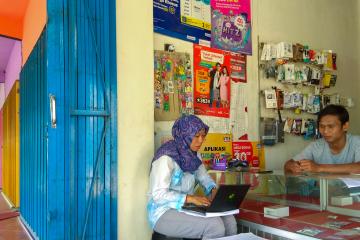
Indonesia has made significant strides in expanding financial inclusion in the recent years due to public and private sector commitment to advancing financial inclusion and the rapid emergence of various technological innovations in the digital financial services (DFS) sector. Expanding DFS innovations to lower-income and rural populations could meaningfully contribute to economic inclusion and poverty alleviation.
However, in Indonesia, most DFS innovation still favors urban and higher-income populations. An important policy question arises: how can technological innovation in finance genuinely help accelerate progress?
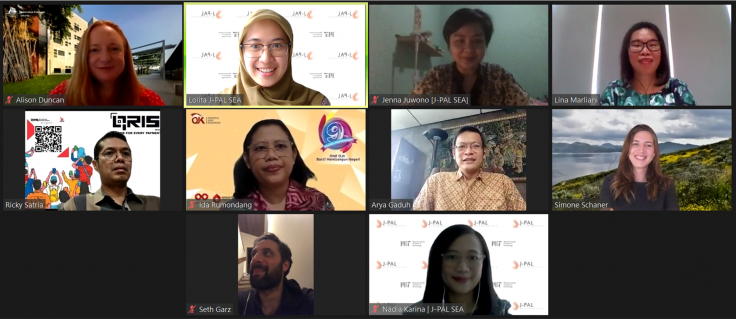
As part of the effort to support the Government of Indonesia’s financial inclusion agenda, J-PAL Southeast Asia (SEA) launched the Inclusive Financial Innovation Initiative (IFII). IFII was introduced in October through a webinar, “Towards Inclusive Digital Finance in Indonesia.” The event featured a presentation by Simone Schaner (USC; Co-Chair, J-PAL’s IFII) summarizing findings from the initiative’s landscape white paper and a panel discussion with Indonesian DFS policymakers Ida Rumondang (Senior Executive Researcher, Department of Financial Services Research, Indonesia’s Financial Services Authority (OJK)), and Ricky Satria (Deputy Director of Payment System Policy, Central Bank of Indonesia (BI)), and moderated by Arya Gaduh (University of Arkansas, J-PAL affiliate).
Opportunities for DFS development in Indonesia
During the launch event, Simone shared results from the IFII white paper, which provides an overview of the financial inclusion and digital finance services sector in Indonesia. Drawing from global literature review of relevant evidence, data analysis, and in-depth stakeholder interviews, this paper aims to give a high-level analysis on how DFS can be leveraged to advance inclusive economic growth and outline strategic areas for future research that can fill evidence gaps to support DFS sector development.
In addition to the presentation, there were two breakout discussion sessions where participants were met in small groups to brainstorm promising use-cases to explore as well as potential solutions to help increase awareness of social protection bank account ownership. Here are some of the highlights of the presentation and discussion:
In Indonesia, demographics are not destiny when it comes to account ownership
To help identify the barriers and triggers of financial inclusion, the IFII team analyzed the 2018 Financial Inclusion Insights (FII) survey data to predict the characteristics that lead to account ownership in Indonesia. While this analysis cannot verify what characteristics cause financial inclusion, it helps us generate hypotheses about what factors might be important.
Perhaps surprisingly, the analysis finds that demographic characteristics such as gender, education, income, and other socioeconomic factors are not the main predictors of why people own bank accounts. Rather, characteristics like participation in government’s social protection schemes and ownership of national identity as well as digital engagement (i.e. measures of phone ownership and use) are better predictors. This suggests there is scope for accelerating financial inclusion by connecting people to government systems while building their digital capabilities.
In Indonesia, digital readiness outpaces digital financial services
The FII data shows that there are far more Indonesians who have the basic skills to adopt e-money than those who are using the service. Among non-e-money users who are smartphone owners, 49 percent are able to search the internet and 45 percent have the ability to download an application. These are substantially higher than the rate of e-money use at the time of survey, which was 9.5 percent of smartphone owners.
This presents a significant opportunity for e-money providers to convert more users. This will rely on providers’ ability to ease the onboarding process and develop use-cases that appeal to the needs of users from different socioeconomic backgrounds.
Remittances, digital G2P programs, and e-commerce are promising DFS use-cases
Increasing DFS adoption, especially among lower-income and rural individuals, is challenging. During the breakout discussions, participants identified agent banking networks, digital Government-to-People (G2P) transfer disbursement, and digital People-to-People (P2P) remittances as a few examples of financial services that may help increase low-income and rural individuals’ adoption of DFS. Participants noted several other possible avenues for greater DFS inclusion:
- Participation in the government's social assistance scheme is one of the main predictors for account ownership. However, only 60 percent of beneficiaries are aware that they own a bank account. In the breakout session, the participants highlighted the lack of awareness of the basic financial features of Kartu Keluarga Sejahtera or KKS card (a bank account linked social protection card in Indonesia) as the main reason why beneficiaries don’t utilize their card for financial transactions. They suggested that cooperation between both central and local social protection stakeholders in ensuring the dissemination of the cards’ features and functions is vital. Our analysis suggests encouraging the use of social protection program-linked bank accounts amongst beneficiaries can increase financial inclusion.
- Remittances are very common amongst Indonesians. SOFIA 2017 data reports that over 60 percent of people sent and received money domestically and internationally in the past year. However, cash is currently still the predominant method to remit, suggesting there is a sizable opportunity for financial providers to develop remittance services that can make transfers easier and more convenient.
- Helping micro and small enterprises onboard and succeed in e-commerce platforms has the potential to help them increase their income and deepen their access to financial services.
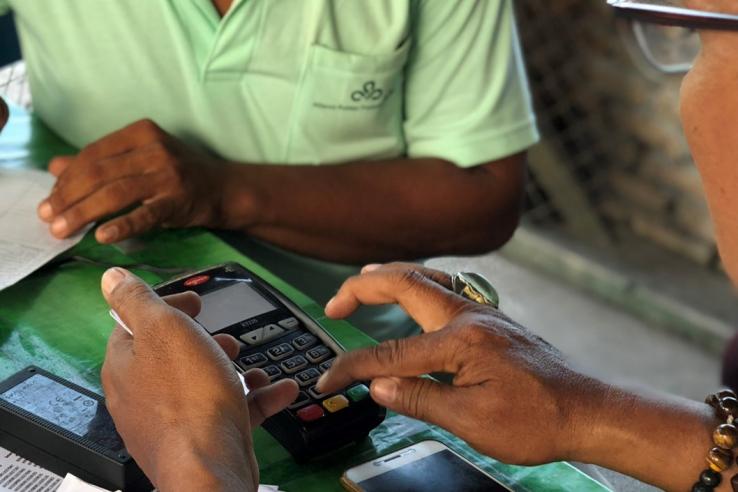
In addition, participants suggested enabling e-money for bill payments and customized savings products as other promising use-cases. They also considered that successes rely on providers’ ability to provide human contact where it is most necessary to help onboard people to the financial service. One of the most important financial services touchpoints for people in rural areas is agent banking networks, where banks recruit agents to provide financial services to the community, providing greater access for those who are unable to reach a branch office or ATM. Moreover, as digital financial literacy is relatively lower among these demographics, developing easy to understand onboarding and user interfaces becomes imperative.
Key evidence gaps for developing DFS in Indonesia
There is currently relatively little rigorous evidence to inform financial inclusion policymaking. The white paper points to several strategic areas of future research that can help unearth why some DFS services/products work and why and how to scale effective DFS programs. Key focuses include designing strategies to onboard and retain new DFS users (particularly in light of COVID-19 induced transitions to DFS); designing use-cases around remittances, G2P transfers, and e-commerce; and strengthening DFS infrastructure such as agent networks.
Policymakers’ perspective on DFS in Indonesia
The event also featured representatives from Indonesia’s Financial Services Authority (OJK) and the Bank of Indonesia, who shared their reflections on the Initiative’s white paper.
Ida Rumondang (Senior Executive Researcher, OJK) highlighted the importance of continuous and multi-stakeholder efforts to promoting financial and digital literacy. In addition to the training and socialization programs developed by OJK, she emphasized the role that financial services providers and agents on the ground should play in training and consumer education. For example, to promote bank account usage among social protection beneficiaries, OJK worked alongside financial services providers, the Ministry of Social Affairs, and the Bank of Indonesia to disseminate information on bank account features and its relevance to daily life.
Ricky Satria (Deputy Director of Payment System Policy, Bank of Indonesia) highlighted the importance of interoperable and low-cost digital payment infrastructure as a way to ensure that adoption is inclusive. This is among the reasons why the Bank of Indonesia developed the standardized Quick Response Indonesia Standard (QRIS) code for e-money providers to issue for their merchants—often small to medium enterprises. However, he noted that alongside infrastructure, a campaign strategy targeting more of these businesses is equally important to drive adoption and expansion of the QRIS.
Finally, both speakers agreed that the high cost of agent management and minimal incentives for both financial services providers to provide optimal support to their agents as well as for agents to actively seek consumers, remain the two main challenges that policymakers and the private sector face in promoting financial inclusion. Improvement in agent banking network business models, features, management, and promotion could be an important step to achieving financial inclusion.
This article summarizes events from the IFII launch webinar, “Towards Inclusive Digital Finance in Indonesia,” on October 16, 2020. To read the content of the presentation, see “Towards Inclusive Digital Finance in Indonesia” by Simone Schaner (USC; Co-Chair, J-PAL’s IFII). Read the full white paper here.
Keberhasilan Indonesia dalam meningkatkan inklusi keuangan dalam beberapa tahun terakhir didukung oleh komitmen yang kuat dari pemerintah dan sektor swasta, serta pesatnya inovasi teknologi terutama yang mendukung penyediaan layanan keuangan digital atau digital financial service (DFS). Memperluas DFS untuk menjangkau rumah tangga miskin dan yang tinggal di pedesaan dapat berkontribusi pada ekonomi masyarakat yang lebih baik dan pengentasan kemiskinan. Namun di Indonesia, DFS baru menjangkau kalangan menengah ke atas dan yang tinggal di daerah perkotaan. Bagaimana inovasi teknologi di sektor keuangan dapat membantu mempercepat inklusi keuangan?
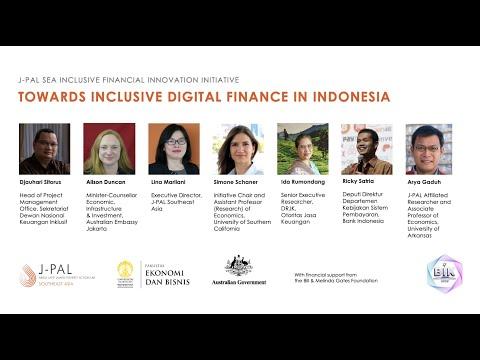
Sebagai dukungan untuk mewujudkan agenda inklusi keuangan pemerintah Indonesia, J-PAL Southeast Asia (SEA) meluncurkan Inclusive Financial Innovation Initiative (IFII), yang diluncurkan pada bulan Oktober 2020 melalui sebuah webinar bertajuk “Menuju Inklusi Keuangan Digital di Indonesia”. Webinar ini diisi dengan presentasi oleh Simone Schaner (peneliti terafiliasi J-PAL, USC, J-PAL IFII Chair) mengenai rangkuman temuan dari laporan Whitepaper IFII, dan diskusi panel dengan pemangku kepentingan di sektor DFS, Ida Rumondang (Senior Executive Researcher, Department of Financial Services Research, Otoritas Jasa Keuangan), dan Ricky Satria (Deputy Director of Payment System Policy, Bank Indonesia) yang dimoderatori oleh Arya Gaduh (peneliti terafiliasi J-PAL, University of Arkansas).
Peluang pengembangan DFS di Indonesia
Dalam acara webinar, Dr. Schaner mempresentasikan hasil kajian whitepaper IFII yang berisi gambaran mengenai kondisi inklusi keuangan dan DFS di Indonesia. Laporan whitepaper IFII bertujuan untuk memberikan analisis yang mendalam mengenai pemanfaatan DFS untuk meningkatkan pertumbuhan ekonomi yang lebih inklusif serta arahan strategis untuk melakukan riset untuk menjawab pertanyaan kebijakan yang berkaitan dengan DFS. Laporan ini adalah hasil dari studi literatur global, analisis data, dan wawancara dengan pemangku kepentingan di sektor DFS.
Di acara webinar ini, juga terdapat dua sesi diskusi interaktif antar partisipan, dimana partisipan yang berkecimpung di sektor DFS mendiskusikan beberapa kasus penggunaan DFS yang potensial dan bagaimana meningkatkan kesadaran masyarakat terhadap penggunaan fitur rekening tabungan pada Kartu Keluarga Sejahtera (KKS). Ada beberapa poin utama yang dibahas dalam presentasi dan diskusi tersebut:
Poin 1: Di Indonesia, karakteristik demografis bukan penentu utama seseorang memiliki rekening bank
Tim riset IFII menganalisis data survei Financial Inclusion Insights (FII) 2018 untuk memprediksi karakteristik yang dapat menjadi prediktor kepemilikan rekening bank di Indonesia. Kajian kami menunjukkan bahwa karakteristik demografis seperti jenis kelamin, tingkat pendidikan, penghasilan, dan faktor sosial ekonomi yang lain bukan merupakan penentu utama kepemilikan rekening bank. Karakteristik lain yaitu partisipasi dalam program bantuan sosial pemerintah dan kepemilikan kartu identitas justru dapat lebih baik memprediksi apakah seseorang memiliki rekening bank. Meskipun analisis ini tidak dapat menyatakan faktor pendorong inklusi keuangan, analisis ini dapat membantu memetakan faktor apa yang mungkin penting untuk diperhatikan, seperti contohnya memperbaiki kualitas hubungan masyarakat pada sistem yang telah dimiliki oleh pemerintah, sambil membangun literasi teknologi masyarakat.
Poin 2: Di Indonesia, kesiapan digital masyarakat tumbuh lebih cepat daripada perkembangan DFS
Data FII menunjukkan bahwa banyak orang Indonesia yang sebetulnya sudah memiliki kemampuan untuk mengadopsi e-money, namun belum pernah menggunakannya. Diantara pemilik smart phone yang belum menggunakan e-money, 49% dari mereka bisa mengoperasikan internet dan 45% dari mereka bisa mengunduh aplikasi. Angka ini jauh lebih tinggi dibandingkan dengan hanya 9.5% dari pemilik smart phone yang sudah menggunakan e-money pada survei tahun 2018. Ini menunjukkan bahwa ada potensi untuk menjaring orang yang telah siap untuk menggunakan e-money. Namun hal ini akan bergantung pada kemampuan provider e-money dalam mempermudah proses adopsi dan mempromosikan penggunaan yang menarik sesuai dengan kebutuhan berbagai kalangan dari berbagai latar belakang sosial ekonomi.
Poin 3: Remitansi, digitisasi transfer G2P (Government-to-People), dan e-commerce merupakan kasus penggunaan yang berpotensi untuk menjadi pintu masuk masyarakat ke DFS
Terdapat berbagai tantangan untuk membuat DFS dapat diadopsi oleh masyarakat berpendapatan rendah dan yang tinggal di pedesaan. Saat sesi diskusi interaktif, partisipan menyebutkan jaringan agen bank, digitisasi transfer G2P, dan remitansi sebagai beberapa contoh layanan keuangan yang berpotensi untuk menjadi jembatan masyarakat mengakses DFS. Ada beberapa contoh penggunaan layanan keuangan lain yang didiskusikan dapat berpotensi meningkatkan adopsi DFS:
- Analisis kami menunjukkan bahwa mendorong penggunaan fitur perbankan KKS dapat meningkatkan inklusi keuangan. Meskipun keikutsertaan dalam program bantuan sosial merupakan salah satu prediktor terkuat dari kepemilikan rekening, hanya 60% penerima bantuan yang tahu bahwa KKS mereka terintegerasi dengan rekening bank. Saat sesi diskusi interaktif, partisipan menggaris bawahi kurangnya pengetahuan masyarakat terhadap fitur KKS adalah alasan utama rendahnya angka transaksi perbankan dengan kartu tersebut. Diperlukan kerja sama antara pemerintah pusat dan daerah untuk menginformasikan fitur perbankan yang terdapat pada KKS.
- Mengoptimalkan sistem yang telah ada untuk mempermudah remitansi berpotensi meningkatkan inklusi keuangan. Remitansi merupakan transaksi yang sangat umum di Indonesia. Data SOFIA 2017 melaporkan bahwa lebih dari 60% orang mengirim dan menerima kiriman uang secara domestik maupun internasional setahun belakang. Namun, pengiriman berbentuk uang tunai masih yang paling umum dilakukan. Ini menunjukan bahwa terdapat potensi yang cukup signifikan untuk mengembangkan produk yang dapat membuat transfer menjadi lebih mudah dan terjangkau.
- Dukungan terhadap UMKM untuk bisa secara optimal memanfaatkan platform e-commerce berpotensi untuk meningkatkan pendapatan dan akses mereka terhadap layanan keuangan.
Dalam diskusi interaktif, partisipan juga mendiskusikan penggunaan lain, contohnya penggunaan e-money untuk pembayaran tagihan dan produk tabungan yang terpersonalisasi sesuai kebutuhan. Partisipan juga menggaris bawahi bahwa kesuksesan dalam memberikan akses layanan keuangan bergantung pada upaya pemberi layanan dalam berinteraksi secara langsung dengan masyarakat. Salah satu sarana utama yang dapat membantu masyarakat di daerah pedesaan adalah jaringan agen bank. Agen bank direkrut oleh bank untuk memberikan layanan berbankan bagi masyarakat yang sulit dijangkau oleh ATM maupun kantor cabang. Selain itu, desain dari tampilan platform atau aplikasi yang mudah dipahami dapat sangat membantu untuk mempercepat adopsi layanan.
Bukti yang diperlukan untuk menjawab pertanyaan kebijakan DFS di Indonesia
Bukti ilmiah yang dapat memberi rekomendasi bagi pembuatan kebijakan terkait inklusi keuangan di Indonesia masih terbatas. Laporan whitepaper IFII memaparkan beberapa lingkup strategis yang berpotensi untuk diteliti lebih lanjut untuk memelajari mengapa dan bagaimana produk DFS dapat berfungsi secara efektif, serta apa yang dapat dilakukan untuk memperluas penggunaannya. Beberapa fokus utama yang direkomendasikan adalah:
- merancang strategi untuk menarik masyarakat untuk mengadopsi DFS dan memastikan penggunaannya berlanjut, terutama yang bisa dilakukan saat pandemic COVID-19;
- merancang program atau strategi dalam lingkup remitansi, digitisasi G2P, dan e-commerce;
- memperkuat infrastruktur DFS, seperti misalnya jaringan agen.
Tanggapan pembuat kebijakan mengenai perkembangan DFS di Indonesia
Acara webinar ini turut dihadiri oleh perwakilan dari Otoritas Jasa Keuangan (OJK) dan Bank Indonesia (BI) untuk memberikan refleksi dan tanggapan pada diskusi temuan mengenai DFS.
Ida Rumondang, (Executive Researcher, OJK) menggaris bawahi pentingnya kerja sama antar pemangku kepentingan untuk mempromosikan literasi keuangan dan digital secara terus menerus. Beliau mendiskusikan program pelatihan dan sosialisasi yang telah dilakukan oleh OJK, serta peran penyedia layanan dan agen di lapangan dalam memberikan pelatihan dan edukasi langsung ke konsumen. Untuk mempromosikan fitur perbankan pada penerima KKS, OJK telah bekerja sama dengan penyedia layanan keuangan, Kementerian Sosial, dan BI dalam memberikan informasi mengenai fitur perbankan dan penggunaannya di kehidupan sehari-hari.
Ricky Satria (Deputy Director of Payment System Policy, Bank of Indonesia) menggaris bawahi pentingnya interoperabilitas dan sarana digital yang terjangkau untuk mendorong adopsi DFS yang inklusif. BI telah meluncurkan kode Quick Response Indonesia Standard (QRIS) yang bisa dipakai oleh penyedia layanan e-money untuk dengan mudah mengintegrasikan merchant kecil seperti UMKM ke dalam sistem. Beliau juga menambahkan, selain memgembangkan infrastruktur, strategi promosi yang menargetkan merchant kecil seperti UMKM penting untuk dilakukan untuk meningkatkan adopsi dan ekspansi QRIS.
Terakhir, Ida dan Ricky setuju bahwa biaya yang tinggi dalam mengelola agen dan insentif yang minim baik bagi penyedia layanan maupun agen, menjadi tantangan yang dihadapi oleh pemerintah dan sektor swasta untuk meningkatkan inklusi keuangan. Perbaikan business model, fitur, pengelolaan, dan promosi jaringan agen menjadi salah satu langkah terpenting untuk meningkatkan inklusi keuangan.
Artikel ini merupakan liputan acara webinar peluncuran IFII bertajuk “Menuju Inklusi Keuangan Digital di Indonesia” pada 16 Oktober 2020. Materi presentasi “Towards Inclusive Digital Finance in Indonesia” oleh Simone Schaner dapat diakses pada tautan ini. Untuk mengakses laporan whitepaper IFII, kunjungi tautan ini.
For those in Indonesia with access to mobile phones and digital literacy, e-commerce and digital financial services may help people to maintain their livelihoods. Not only do digital financial services offer a fast and contactless means of payment and transfer, but evidence from around the world has found other benefits.
Read this post in Bahasa Indonesian.
Countries across the world have imposed unprecedented restrictions on mobility and social interaction to combat the spread of COVID-19. Indonesia is no exception.
In April, the government of Indonesia announced the enactment of large-scale social distancing regulations (Pembatasan Sosial Berskala Besar, PSBB) and banned travel for the upcoming Eid holiday, when tens of millions of Indonesians typically return to their home villages to celebrate with family.
Other restrictions include instruction to work from home, closures of public spaces and transport, and even travel bans to and from specific locations. These measures have profoundly impacted many aspects of people’s lives—from the way people communicate, work, obtain goods, and transact.
In the midst of this, there is a growing push to accelerate e-commerce and adoption of digital financial services (DFS). Anecdotal data from J-PAL Southeast Asia’s Inclusive Financial Innovation team’s conversations with e-commerce platforms in Indonesia suggests an increase in both the number of transactions and the number of new users. Specifically, there has been an increase in demand for purchases such as staple foods, health products, and school supplies.
Instructions to practice social distancing and to avoid public places have encouraged individuals to shift from procuring daily necessities offline to using online sources. In addition, digital payment may play an increasingly important role as it facilitates e-commerce transactions and remittances to far-away family members.
How can DFS and e-commerce help curb the impact of Covid-19?
For those with access to mobile phones and digital literacy, e-commerce and DFS may help people to maintain their livelihoods. Not only does DFS offer a fast and contactless means of payment and transfer, but evidence from around the world has found other benefits.
For example, there is strong evidence that mobile savings and remittances can be used to improve risk-sharing between individual's social networks and smooth consumption. In Rwanda, during a time of crisis, remittances through mobile airtime accounts were used by less impacted individuals to help relieve the pressure of income loss for people who were affected the most.
E-commerce can be a valuable way for people to locate and purchase scarce resources, especially in remote areas or localities experiencing shortages. However, an important concern during the COVID-19 crisis is price gouging, or exorbitant price increases for items in high demand. Currently major Indonesian e-commerce firms are launching initiatives to limit this practice.
But who will enjoy these benefits? Despite its promises, DFS and e-commerce are still inaccessible to most people. To shed light on Indonesians’ access to DFS, we turned to the latest round of the Financial Inclusion Insights Survey, conducted by SNKI (Sekretariat Nasional Keuangan Inklusif, or National Council for Financial Inclusion) and Kantar. These data were collected between March and May of 2019 and are nationally representative: thus, they give us a relatively up to date picture of digital inclusion across the country.
The first thing to note is that the vast majority of Indonesians have no experience with e-money.
Overall, just 6.8 percent of people reported having ever used e-money in 2019.
Use is strongly correlated with education: while just 5.2 percent of people with junior high school education use e-money, 27.3 percent of university graduates use the service. Still, the vast majority of even the most educated individuals lack exposure.
There is a bright spot, however: the survey suggests many more Indonesians are capable of adopting DFS.
Smartphone ownership is an especially important proxy to measure potential access to e-money and e-commerce. While smartphone ownership is also strongly correlated with education, the graph makes it clear that many non-users of e-money have the tools to adopt. Other analysis from SNKI’s report on the survey shows that smartphone skill levels are also high. Thus, there is an opportunity to onboard a sizable amount of the smartphone owners to DFS and e-commerce in the near term.
Potential for greater DFS and e-commerce adoption
There are at least two major opportunities that providers can leverage to boost digital financial inclusion.
First, the government has started to expand the channels of some of its government-to-people transfer programs to include e-money platforms, which may activate inactive e-money users or create new ones.
Second, the demand for digital remittances may continue to rise especially as the religious festival, Eid, is approaching. It is central to the Eid tradition that people across socioeconomic groups give out allowance money to family members. With the travel restriction in place, a digital alternative to remitting funds will be in demand.
However, onboarding a broader segment of people into the DFS and e-commerce ecosystem will rely on providers’ ability to appeal to them.
A big part of this effort may include easing the onboarding process and making these services more accessible. For example, DFS platforms could make the registration and verification (“Know Your Customer”) process less complicated or prepare easy-to-understand introductory materials for new e-money users.
To improve accessibility, existing e-commerce or DFS agents can be leveraged to disseminate introductory messages and information campaigns more broadly, in addition to helping more people access DFS and e-commerce products or services. Of course, ensuring that this approach also supports good social distancing practices is important.
J-PAL Southeast Asia’s Inclusive Financial Innovation Initiative (IFII) is working alongside governments, private sector firms, and nonprofits to explore how DFS and e-commerce can further support people’s livelihoods during this COVID-19 crisis.
This blog post draws on background research conducted as part of these effort funded by the Bill & Melinda Gates Foundation. The findings and conclusions contained within are those of the authors and do not necessarily reflect positions or policies of the Bill & Melinda Gates Foundation. The mission of IFII is to ensure that digital financial services can drive economic development while lifting up women, low-income groups, and marginalized communities.
For more information about IFII, contact Aliyyah Rusdinar.
The digital financial services (DFS) sector is among the fastest-growing: the number of financial technology (“fintech”) companies in Indonesia more than doubled from 130 in 2017 to more than 320 in 2019. In addition to this rapid growth in the private sector, the Indonesian government is increasingly moving towards digital delivery of social assistance programs in the public sector. J-PAL Southeast Asia, based at the Faculty of Business and Management at the University of Indonesia, is launching the Inclusive Financial Innovation Initiative to answer important policy questions now at the forefront of the region’s economic growth.
Indonesia’s digital economy has quadrupled since 2015—reaching an approximate value of USD$40 billion in 2019. Much of this growth is driven by the country’s e-commerce sector, which recorded 88 percent growth from $1.7 billion in 2015 to $21 billion in 2019.
The digital financial services (DFS) sector is among the fastest-growing: the number of financial technology (“fintech”) companies in Indonesia more than doubled from 130 in 2017 to more than 320 in 2019. In addition to this rapid growth in the private sector, the Indonesian government is increasingly moving towards digital delivery of social assistance programs in the public sector.
J-PAL Southeast Asia, based at the Faculty of Business and Management at the University of Indonesia, is launching the Inclusive Financial Innovation Initiative to answer important policy questions now at the forefront of the region’s economic growth. With the support of the Bill and Melinda Gates Foundation, the three-year initiative aims to ensure that digital financial services can drive economic development while lifting up women, low-income groups, and marginalized communities.
While growth in e-commerce and DFS represents a promising opportunity to advance financial inclusion, use of DFS is currently concentrated among young, urban, and higher-income populations. As digital technologies continue to improve and costs of service provision decline, there is a growing opportunity to expand the reach of DFS and leverage it as a tool for broad-based financial inclusion.
The Inclusive Financial Innovation Initiative will build on existing global evidence to understand how DFS can be used to accelerate financial inclusion and broad-based economic development within Indonesia and beyond.
The Initiative will include three intersecting workstreams to provide actionable evidence to members of Indonesia’s DFS ecosystem, including policymakers, practitioners, and non-profit organizations:
- Policy research and analysis: Under the Initiative, J-PAL staff and researchers will review the existing global evidence base to offer evidence-based policy recommendations for how to leverage DFS to improve government anti-poverty programs and benefit marginalized groups, and to identify knowledge gaps where new research is needed to answer important questions.
- Creation of a Learning Collaborative: To encourage collaboration, the Initiative will facilitate a learning and communication platform where relevant stakeholders in the financial inclusion and digital finance sector can connect, share knowledge and best practices, and formulate strategies to answer priority research and policy questions.
- Research collaboration: The Initiative will develop innovative pilot studies and randomized evaluations to answer policy-relevant questions. It will build partnerships to ensure that the evidence produced by these studies can directly contribute to policy decisions.
Why focus on financial inclusion?
Financial products and services are designed to help individuals build resilience to unexpected events and take advantage of opportunities, and are often viewed as key tools for improving families’ welfare and economic mobility.
Existing evidence suggests that improving access to savings accounts can have positive effects on household welfare, and that digital financial tools like mobile money may offer users significant benefits. For example, studies in Chile and Kenya have found that access to basic bank accounts allowed households to better manage fluctuations in income, increase business investment, and increase private expenditure levels. Meanwhile, offering mobile phone-based savings accounts to parents in Kenya whose children were about to enter high school increased enrollment by 5 to 6 percentage points.
Digital financial services can also be a tool for boosting women’s economic engagement and empowerment.
For example, a study in India found that linking earnings from a government workfare program to women’s bank accounts (rather than household-level accounts), coupled with a basic account training, led to increased female employment both within the workfare program and the private sector, especially for those women whose husbands expressed the most opposition to women working.
In Niger, disbursing cash transfers via mobile money improved diet diversity during the 2009-2010 food crisis relative to cash-in-hand transfers. Women who received mobile transfers were more likely to travel to weekly markets, be involved in selling household grains, and spend more on children’s clothing than those in the other groups.
Why focus on Indonesia?
Indonesia’s DFS providers are developing tech-based innovations to increase financial inclusion among households that are currently underbanked or unbanked altogether. For example, micro, small, and medium enterprises (MSME) now have access to digital payment services designed to boost transactions, improve bookkeeping, and build better credit scores.
Women’s savings collectives, called arisan, also have opportunities to go digital through MAPAN arisan. Digitized arisan groups can collectively purchase goods online without disrupting their household cash flow.
Finally, online peer-to-peer lending such as Amartha and TaniFund offer access to credit for farmers, fishermen, and micro-merchants who have been largely ignored by formal banking institutions. While these and other innovations are promising, we know little about their real causal impacts on the lives of the poor.
To push the frontier further, we need more evidence on what types of DFS work within the context of Indonesia’s regulatory and business environment, infrastructure, and demographics; why they work; and how they can be deployed to maximize impact.
Working alongside a diverse set of collaborators, the Inclusive Financial Innovation Initiative aims to contribute to an inclusive, impact-driven digital finance ecosystem in Indonesia.
For more information, contact Aliyyah Rusdinar.