

Improving women’s digital literacy as an avenue for financial inclusion
Indonesia is a standout country in terms of gender-equitable financial inclusion. Reports from the Global Findex and SNKI Financial Inclusion Insights state that although there is an average gender gap in account ownership of 8 percentage points in developing economies, no such gap exists in Indonesia. At the same time, there is still a large scope for overall expansion, as over 44 percent of Indonesian adults remain unbanked. To ensure Indonesia continues to experience gender-equitable growth, efforts geared towards financial inclusion must take into consideration women’s needs, in particular among poor and digitally illiterate populations.
On June 9, 2020, the Government of Indonesia (GoI) launched the National Women’s Financial Inclusion Strategy (SNKI-P), aimed at promoting access to finance for Indonesian women in a way that accommodates women’s diverse needs, interests, and backgrounds. Among others, SNKI-P’s mission is to provide a comprehensive and gender-responsive program to improve access to formal financial services, while ensuring all Indonesian women are equipped with financial skills (including digital finance). How can insights from Indonesia’s past financial inclusion experiences inform policies to support this mission? In this blog post, we summarize some key lessons from J-PAL SEA research conducted as part of its Inclusive Financial Innovation Initiative.
Understanding determinants of women’s financial inclusion
Social protection is important for women’s access to financial services, and digital readiness is likely to become more important as digital finance grows. As Indonesia moves to expand financial inclusion, it is important to understand why people do or do not own accounts. We utilized data from the 2018 Financial Inclusion Insights survey (FII) with a machine learning algorithm called Random Forest to identify key predictors of account ownership.
We find that features related to demographics, socioeconomic status, and economic engagement rarely rank highly as predictors. Gender was also not one of the top predictors of account ownership. Instead, the top predictor of female account ownership is whether the woman receives government assistance: specifically, women who report receiving government assistance are more likely to have an account, all else equal. This suggests that the Government of Indonesia’s push to digitize assistance is a driving force in women’s financial inclusion.
We also find that owning a mobile or smartphone and the ability to perform phone-related tasks are important predictors of account ownership for both men and women. In the future, digital engagement and digital literacy are likely going to become even more important for financial inclusion.
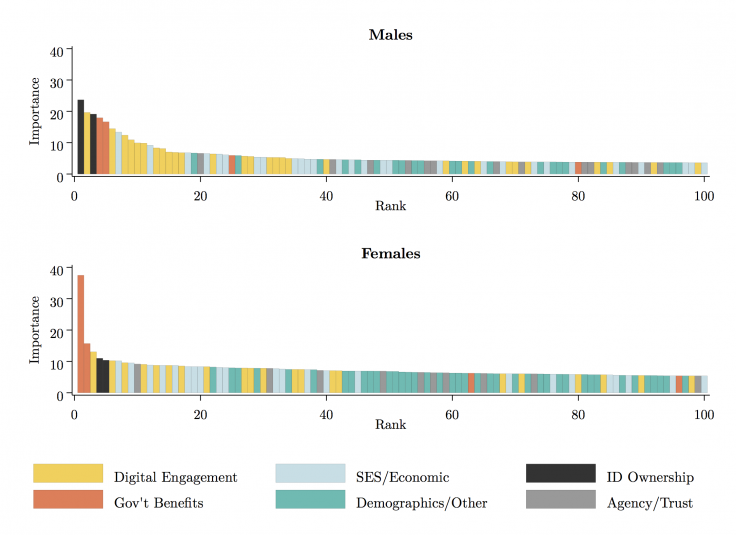
Source: FII 2018 Survey
Indonesia has a gender gap in digital readiness, which if not addressed may lead to future gender gaps in financial inclusion. As digital financial services (DFS) continue to expand in Indonesia, digital engagement and literacy will be key for connecting women to new technologies like e-money. However, we see a significant gender gap in phone capability between men and women. While 45 percent of men are digitally ready—that is, own a smartphone and can use it to download apps and surf the web—only 38 percent of women are.
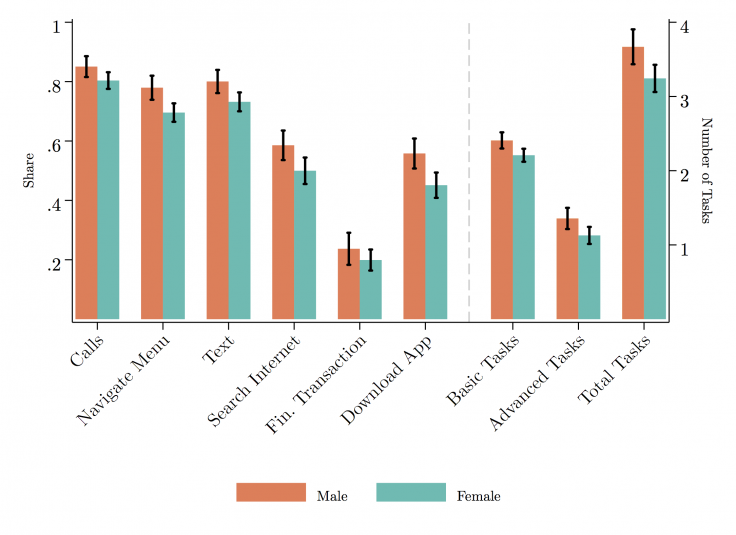
Source: FII 2018 Survey
Inclusive digital financial products must take account of women's life stages and needs
Use cases of DFS will be different for women who are running the household, leading their own business, or working for a firm. How included are these groups now, and prepared are they to take up digital tools?
The use rate of financial services is significantly lower among women not engaged in income-generating activities. Our analysis of FII data indicates that married women are more likely to report having a dominant role in financial decisions, as compared to married men. This is in line with previous research suggesting Indonesian women have authority over household finances, regardless of their contribution to the household’s income. Despite this, married women whose main occupation is taking care of the home or who only work temporarily/seasonally are significantly less likely to use financial services as compared to those who own a business or are in permanent employment. As such, there is still scope for expansion to ensure financial inclusion covers women who do not engage in income-generating activities.
Targeted digital financial education may be needed to ensure financial inclusion for all women. We observe a lower rate of digital literacy among business owners. Relative to business owners, women who are in full-time employment are 18 percentage points more likely to report the ability to perform basic tasks (i.e. place calls, navigate menu, send SMS). This gap is even larger at 38 percentage points for complex tasks (i.e. search internet, download apps, financial transactions). This discrepancy is likely to affect knowledge and use of DFS, especially with newer innovations such as card-based and app-based e-money products. One way to address this capability gap would be digital financial education and opportunities to build smartphone skills targeted to female entrepreneurs.
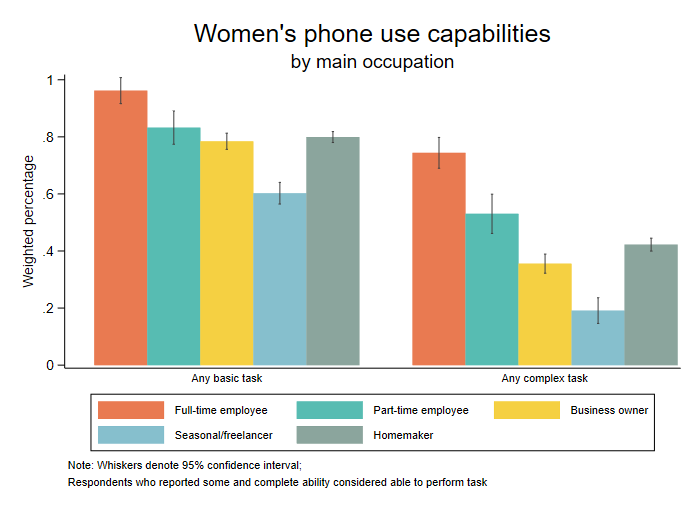
Source: 2018 FII survey
Efforts by the Government of Indonesia to drive financial inclusion for women, such as through government assistance, have resulted in significant achievements. As DFS continues to expand, digital engagement and literacy is only going to become more important. To ensure Indonesia experiences continued expansion in financial inclusion for women, significant gender gaps in phone capability must be addressed. DFS innovations which contribute to financial inclusion will also take into account women’s life stages and needs, including female entrepreneurs and those not engaged in income-generating activities.
This blog post is based on efforts funded by the Bill & Melinda Gates Foundation. The findings and conclusions within are those of the authors and do not necessarily reflect positions or policies of the Bill & Melinda Gates Foundation. The mission of IFII is to ensure that digital financial services can drive economic development while lifting up women, low-income groups, and marginalized communities.
For more information about IFII, contact [email protected].
Agar pertumbuhan setara gender terus berlanjut, upaya inklusi keuangan di Indonesia harus memenuhi kebutuhan perempuan, terutama kelompok berpendapatan rendah dan kemampuan digital yang terbatas. Bagaimana wawasan dari pengalaman inklusi keuangan Indonesia dapat menginformasikan kebijakan untuk mendukung misi tersebut?
Indonesia telah menunjukkan pencapaian yang signifikan dalam hal inklusi keuangan setara gender. Laporan dari Global Findex dan SNKI Financial Inclusion Insights menyatakan, meskipun rata-rata kesenjangan gender dalam kepemilikan rekening di negara berkembang adalah 8 poin persentase, kesenjangan gender tersebut tidak tampak di Indonesia. Namun demikian, dengan lebih dari 44 persen orang dewasa tanpa akses rekening bank, masih besar peluang Indonesia untuk memperluas inklusi keuangan. Agar pertumbuhan setara gender terus berlanjut, upaya inklusi keuangan di Indonesia harus memenuhi kebutuhan perempuan, terutama kelompok berpendapatan rendah dan kemampuan digital yang terbatas.
Pada 9 Juni 2020, Pemerintah Indonesia meluncurkan Strategi Nasional Keuangan Inklusif Perempuan (SNKI-P), bertujuan untuk mendorong akses terhadap layanan keuangan bagi perempuan Indonesia yang memenuhi beraneka kebutuhan, minat dan latar belakang perempuan. Salah satu misi SNKI-P adalah menyediakan sebuah program yang komprehensif dan responsif terhadap gender untuk meningkatkan akses terhadap layanan keuangan formal, seraya melatih kemampuan finansial perempuan (termasuk keuangan digital). Bagaimana wawasan dari pengalaman inklusi keuangan Indonesia dapat menginformasikan kebijakan untuk mendukung misi tersebut? Dalam artikel blog ini, kami merangkum beberapa pembelajaran kunci dari riset J-PAL SEA yang dilaksanakan sebagai bagian dari Inclusive Financial Innovation Initiative.
Memahami faktor inklusi keuangan perempuan
Perlindungan sosial penting bagi perempuan untuk dapat mengakses layanan keuangan, dan pentingnya kesiapan digital akan turut meningkat seiring perkembangan keuangan digital. Dalam upaya lanjutan peningkatan inklusi keuangan, penting untuk memahami kenapa masyarakat memiliki / tidak memiliki rekening saat ini. Kami menggunakan data dari survei Financial Inclusion Insights (FII) 2018 dengan algoritma machine learning bernama Random Forest untuk mengidentifikasi prediktor kunci kepemilikan rekening.
Analisis kami menunjukkan fitur demografi, status sosial-ekonomi dan keterkaitan ekonomi jarang berperingkat tinggi sebagai prediktor. Gender juga bukan salah satu prediktor utama bagi kepemilikan rekening. Di sisi lain, predictor teratas kepemilikan rekening bagi perempuan adalah apakah perempuan tersebut menerima bantuan pemerintah: secara khusus, kepemilikan rekening lebih tinggi di antara perempuan yang melaporkan menerima bantuan pemerintah, dengan hal lainnya tetap sama. Hal ini menunjukkan pencapaian Pemerintah Indonesia sebagai pendorong inklusi keuangan perempuan melalui digitalisasi bantuan sosial. Analisis kami juga menunjukkan kepemilikan ponsel atau smartphone dan kemampuan penggunaan ponsel sebagai prediktor kepemilikan rekening yang penting bagi perempuan dan laki-laki. Di masa depan, literasi digital dan interaksi digital akan menjadi semakin penting untuk inklusi keuangan.
Sumber: Survei FII 2018
Terdapat kesenjangan gender dalam kesiapan digital di Indonesia yang, jika tidak diatasi, dapat berdampak pada kesenjangan gender dalam inklusi keuangan di masa depan. Seiring perluasan layanan keuangan berbasis teknologi digital di Indonesia, literasi dan interaksi digital akan menjadi kunci untuk menghubungkan perempuan dengan teknologi baru seperti uang elektronik (e-money). Namun, terdapat kesenjangan gender yang signifikan antara perempuan dan laki-laki dalam kemampuan penggunaan ponsel. 45 persen laki-laki, tapi hanya 38 persen perempuan, siap secara digital – yaitu, memiliki smartphone dan dapat meggunakannya untuk mengunduh aplikasi atau menelusuri internet.
Sumber: Survei FII 2018
Produk keuangan digital yang inklusif harus memperhitungkan fase kehidupan dan kebutuhan perempuan.
Jenis penggunaan layanan keuangan berbasis teknologi digital akan berbeda bagi perempuan yang mengelola rumah tangga, memimpin usaha sendiri, atau bekerja di perusahaan. Seberapa terjangkau kelompok-kelompok tersebut saat ini, dan apakah mereka siap untuk mengadopsi teknologi digital?
Tingkat penggunaan layanan keuangan secara signifikan lebih rendah bagi perempuan yang tidak berpenghasilan. Analisis data FII kami mengindikasi bahwa perempuan yang sudah menikah lebih mungkin melaporkan memiliki peran yang dominan dalam keputusan finansial, dibandingkan laki-laki yang sudah menikah. Hal ini sejalan dengan penelitian sebelumnya yang menunjukkan perempuan Indonesia memiliki wewenang terhadap keuangan rumah tangga, meskipun tidak berkontribusi pada penghasilan rumah tangga. Namun demikian, penggunaan layanan keuangan oleh perempuan yang sudah menikah yang hanya bekerja sementara/musiman dan ibu rumah tangga secara signifikan lebih rendah dibandingkan dengan perempuan menikah yang bekerja secara permanen atau memiliki usaha. Oleh karena itu, masih ada peluang untuk meningkatkan inklusi keuangan agar dapat menjangkau perempuan yang tidak berpenghasilan.
Edukasi keuangan digital yang ditargetkan diperlukan agar inklusi keuangan menjangkau semua perempuan. Data FII 2018 menunjukkan tingkat literasi digital yang lebih rendah bagi perempuan pemilik usaha. Dibandingkan dengan perempuan pemilik usaha, perempuan yang bekerja penuh waktu 18 poin persentase lebih mungkin untuk melaporkan kemampuan penggunaan ponsel dasar (membuat panggilan, navigasi menu, menerima SMS). Kesenjangan ini lebih besar, 38 poin persentase, untuk penggunaan ponsel lanjutan (menelusuri internet, mengunduh aplikasi, transaksi finansial). Keterbatasan tersebut kemungkinan akan berdampak pada pengetahuan dan penggunaan layanan keuangan berbasis teknologi digital, terutama inovasi baru seperti produk-produk uang elektronik berbasis kartu dan aplikasi. Salah satu jalan untuk mengatasi kesenjangan kemampuan tersebut adalah edukasi keuangan digital dan peluang untuk membangun kemampuan smartphone bagi perempuan pemilih usaha.
Sumber: Survei FII 2018
Upaya Pemerintah Indonesia untuk mendorong inklusi keuangan bagi perempuan, misalnya melalui bantuan sosial, telah menunjukkan pencapaian yang signifikan. Seiring dengan berkembangnya layanan keuangan berbasis teknologi digital, literasi dan interaksi digital akan menjadi semakin penting. Agar Indonesia dapat terus memperluas inklusi keuangan bagi perempuan, kesenjangan gender yang signifikan dalam kemampuan penggunaan ponsel harus diatasi. Inovasi layanan keuangan berbasis digital yang akan berkontribusi terhadap inklusi keuangan juga harus memperhatikan fase kehidupan dan kebutuhan perempuan, termasuk perempuan pemilik usaha dan perempuan yang tidak berpenghasilan.
Artikel blog is didasarkan pada inisiatif yang didanai oleh the Bill & Melinda Gates Foundation. Temuan dan kesimpulan di dalamnya adalah pandangan penulis dan tidak mencerminkan posisi atau kebijakan the Bill & Melinda Gates Foundation. Misi IFII adalah memastikan layanan keuangan berbasis teknologi digital dapat mendorong pembangunan ekonomi serta memberdayakan perempuan, kelompok berpendapatan rendah, dan komunitas marjinal.
Untuk informasi lebih lanjut tentang IFII, hubungi [email protected].
How can technological innovations in digital finance help accelerate progress? This blog recaps an October webinar hosted by J-PAL SEA's Inclusive Financial Innovation Initiative (IFII), which provided an overview of the financial inclusion and digital finance services sector in Indonesia and featured reflections from Indonesian policymakers.
Indonesia has made significant strides in expanding financial inclusion in the recent years due to public and private sector commitment to advancing financial inclusion and the rapid emergence of various technological innovations in the digital financial services (DFS) sector. Expanding DFS innovations to lower-income and rural populations could meaningfully contribute to economic inclusion and poverty alleviation.
However, in Indonesia, most DFS innovation still favors urban and higher-income populations. An important policy question arises: how can technological innovation in finance genuinely help accelerate progress?
As part of the effort to support the Government of Indonesia’s financial inclusion agenda, J-PAL Southeast Asia (SEA) launched the Inclusive Financial Innovation Initiative (IFII). IFII was introduced in October through a webinar, “Towards Inclusive Digital Finance in Indonesia.” The event featured a presentation by Simone Schaner (USC; Co-Chair, J-PAL’s IFII) summarizing findings from the initiative’s landscape white paper and a panel discussion with Indonesian DFS policymakers Ida Rumondang (Senior Executive Researcher, Department of Financial Services Research, Indonesia’s Financial Services Authority (OJK)), and Ricky Satria (Deputy Director of Payment System Policy, Central Bank of Indonesia (BI)), and moderated by Arya Gaduh (University of Arkansas, J-PAL affiliate).
Opportunities for DFS development in Indonesia
During the launch event, Simone shared results from the IFII white paper, which provides an overview of the financial inclusion and digital finance services sector in Indonesia. Drawing from global literature review of relevant evidence, data analysis, and in-depth stakeholder interviews, this paper aims to give a high-level analysis on how DFS can be leveraged to advance inclusive economic growth and outline strategic areas for future research that can fill evidence gaps to support DFS sector development.
In addition to the presentation, there were two breakout discussion sessions where participants were met in small groups to brainstorm promising use-cases to explore as well as potential solutions to help increase awareness of social protection bank account ownership. Here are some of the highlights of the presentation and discussion:
In Indonesia, demographics are not destiny when it comes to account ownership
To help identify the barriers and triggers of financial inclusion, the IFII team analyzed the 2018 Financial Inclusion Insights (FII) survey data to predict the characteristics that lead to account ownership in Indonesia. While this analysis cannot verify what characteristics cause financial inclusion, it helps us generate hypotheses about what factors might be important.
Perhaps surprisingly, the analysis finds that demographic characteristics such as gender, education, income, and other socioeconomic factors are not the main predictors of why people own bank accounts. Rather, characteristics like participation in government’s social protection schemes and ownership of national identity as well as digital engagement (i.e. measures of phone ownership and use) are better predictors. This suggests there is scope for accelerating financial inclusion by connecting people to government systems while building their digital capabilities.
In Indonesia, digital readiness outpaces digital financial services
The FII data shows that there are far more Indonesians who have the basic skills to adopt e-money than those who are using the service. Among non-e-money users who are smartphone owners, 49 percent are able to search the internet and 45 percent have the ability to download an application. These are substantially higher than the rate of e-money use at the time of survey, which was 9.5 percent of smartphone owners.
This presents a significant opportunity for e-money providers to convert more users. This will rely on providers’ ability to ease the onboarding process and develop use-cases that appeal to the needs of users from different socioeconomic backgrounds.
Remittances, digital G2P programs, and e-commerce are promising DFS use-cases
Increasing DFS adoption, especially among lower-income and rural individuals, is challenging. During the breakout discussions, participants identified agent banking networks, digital Government-to-People (G2P) transfer disbursement, and digital People-to-People (P2P) remittances as a few examples of financial services that may help increase low-income and rural individuals’ adoption of DFS. Participants noted several other possible avenues for greater DFS inclusion:
- Participation in the government's social assistance scheme is one of the main predictors for account ownership. However, only 60 percent of beneficiaries are aware that they own a bank account. In the breakout session, the participants highlighted the lack of awareness of the basic financial features of Kartu Keluarga Sejahtera or KKS card (a bank account linked social protection card in Indonesia) as the main reason why beneficiaries don’t utilize their card for financial transactions. They suggested that cooperation between both central and local social protection stakeholders in ensuring the dissemination of the cards’ features and functions is vital. Our analysis suggests encouraging the use of social protection program-linked bank accounts amongst beneficiaries can increase financial inclusion.
- Remittances are very common amongst Indonesians. SOFIA 2017 data reports that over 60 percent of people sent and received money domestically and internationally in the past year. However, cash is currently still the predominant method to remit, suggesting there is a sizable opportunity for financial providers to develop remittance services that can make transfers easier and more convenient.
- Helping micro and small enterprises onboard and succeed in e-commerce platforms has the potential to help them increase their income and deepen their access to financial services.
In addition, participants suggested enabling e-money for bill payments and customized savings products as other promising use-cases. They also considered that successes rely on providers’ ability to provide human contact where it is most necessary to help onboard people to the financial service. One of the most important financial services touchpoints for people in rural areas is agent banking networks, where banks recruit agents to provide financial services to the community, providing greater access for those who are unable to reach a branch office or ATM. Moreover, as digital financial literacy is relatively lower among these demographics, developing easy to understand onboarding and user interfaces becomes imperative.
Key evidence gaps for developing DFS in Indonesia
There is currently relatively little rigorous evidence to inform financial inclusion policymaking. The white paper points to several strategic areas of future research that can help unearth why some DFS services/products work and why and how to scale effective DFS programs. Key focuses include designing strategies to onboard and retain new DFS users (particularly in light of COVID-19 induced transitions to DFS); designing use-cases around remittances, G2P transfers, and e-commerce; and strengthening DFS infrastructure such as agent networks.
Policymakers’ perspective on DFS in Indonesia
The event also featured representatives from Indonesia’s Financial Services Authority (OJK) and the Bank of Indonesia, who shared their reflections on the Initiative’s white paper.
Ida Rumondang (Senior Executive Researcher, OJK) highlighted the importance of continuous and multi-stakeholder efforts to promoting financial and digital literacy. In addition to the training and socialization programs developed by OJK, she emphasized the role that financial services providers and agents on the ground should play in training and consumer education. For example, to promote bank account usage among social protection beneficiaries, OJK worked alongside financial services providers, the Ministry of Social Affairs, and the Bank of Indonesia to disseminate information on bank account features and its relevance to daily life.
Ricky Satria (Deputy Director of Payment System Policy, Bank of Indonesia) highlighted the importance of interoperable and low-cost digital payment infrastructure as a way to ensure that adoption is inclusive. This is among the reasons why the Bank of Indonesia developed the standardized Quick Response Indonesia Standard (QRIS) code for e-money providers to issue for their merchants—often small to medium enterprises. However, he noted that alongside infrastructure, a campaign strategy targeting more of these businesses is equally important to drive adoption and expansion of the QRIS.
Finally, both speakers agreed that the high cost of agent management and minimal incentives for both financial services providers to provide optimal support to their agents as well as for agents to actively seek consumers, remain the two main challenges that policymakers and the private sector face in promoting financial inclusion. Improvement in agent banking network business models, features, management, and promotion could be an important step to achieving financial inclusion.
This article summarizes events from the IFII launch webinar, “Towards Inclusive Digital Finance in Indonesia,” on October 16, 2020. To read the content of the presentation, see “Towards Inclusive Digital Finance in Indonesia” by Simone Schaner (USC; Co-Chair, J-PAL’s IFII). Read the full white paper here.