
Evidence Matters: Building effective government-researcher partnerships
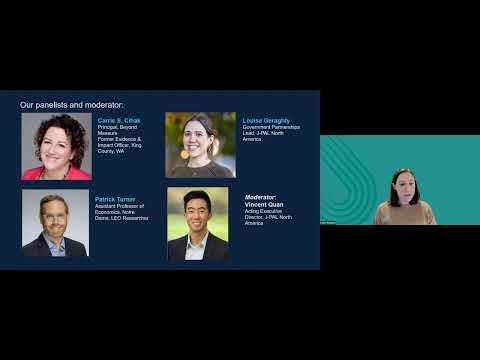
Hosted by the Wilson Sheehan Lab for Economic Opportunities (LEO) at Notre Dame, J-PAL North America, and Carrie S. Cihak, Evidence Matters is a collaborative learning series bringing together government, researcher, and community perspectives to advance evidence-informed solutions that increase economic mobility and equity. In March 2026, Evidence Matters held “Ten Lessons for Building Government & Research Partnerships That Matter,” featuring a candid conversation with Carrie S. Cihak (Public Sector Evidence Leader), Louise Geraghty (J-PAL North America), Patrick Turner (LEO), and Vincent Quan (J-PAL North America) on the practical lessons, unexpected challenges, and long-term rewards of investing in these sustained evidence-building partnerships. This blog highlights select takeaways from the webinar, which can be viewed in full here.
Evidence from rigorous impact evaluations provides key information for solving social problems, shedding light on the most effective ways to allocate resources, design policy, and improve lives. In short, evidence matters.
Public sector leaders, community members, and researchers all have a stake in generating good evidence. Government leaders have a wide mandate: they must identify and respond to constituents’ needs and efficiently allocate taxpayer dollars to address those needs. Governments can also serve as connectors to their communities—including service providers and clients—who are closest to the issues at hand and critical to identifying and understanding effective solutions. Academic researchers answer novel questions and share generalizable lessons to strengthen our collective knowledge base.
While leaders in each of these sectors may independently use or develop evidence, the most valuable learnings result from when these stakeholders work together to understand how a program or policy can create the greatest impact.
However, from finding the right partners to navigating administrative hurdles, cross-sector partnerships can be challenging to build and maintain. To address these challenges, Evidence Matters—a collaborative learning series on advancing equitable, evidence-informed economic mobility—held a webinar on “Ten Lessons for Building Government & Research Partnerships That Matter.”
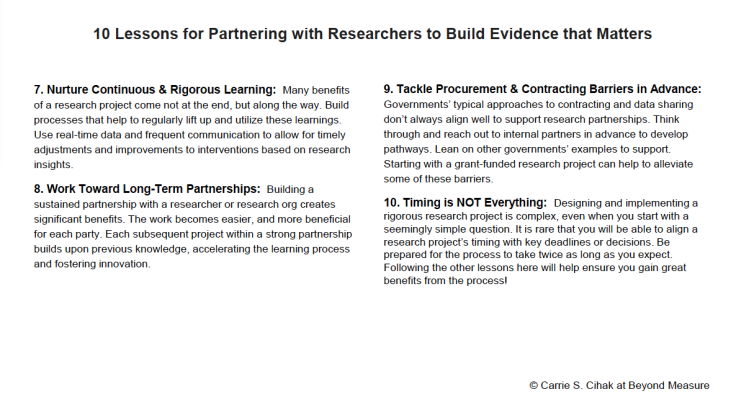
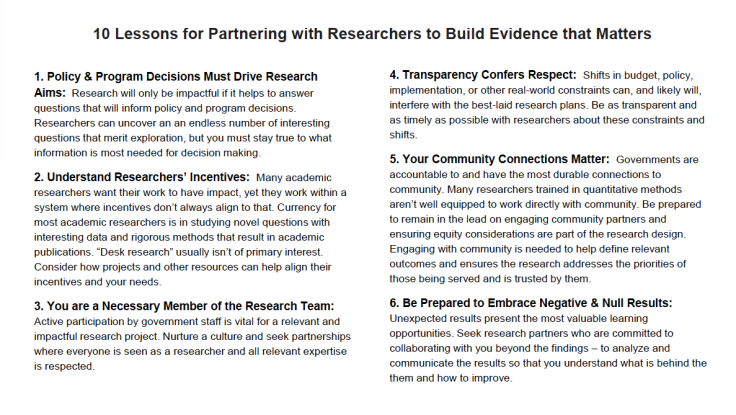
In the webinar, Carrie S. Cihak, long-time public sector evidence leader and founder of Beyond Measure, introduced the lessons she learned from her experience building strong partnerships:
Throughline: Valuing and Leveraging Everyone’s Expertise
Across the discussion of these lessons, a central throughline emerged: successful cross-sector research partnerships honor the expertise of each stakeholder at every stage of the policy cycle.
At its core, the policy cycle involves identifying a potential solution to a community need, implementing that intervention, evaluating its effects, and learning from the evaluation to modify and improve the solution, thus continuing the cycle.
Understanding Needs and Developing Potential Solutions
To develop potential solutions that are likely to succeed, it is crucial to understand a community’s needs and geopolitical context. Public sector leaders have the expertise to engage their constituencies and an understanding of the ecosystems in which they operate. They are able to tap into on-the-ground providers to ensure any solution is informed by those who would carry it out (i.e., service providers) and the community that stands to benefit. It can be valuable to bring in an academic researcher even at this early stage, as they may be able to provide insights into what existing literature says about promising solutions to the issues at hand. However, as Louise noted, a successful research partnership should always “start with the government partner’s priorities and build from there.”
Implementing the Intervention
Once a solution has been identified, enacting and implementing the intervention, too, relies upon the expertise of all of these partners. This is where cross-sector teams really benefit from the expertise of government partners and service providers who understand the intricacies of funding and implementing programs. On the webinar, Carrie noted that government staff understand how decisions get made and how information gets used. Governments know what is politically, financially, and practically feasible; what data can be collected and how; how to communicate with and enroll constituents; and the various barriers that need to be overcome. Researchers may be able to help with additional program monitoring and data collection, and each sector can learn from one another to ensure the policy is being implemented as intended.
Evaluating the Intervention
Evaluating the intervention is where an academic researcher’s expertise may be most prominent. Academics have precise training in rigorous research methods, data analysis, and results interpretation. At the same time, during the webinar Carrie advised, “Everyone in this [zoom] room should consider themselves a researcher.” Government leaders, too, bring critical insights into what research designs are feasible in their contexts, including ethical and logistical hurdles the researcher may not be familiar with. They know what program implementation looks like on the ground, and what data they collect. Public sector partners can elevate the voices of their communities and explain how participants will experience the research process, which then influences key aspects of how the study is designed—including how consent forms are written and what questions are asked.
In this vein, Patrick implored the government leaders in the audience to not be afraid to “ask questions” of their academic partners. Governments may have a tendency to defer entirely to an academic researcher during an evaluation, or they may be wary of a research design because there isn’t a clear vision of how it would work. A good partnership, and a good evaluation, requires a dialogue where everyone can understand each others’ concerns and contributions, and where everyone is clear on and supportive of the research aims and design.
Using Results to Continue Learning and Improving
A good partnership also continues even after the formal evaluation concludes. All parties can work together to understand not only what the results show, but how to use them. Public sector leaders and other community members can contextualize findings, while academic researchers can help explain what the data does and does not say about a program’s effectiveness. Together they can use the results to modify or scale a program as needed, while contributing broader lessons learned to build a wider evidence base. Moreover, findings may inform new solutions—and new questions—thus continuing the cycle.
The strongest evidence-building partnerships are not one-offs, but rather long-term relationships committed to continuous learning. When everyone’s expertise is respected and utilized across the whole policy cycle, cross-sector research partnerships can generate evidence that truly matters.
For more information on Evidence Matters, visit our website and subscribe to our newsletter. Read this blog and watch this video for a summary of the in-person convening we held in fall 2025.
King County, Washington, Notre Dame’s Wilson Sheehan Lab for Economic Opportunities (LEO), and J-PAL North America went live to co-host an all-day, in-person Evidence Matters Convening in November 2025.
King County, Washington is a leader in evidence-based policymaking. The County regularly conducts rigorous studies of their innovative programs, consistently uses evidence to inform decision-making, and embeds evaluation and evidence into operations. J-PAL North America has collaborated with King County to support these efforts for nearly ten years. This partnership has included projects investigating key research questions in transit mobility, energy efficiency, and housing and homelessness prevention.
J-PAL North America has been a longtime partner of King County and Notre Dame’s Wilson Sheehan Lab for Economic Opportunities (LEO), supporting their respective evidence practice. In 2024, J-PAL North America joined as a formal partner of the Evidence Matters webinar series, which focuses on how local governments and researchers collaborate to build and use evidence to improve economic mobility.
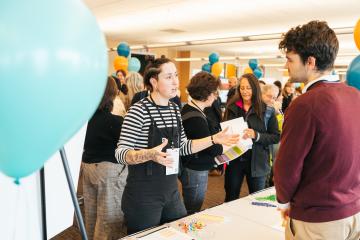
These partners went live to co-host an all-day, in-person Evidence Matters Convening in November 2025. The event was a celebration of the work King County, policy labs, researchers, and other state and local jurisdictions are doing across the country. Through an Evidence Fair, attendees learned about ongoing evaluations, strategies to incorporate evidence into the decision-making process, and opportunities to collaborate with other evidence leaders. The exchange of ideas, connections, and enthusiasm is a testament to the continued strength of the evidence-based policymaking movement.
The convening also featured concurrent sessions on priority policy issues facing communities, highlighting concrete opportunities and actions to advance evidence-based policymaking.
Access to mobility for low-income transit riders: The role of fare policy
Research conducted across the country, including in King County, has found that fare reduction programs have improved mobility for low-income riders. However, subsidies alone may not immediately impact employment outcomes. This session featured J-PAL affiliated professor David Phillips (LEO and Notre Dame), Anne Gienapp (King County Metro Transit), and Rachel Wilch (King County Metro Transit). Key takeaways included:
- Policies need to address more than just fare price, including “time cost” of travel and provide solutions for riders who lack access to digital payment systems.
- Areas for future research and action include better integration of first-and-last-mile mobility (e.g., bike shares) and incentivizing fare payment through a safety-net lens.
Supporting safety net access during changes at the federal level
Amid funding cuts at the federal level, how can evidence continue to play an important part in informing policy design of the social safety net? This session featured J-PAL affiliated professor Elizabeth Linos (The People Lab and Harvard University), Matt Goldman (King County) and Nadine Chan (King County Public Health Department). Session takeaways included:
- Before designing an evaluation, stakeholders must first understand people’s needs and the existing gaps in the social safety net so that actions can be based on community priorities—including the outcomes they deem most important.
- Co-creating evaluations with the people most affected by federal changes can help center community perspectives during evaluation design and implementation.
- For researchers, working with communities to translate research results into clear and actionable policy insights can ensure research is actually used and embraced by communities.
Incorporating evidence into the local budgeting process
Budgeting decisions are about opportunity costs. What will happen if money is spent on expanding or improving a program? This session featured Sam Quinney (The Tobin Lab and Yale University) and Ricardo Basurto-Davila (San Diego County). Emerging considerations on incorporating evidence into local budgeting processes included:
- Evidence can play a role in the budgeting process by identifying which programs have the most impact, for whom, and under what circumstances.
- Institutionalizing evidence into the budgeting process requires more than just defining “evidence” and requesting it be used in budget requests. It requires buy-in from stakeholders and a central body providing support to agencies on identifying, classifying, and sharing evidence.
- The relative decision-making authority of an agency plays an important role in how recommendations will be interpreted and acted upon.
Supporting the childcare workforce
Evidence can play a crucial role when designing strategies to better support the childcare workforce. This session featured Justin Doromal (Urban Institute), Kathleen Gallagher (University of Oklahoma), Chrishana M. Lloyd (Child Trends), and Jessica Tollenar-Cafferty (King County Best Start for Kids). Key themes included:
- The importance of communicating the key role childcare workers play in early childhood outcomes by showing how solutions that support this workforce can directly improve childcare delivery.
- Research in this space needs to include partnerships with providers to center their lived experiences and equity in new solutions being put forward.
- Policymakers and researchers can use a strength-based approach to identifying solutions to be scaled-up and implemented in other contexts. For example, starting with: what is already working for the childcare workforce?
What’s next
We were thrilled for this opportunity to spotlight the evolving landscape of evidence-informed policymaking and showcase how leading local governments are leveraging research and data to inform decisions, improve services, and drive meaningful change. Many partners came with renewed energy to carry this work forward, despite the challenges of the current time. We look forward to continuing the Evidence Matters webinar series and advancing discussions on how to embed evidence-based policymaking and continuous learning at the local level. For more information, access the Evidence Matters webpage. And to never miss a webinar, sign-up for the Evidence Matters newsletter.
In this Evidence Champion series, J-PAL North America is recognizing individuals in our network who have made extraordinary contributions to the field of evidence-based policymaking. This piece features the work of Carrie S. Cihak, our inaugural partner recipient. Carrie is the evidence and impact officer at King County, Washington, and is working across a range of departments and programs to advance the use of data and evidence across the jurisdiction. In this post, we highlight Carrie’s efforts to center community perspectives, promote continual learning, and bring proven solutions to scale.
From a national scope to centering community perspectives
Over the past two decades, Carrie has cultivated a culture of data and evidence use throughout King County, Washington. Carrie first joined King County government in 2001 after working at the White House Council of Economic Advisors (CEA). While Carrie remembers feeling hesitant at first in the transition from the federal level, where impact can be made across national programs, Carrie quickly came to appreciate the benefits of regional level work. “I've stayed at King County now for over twenty years because the work has been so exciting,” Carrie said, “I love that I can affect change on the ground in my own community in ways that are so visible and concrete.”
For Carrie, engagement at the community level has been central to evidence-based policymaking work. “It's critical that we engage community in helping to define the outcomes and co-create interventions to achieve those. If you're truly engaged with community and you’re following their lead in defining the outcomes that are most important to them, then you're going to measure what reflects those priorities. And that’s likely to lead to stronger results from the study, as well as more impact in the community.”
David Phillips, a J-PAL affiliate and associate research professor of economics at the University of Notre Dame who has partnered with Carrie on a range of evaluation projects, also noted Carrie’s commitment to centering community voices. “Carrie has a particular passion for bringing together rigorous evaluation and being very focused on people. A lot of people let rigor and a human touch come into conflict. Carrie does a wonderful job of being data-driven at the same time as always making sure that the voices of the actual people involved are at the center.”
Carrie sees the ongoing work with communities to advance racial equity in King County as the most important of Carrie’s career. “I have learned so much from our communities here. I think one of the things that has really distinguished our work in King County is that we’re trying to bring both an evidence and an equity focus together.” Carrie noted that King County was among the first local governments to have an intentional and integrated focus on advancing equity and social justice. In 2010, King County adopted an ordinance setting a framework for advancing equity, and the jurisdiction is currently developing a second six-year Racial, Equity, and Social Justice Strategic Plan. “The work has really extended into all corners of County government,” Carrie said.
Promoting continuous learning
Throughout Carrie’s career in King County, Carrie has championed a range of randomized evaluations in multiple policy areas, including transportation access, housing stability, and climate. Beyond dedicated support on individual projects, such as an evaluation of a homelessness prevention program for youth and families with children and a subsidized transit pass intervention for low-income individuals, Carrie has kept an eye towards leveraging lessons from each study to contribute to the broader evidence base and reveal additional research questions that can inform these policy areas.
Carrie encourages teams in King County to promote a process of continual learning in their approach to evaluation. “Teams that I work with often hear me say that the success of an evaluation is not measured by whether you get great results. It’s really about whether you are generating the next set of questions for learning,” Carrie explained, “our approach in any of our evaluation projects and partnerships is not to think of it as just one study and its results, but to think of it as a stepping stone in a continual path of serving people better and getting better outcomes for our communities in King County.”
Those who have partnered with Carrie in these efforts commend that approach to continuous learning. “Carrie has spent a long career thinking about evaluation, actively looking for ways for academics and local governments to create evidence-based policy. And Carrie leads by example, designing King County's policies with evaluation in mind from the start. Today, thanks to those efforts, King County is a hub of learning about increasing transportation access for low-income community members and decreasing homelessness for youth and families,” said James Sullivan, a J-PAL affiliate and Professor of Economics at the University of Notre Dame.
Evidence-based policymaking at scale
Carrie also thinks critically about how evidence from King County can inform work in other regions. “Carrie has pushed to connect what we're doing in King County to other communities working through the same questions,” said David Phillips, “A great example of this is the Evidence Matters webinar series that the Wilson Sheehan Lab for Economic Opportunities and King County have conducted together, which highlights particular studies and talks through both the results and the process of rigorous evaluation with a broader audience.”
“I believe that local governments like King County can really be pacesetters. And we can be innovators,” said Carrie, “We can be more adaptive than other levels of government because we are closer to our communities. And that gives us the ability to understand the context and what's happening on the ground more quickly and respond more quickly. A lot of the work that we've done in King County actually has national impact because it ends up moving into a replication cycle in other places, and sometimes it even influences Federal policy. And that's been really exciting to see for me and for our staff.”
Building and recognizing expertise
Reflecting on key insights learned throughout a career in government, Carrie emphasizes the importance of building capacity among government staff. “A lot of times when we think about evaluation with external partners and researchers, there can be a tendency to just shift the work on to that external team. Instead, we need to build the capacity within our government and build the knowledge and skills among our staff so they can be an integral part of the process. We need to encourage our staff and our community partners to see themselves as researchers, too, so we are continually learning how to do better.”
Carrie constantly strives to bring together the expertise of three key stakeholders groups to inform the evaluation process: external researchers, government staff, and members of the community who participate in the programming. It is this network of experts who Carrie sees as the true evidence champions in King County. “The success of the work that J-PAL is recognizing is really the success of our whole team at King County, our research partners, and the communities with whom we work,” said Carrie, “That team effort is critically important in evidence building and how we approach the work.”
In reflecting on Carrie’s many contributions to the field of evidence-based policymaking, King County Executive Dow Constantine, noted “Our Evidence & Impact Officer is dedicated to nurturing partnerships, increasing our capacity, and developing “One King County” approaches to generating and using evidence. This helps us to do all we can, as soon as we can, and as best we can to better meet the needs of King County residents.”
Carrie would like to thank the broad team of researchers, policymakers, practitioners, and community members who are partnering with King County to make this work possible:
- King County: Executive Dow Constantine and his Executive Office team, including those in the Office of Performance, Management, & Budget, Climate Office, and Office of Equity, Racial, and Social Justice; leadership and research teams from the Department of Executive Services, Metro Transit, Community & Human Services, and Public Health, and all King County employees who are pushing us and themselves to advance equity and build evidence.
- Research and Policy Partners: including those affiliated with the University of Washington, the Center for Advanced Study in the Behavioral Sciences and the Regulation, Evaluation, and Governance Lab at Stanford University, the Lab for Economic Opportunities at Notre Dame, J-PAL North America, the Policy Lab at Brown University, the Equitable Evaluation Initiative, Results for America, Urban Institute, Project Evident, Centre for Public Impact, Actionable Intelligence for Social Policy at University of Pennsylvania;
- Colleagues from other governments: including Washington State Department of Community & Human Services, Results for America Local Government Fellows and other RFA affiliates, North Carolina Office of Strategic Partnerships, U.S. Office of Evaluation Sciences, and so many federal partners working to advance the Evidence Act with an equity focus.
- King County has also received generous funding, encouragement, and technical support from several foundations and other organizations.
- Most thanks go to the many King County community leaders, organizations, and residents who have led, challenged, and worked alongside us, so that we do all that we can, as soon as we can, and as best we can to build a region where everyone thrives.
J-PAL affiliate and Director of Opportunity Insights Raj Chetty reflects on partnering with J-PAL North America to evaluate an intervention called Creating Moves to Opportunity, which aims to help lower-income families in the United States to move to higher-opportunity areas.
Raj Chetty is the William A. Ackman Professor of Public Economics at Harvard University and a J-PAL affiliated researcher. Chetty was one of the Principal Investigators for the Creating Moves to Opportunity (CMTO) project, an ongoing collaboration between J-PAL-affiliated researchers and public housing authorities to introduce and evaluate interventions to “create moves to opportunity” for low-income families.
Chetty is also the Director of Opportunity Insights, a research center based at Harvard University, with the mission to identify solutions to help more children rise out of poverty and achieve better life outcomes in the United States. In response to COVID-19, Chetty and the Opportunity Insights Team developed The Opportunity Insights Economic Tracker, a publicly available platform that tracks real time economic activity at a granular level using anonymized private sector data. Using data from the tracker, Opportunity Insights researchers have outlined key insights on household spending patterns, the impact of policy efforts to date, as well as long-term solutions to the current economic crisis.
CMTO beginnings
Often as a researcher, you have an idea about something that can make a difference in the world. One such idea emerged from observational data we were collecting at Opportunity Insights. The data showed how children’s chances of rising up out of poverty varied sharply across different neighborhoods in Seattle. Yet we also noticed that, in spite of receiving housing vouchers (governmental rental assistance worth about $1,500 a month), low-income families tended to live in low-opportunity areas where poverty was likely to persist across generations.
This led us to the question: Why did low-income families tend to be segregated into low-opportunity areas where their kids are unlikely to escape poverty? Did they not want to live in other parts of Seattle that might be further away from their families or jobs and were perfectly happy to live where they resided? Or did they face barriers—like complicated housing voucher inspection processes and regulations, or lack of information and assistance in the housing search process—that prevented them from moving to higher upward mobility areas?
Answering these questions could help figure out how to get lower-income families to move to higher-opportunity areas, which could have a transformational impact on the lives of the children from these families. So we designed a simple intervention called the Creating Moves to Opportunity (CMTO) pilot that provided a set of services to families who applied for housing vouchers in Seattle. Through the CMTO pilot, randomly selected households were paired with a housing navigator to help them throughout the search process, connect them to landlords, and provide a small amount of financial assistance at critical points in the process.
Partnering with J-PAL North America
The challenge in turning this sort of idea into a study, especially for an individual researcher, is that it takes an enormous amount of work—work that often falls outside of the traditional domain of scientific research. In order to carry out a study to measure the pilot’s impact on the lives of families on the ground, it was critical for us to identify the right partners with the expertise and experience necessary to bring the idea to fruition.
Given its reputation, J-PAL quickly rose to the top of the list of potential partners. The number of studies we've seen come out of J-PAL have been some of the most important randomized evaluations in social science. We look to J-PAL for top-quality execution and for high fidelity in that execution. There are many logistical issues and challenges that researchers might not anticipate, and running an experiment in the real world requires specialized tools and juggling a lot of moving parts. J-PAL complements the technical expertise of researchers by working through such hurdles to actually create change in the field.
For the CMTO project, success also depended on our ability to work collaboratively not only with other academics, but also with people who were doing this work on the ground. J-PAL North America helped us determine that Public Housing Authorities (PHAs) were best placed to pilot the CMTO intervention and test them early on. Partnering with PHAs was what ultimately allowed us to test timely and policy-relevant questions related to housing.
We also needed to ensure that, throughout the project, all stakeholders were given a voice. This included housing authority staff who had spent their lives thinking about these issues, tenants who were actually seeking to make these moves, and landlords who faced various concerns themselves. J-PAL North America helped bring all of these groups together to have a constructive dialogue on how to design a program that could have the greatest impact.
Additionally, when you're doing an experiment of this scale, it typically takes several years from planning to implementation to see results. This requires keeping track of compliance with local regulations, meeting diverse stakeholder needs, and taking all the necessary steps to launch the study. J-PAL North America provided added capacity during critical phases of project development and management to oversee these details and ensure all stakeholders were coordinated in our execution. And with a foot in both the policy door and the academic door, J-PAL North America staff also served as a helpful resource in translating between researchers and practitioners.
Through our partnership with J-PAL North America, we went from an idea discussed in our offices, to ultimately visiting Seattle and meeting families who had moved to these different neighborhoods. And the most poignant moment during all of this was receiving a thank you card from a seven-year-old child who felt that her life had been transformed as a result of this pilot study.
Learning from preliminary results
The initial data from phase one of the study showed that the CMTO pilot really changed where families choose to live. In the first year of the study, we found that families who received the additional support services in the pilot were much more likely to move to high-opportunity areas. The rate of families moving to high opportunity places increased from fourteen percent in the control group to 55 percent in the treatment group. The majority of the children whose families participated in the pilot are now growing up in places where we estimate that they will go on to earn an average of $200,000 or more over their lifetimes as a result of this intervention.
To me, the data also gave a positive message about the world. It told us that segregation in America and many other countries is not the result of deep-rooted preferences that landlords or tenants hold, but rather barriers that can be overcome through changes in policy.
In phase two of the study, we are attempting to understand the mechanisms through which phase one had such a great impact. We want to understand, in greater detail, exactly why that bundle of interventions was so successful. We will also determine how we can optimize the program to reduce costs so we can make the program available to more families throughout the United States.
The case for more evidence—and the research partnerships that generate it
Evidence can play a pivotal role in reshaping policy debates. Political discourse often tends towards people's ideologies or prior convictions about what may or may not work. But when rigorous research brings evidence to bear on a politically charged issue, it can completely change the tenor of the conversation. As we’ve learned from CMTO, evidence can shift the focus from “What do I think is most important based on my initial beliefs?” to “What does the research show is best for our kids?”
Rigorous research results can bring people from different backgrounds together, cut through debates, and make real progress. This is the power of evidence, and the power of collaborative research partnerships that can help us put evidence into action.