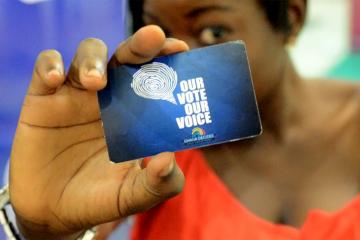
Digital IDs and e-payments in Africa: Consolidating what we (don’t) know (yet)

Digital IDs: A focus on growing the body of evidence
Digital identification (ID) can improve targeting and reduce leakages of government programs, while also enabling citizens to participate in the digital economy. However, digital ID systems can also lead to exclusion of vulnerable groups—such as marginalized women and people living in rural areas who may be less likely to have the ID—to ID-linked government services and could lead to the erosion of privacy if strong data protection protocols aren’t in place. The implementation of digital ID systems may be particularly challenging in specific contexts, such as remote areas with limited internet connectivity and electricity.
Conducting research on the impact of IDs can be helpful to understand the potential of these ID systems, and generate alignment among implementing partners on how best to design and implement these programs. Although some research has been conducted on digital IDs in South Asia, more evidence is needed to understand the impacts of these reforms in sub-Saharan Africa.
Read more about how expanding the evidence base on digital IDs in Africa can impact policy and practice in three consolidated resources from the Digital Identification and Finance Initiative (DigiFI Africa) team:
Digital payments: Access to mobile money and digital transfers can support households during tough times
The growing body of research on mobile money shows a consistent finding: households are able to better respond to unforeseen difficulties when they have access to mobile money. When an unexpected negative event—such as a flood or a child falling ill—occurs, households with mobile money are able to rely on the easy and affordable transfer of money from family and friends, even if they are living far away.
Digital transfers, distributed through mobile money, can be particularly useful in supporting households through tough times. New evidence from two Kenyan counties shows that digital transfers reduce hunger, illness, and risk exposure during crises, such as the Covid-19 pandemic.
Read more about the summary of the impacts of mobile money and digital payments:
- [Project syndicate blog] How a universal basic income helped Kenyans fight Covid
- [African Arguments blog] Preparing for shocks through universal basic income: Evidence from Kenya
- [J-PAL blog] The role of a (digital) universal basic income in supporting pandemic resilience
- [J-PAL blog] Digital payments in sub-Saharan Africa: Trends over the past decade
- [J-PAL blog] The rise of mobile money in sub-Saharan Africa: Has this digital technology lived up to its promises? [African Arguments blog repost]
- [J-PAL blog] Should government payments be digitized?
Gender and digitization
While there is no silver bullet for achieving gender parity, transferring funds through direct deposits to women’s accounts or mobile payments can give women more control over the use of financial resources and improve their economic empowerment. In general, digital technology presents an opportunity to narrow gender gaps by enhancing women’s access to welfare services, ID, and financial services and information. However, given the gender gap in digital literacy and the takeup of digital products, the rollout of digital technology could amplify the divide in access to financial services between men and women. More research is needed to unpack these gender effects and understand the mechanism behind the way that technology may facilitate more equitable outcomes based on gender.
The DigiFI team explores these gender effects in the following blog:
Big-data and digitization
As governments and organizations digitize more systems, new data can be more regularly collected and updated and more easily transmitted. Leveraging these data could have a big effect on the ability to manage and use the information generated.
We explore the way that data can be leveraged in the following post and display an example of a dashboard based on digital ID and e-payments data.
Unpacking the mechanisms behind digitisation of IDs and payments
In late 2020, the Digital Identification and Finance Initiative staff launched a blog series: Deepening our understanding of the digital ID and e-payment research agenda. The series unpacks ways in which digital ID and e-payment reforms may have an impact in sub-Saharan Africa and digs into the possible channels underlying these effects.
| Identifying intended participants | Managing the delivery of the program | Ensuring high take-up of the program |
|
[African Arguments blog] The challenges of targeting social protection programs [J-PAL blog] Reaching the most vulnerable: Can digitization improve social assistance targeting? |
[J-PAL blog] The leaky bucket: Can digitization of social welfare programs reduce leakages? [African Arguments blog repost] [J-PAL blog] Incentivizing public sector employees: The role of digital technology in enhancing the carrot and the stick |
[J-PAL blog] Overcoming under-subscription of welfare programs: Digital solutions to low take-up [African Arguments blog repost] |
Funding and celebrating African Scholars
Forty percent of DigiFI projects are led by J-PAL African Scholars. These funded African Scholar projects include four pilot projects and nine proposal development grants, and we look forward to funding more African Scholar projects in the future. Read more about our African Scholars program and the spotlights series on specific African Scholars who are part of our network.

Digital Identification and Finance initiative (DigiFI Africa)
DigiFI Africa, based at J-PAL Africa, was launched in early 2019. We fund rigorous research to understand the impact of digital identification and e-payment reforms on citizens, the private sector, and governments across sub-Saharan Africa. DigiFI Africa is also honored and excited to be one of the pillars of the G7 Partnership for Women’s Digital Financial Inclusion in Africa. A number of high-level events were hosted in support of this partnership.
- [J-PAL blog] J-PAL Africa launches the Digital Identification and Finance Research Initiative (DigiFI Africa)
- [Framing paper] Digital Identification & Finance Initiative Africa: An Overview of Research Opportunities
- [J-PAL blog] DigiFI Africa: A pillar of the G7 Partnership for Women’s Digital Financial Inclusion in Africa
- [J-PAL blog] Building back better: Catalyzing digital financial services for women across Africa

J-PAL Africa, based at the University of Cape Town, recently launched the Digital Identification and Finance Research Initiative (DigiFI Africa). Supported by the Bill and Melinda Gates Foundation, this USD$7 million research fund is designed to study the impact of innovative government and private sector payment systems and digital identification (ID) reforms on citizens and governments across Africa.
Policymakers across Africa are increasingly investing in large-scale digital identification and digital payment systems. Because these systems are so new, little rigorous research exists on how best to design and implement such systems in low-income contexts. How do these rapid changes affect the lives of citizens? How can they best be structured to lead to the most benefit? Are any groups adversely affected by these reforms?
DigiFI Africa will cluster research around these questions, supporting research that evaluates impacts on citizens and generating results that provide guidance on critical design questions as reforms go to scale.
Improving efficiency in public spending through digital finance and digital identification has the potential to have large impacts across Africa. For example, these technological innovations have the potential to enhance record-keeping and transparency by collating administrative data and automating transactions, decreasing the potential for delays and errors in payment systems. Digitizing payments can reduce both the need for travel to access financial services and the time burden of engaging with administrative processes. In addition, digitizing the process of business registration and firm regulation can bring more firms into the tax system and raise revenues for the government.
The DigiFI Africa framing paper lays out the research agenda for the initiative. DigiFI Africa promotes research to address the following questions:
-
From a government’s perspective:
-
How can digital ID systems assist with targeting and efficiency in public programs? Do digital ID systems assist or hinder in reaching marginalized populations?
-
Can digital ID systems and digital payments reduce rent-seeking? What are the generalized equilibrium effects of digital payments on rent-seeking?
-
How can digital ID systems and digital payments assist in building incentive systems to motivate public servants?
-
How can payment design (such as targeting a specific household member to receive the transfer or changing timing the payment) affect its impact?
-
-
From a citizen’s perspective:
-
How do government services linked to digital IDs affect citizens? What are the best ways to design these linked services for the greatest impact at the lowest cost? Do digital ID systems and digital payments encourage or dissuade take-up of government programs?
-
Do digital ID systems improve the overall efficiency of government programs? If so, do these efficiency gains reduce poverty?
-
How do digital IDs affect voter participation, the fairness of elections and electoral outcomes? Does increased enfranchisement affect policy decisions?
-
Can digital IDs promote further digitization in financial systems and thus enhance financial inclusion? How does this affect short- and long-term poverty outcomes?
-
Can digital payment schemes empower traditionally weaker household members or affect the allocation of household resources?
-
-
Fiscal capacity:
-
Can expanding the formal economy increase the tax base through incentives and simplified processes introduced by digital payments and digital IDs?
-
-
Externalities:
-
What is the impact of digital ID and digital payment systems on market-level general equilibrium effects? What are their impacts on wages and employment? Are there impacts on occupational choice or migration?
-
What are the spillovers on non-beneficiaries of digital ID and digital payment systems?
-
-
Private sector impacts:
-
Can digital ID systems encourage businesses to enter the formal sector? Do these reforms reduce entry costs to entrepreneurship and enable productive investment?
-
Can digital ID systems help strengthen law-enforcing institutions and in turn affect private investment?
-
DigiFI Africa will run a competitive research fund with requests for proposals (RFPs) twice annually through 2022. The initiative will support researchers in conducting two phases of work:
-
Formative research that includes pilots and high-frequency monitoring systems to assess the status and health of digital payments and digital ID programs at various stages of reforms.
-
Rigorous randomized impact evaluations to test the impact of roll-outs of promising digital payment and digital ID reforms.
Funding is open to J-PAL affiliates, invited researchers, researchers with a PhD based at an academic institution in Sub-Saharan Africa (details here), and PhD students who have a J-PAL affiliate on their dissertation committee. The Round 1 RFP closes on September 20, 2019. For more information, contact Aimee Hare.
As policymakers across Africa are increasingly investing in digital identification systems, the Digital Identification and Finance Initiative in Africa (DigiFI) explores what the benefits, challenges, and unknowns are.
Especially in the era of COVID-19, it is hard to imagine a world without WhatsApp or Zoom. Yet, these tech platforms did not even exist two decades ago. These and many other innovations are proof of the ability of digital technology to transform our lives at rapid speed.
These changes extend far beyond just the individual level of messaging apps, reaching a much larger scale, with entire economies becoming more digital. Digitization of economies is being accelerated by the COVID-19 pandemic and provides an opportunity for countries to make large strides towards greater economic development.
Policymakers across sub-Saharan Africa are increasingly investing in a particular digital technology with transformative potential—biometric identification (ID) systems. Biometric IDs are a form of identification that uses biometric information of individuals to record, identify, and verify their identity. They use traits such as fingerprints, eye retina and iris scanning, voice recognition, facial patterns, and body movement as biometric measures of verification. Traditional IDs usually use other documents or people to verify information about someone or are prepared at birth. This step of digitizing ID systems is partly to increase the provision of a legal ID, which is often essential for citizens to access basic government services and lead a dignified life. It will also enable broader use of digital payment systems and promote digitization of services more generally.
Countries like Malawi, Senegal, and Uganda have rolled out national biometric ID systems, while others including Ghana, Kenya, Nigeria, and Tanzania are in the process of implementing mass registration campaigns for their new biometric IDs. More countries still, including Ethiopia, have announced plans to start enrollment for such IDs in the coming months and years. As this digital ID revolution sweeps the continent, what do we really know about its benefits and drawbacks? How does this rapid digitization and proliferation of biometric IDs affect the lives of citizens? And how can they best be structured to result in the most benefit? In this blog, we explore the benefits and drawbacks of digital IDs, as well as the various questions that remain unanswered.
The Good
Overcoming the problems associated with a lack of identification through digital IDs might have powerful implications. A digital repository may make it easier to implement and target government programs, while also enabling citizens to participate in the digital economy. Since these IDs can function as a universally valid proof of identity, they can easily be linked to existing functional systems—like bank accounts and payroll, asset registries, insurance, and school records—to avoid corruption and siphoning of resources, as well as double counting and targeting errors in beneficiaries. By easing processes to obtain voter IDs, drivers’ licenses, telecom services, and banking facilities, IDs can mobilize citizens’ political and economic participation. Additionally, IDs can catalyze the growth of a country’s fiscal capacity by not only minimizing tax evasion but also by being instrumental in promoting financial inclusion and growth of the formal economy. Evidence points to many potential benefits of digital ID systems such as:
- Improved data: It is difficult to allocate funding or identify problem areas without access to quality, granular data. Digital ID systems may alleviate this issue by facilitating improved record-keeping and generating administrative data (routine information collected, used, and stored by governments and other organizations primarily for operational, rather than research purposes) on individuals in the country.
- Improved public service delivery: Many countries plan to link ID systems to digital payment and welfare systems, which should help make public services more efficient and accessible. These policy changes aim to eliminate leakages and enhance the accuracy of transactions as well as the ability of the government to monitor them. When linked with monitoring systems, digital IDs have reduced absenteeism among health workers, reduced data forgery, and improved patient adherence to treatment in India.
- Improved targeting: Following from the previous point, digital ID systems may make it easier to implement and target government welfare programs. Evidence from India shows that biometric IDs cost-effectively increased efficiency of welfare payments by reducing leakages and delays while not reducing program access, particularly to vulnerable households. Further, in India, beneficiaries overwhelmingly preferred the smartcard systems.
- Better credit market efficiency: Digital IDs can help address barriers to accessing formal financial products. Evidence from Malawi shows that fingerprinting for credit can improve loan repayment rates and lead to a better functioning credit market. By using biometric identification, lenders were better able to identify borrowers. Introducing fingerprinting identification for microloans caused high-risk borrowers to take out smaller loans and to improve their repayment behavior.
The Bad
While there are many potential benefits to using digital IDs, they often have their drawbacks. Digital ID systems have seen large pushback in many countries due to fear of exclusion and erosion of privacy. Further, the implementation of digital ID systems could cause more pain than gain in specific contexts such as remote areas with limited connectivity. Governments need to carefully evaluate where digital ID systems will maximize welfare without inconveniencing or excluding the already marginalized. Some of the recorded challenges with digital ID systems are:
- Exclusion errors: Stringent ID requirements can generate non-trivial costs in terms of exclusion and inconvenience to genuine beneficiaries. Evidence from India shows that making biometrics compulsory in the public food distribution system created exclusion problems and increased transaction costs, especially for vulnerable groups, without reducing corruption. These findings were corroborated by a second study, which found that biometric IDs led to limited improvements, such as more timely and reliable recording of PDS transactions, and resulted in the exclusion of households (usually the most vulnerable ones such as widows, the elderly, and manual workers) that were unable to pass the biometric authentication test. The authors argue that the imposition of the digital system here led to “pain without gain” as it did not address the type of leakages that were prevalent in the given context.
- Implementation concerns: Another study in India found that while a biometric attendance-monitoring intervention led to health improvements, its imperfect enforcement illustrated the limitation of technological monitoring solutions when they are not combined with changes in the broader rules governing health workers. While there were some health gains from this, the biometric devices led to lower work satisfaction among staff and increased difficulty hiring new nurses, lab technicians, and pharmacists. As a result of this and other factors, there was limited appetite at all levels of government to use the better quality attendance data to enforce the government’s human resource policies.
- Privacy and data misuse concerns: Biometric authentication raises important privacy and data misuse concerns. There has been major pushback in India and Kenya to biometric national ID systems due to concerns regarding safety and misuse of collected data. Large data sets have been shown to have great power in surveillance, as well as predicting and shaping people’s decisions. In light of this, it is crucial to ensure that strong data privacy and security legal frameworks and systems are in place.
The Unknown
While we are beginning to glean insights on some of the benefits and drawbacks of digital ID systems, many questions remain unanswered, particularly in the context of sub-Saharan Africa. With the broad impacts that digital IDs can have, there is little research on how they can improve the implementation of welfare programs, how these systems and linked programs affect citizens, and what unintended consequences may result from having access to IDs and their associated technology. As government reforms in both IDs and payments advance, rigorous research can help them answer these questions, including providing insights into design questions as reforms scale up.
The Digital Identification and Finance Initiative in Africa (DigiFI)—hosted by J-PAL Africa at the University of Cape Town—aims to fill this evidence gap by generating cutting-edge policy research projects focussed on the study of innovative government payment and ID systems. We lay out our research agenda in our framing paper. Some examples of questions we hope to answers in the digital ID space are:
- What are the best ways to design digital ID linked services for the greatest impact at the lowest cost?
- To what extent and when can digital ID systems improve targeting and efficiency in public programs?
- How can digital ID systems assist in building incentive systems to motivate public servants?
- How do digital IDs affect voter participation, the fairness of elections, and electoral outcomes?
- Can digital IDs promote further digitization in financial systems and thus enhance financial inclusion?
- Can digital ID systems encourage businesses to enter the formal sector? Do these reforms reduce entry costs to entrepreneurship and enable productive investment?
- Can digital ID systems help strengthen law-enforcing institutions and, in turn, affect private investment?
If you are a policymaker interested in jointly understanding how to design digital ID and payment systems in your country or a researcher wanting to add to this body of literature, please reach out to us at [email protected]. We are very interested in understanding digital systems across the continent and are keen to help co-generate analysis that can inform policy decisions on digital ID and payment systems.
Author’s Note: This is the first blog in the DigiFI series on the various aspects of their research and policy priorities. The next blog will focus on government to person digital payments.
Dr. Kodjo Aflagah joined the J-PAL Teaching at the Right Level and Digital Identification and Finance Initiative teams, having just completed his PhD in economics at the University of Maryland. His fields of specialization include development economics and applied econometrics, with a particular interest in labor markets and agriculture in developing countries.
The African Scholars Spotlight series highlights the work and journey of economists from the African continent who are working on issues of poverty and using experimental methods.
Dr. Kodjo Aflagah joined the J-PAL Teaching at the Right Level and Digital Identification and Finance Initiative teams, having just completed his PhD in economics at the University of Maryland. Hailing from Togo, Kodjo holds a BS in Mathematics from the University of Lome as well as a MA In Economics and Statistics from ENSAE in Senegal. His fields of specialization include development economics and applied econometrics, with a particular interest in labor markets and agriculture in developing countries.
Could you tell us a bit about your career aspirations and why you want to pursue a career in academia?
One can impact people’s lives either through direct action on the ground or by helping produce knowledge around effective interventions. I would be interested in the long run in a career in the implementation space, but for now I feel I will make a greater contribution building the body of knowledge around policy evaluation.
I value the freedom granted in academia, where I am not constrained by specific ways of thinking or limited to particular topics of investigation. Teaching is also a major passion of mine and one of the main ways in which I try to give back. I’ve been tutoring high school students since my days as an undergraduate student, so I’m really excited about opportunities to teach going forward.
What drew you into the field of development economics and in particular, working with impact evaluations?
I found my undergraduate studies in mathematics interesting but abstract, and was looking for something more applicable to the world around me. I thus slowly made the transition from math to statistics and eventually into economics.
Economics offers interesting tools to explore human behavior and the ways in which it could be influenced for good. Microeconomic theory in particular, with its focus on incentives, caught my attention. I inevitably ended up in development economics as it allows me to apply microeconomic theory to questions I think are important, and particularly relevant for contexts similar to the one I grew up in. Impact evaluations are really an extension of this—being one of the best available tools for exploring such questions—so it made sense to engage with them more fully.
What has the path to an academic career been like for you? Were there any challenges you faced along the way?
One of the biggest challenges I’ve grappled with is learning to ask for help. University systems, and in fact the whole education system in Francophone Africa, emphasize the importance of figuring things out by yourself, and you do not get access to teachers as one does in the US. Learning to reach out to advisors or asking colleagues for feedback has been a big shift for me.
A PhD can be a very lonely and isolating experience that can negatively impact one's mental health. This will be particularly true for Africans in western universities. I had to adapt to a new culture (especially my first time being in a country where I am in the minority group), and a new education system. That said, friends who chose to go into Canadian universities for their PhD had a different experience: there are usually many in their cohorts that know each other, and this eases the transition into the new system.
Another important challenge was funding and supporting myself during the PhD. I was fortunate to secure a teaching assistantship but my last year was extremely challenging, as I was no longer funded. The last summer of my PhD, I was writing my job market paper, doing some consultancy work to fund my last year, and figuring out visa requirements for jobs outside the US—all at the same time. You need to be very proactive to protect your research time and not fall behind.
What or whom had the most impact on your career journey so far?
First, the training I received at ENSAE in Senegal ensured I was adequately prepared for the rigorous demands of PhD quantitative coursework. It instilled in me a strong work ethic and I doubt I would have made it here today without having attended that school.
Before and at the start of my graduate studies, talking to people about the real experience of completing a PhD was incredibly important. The feedback I got about long working hours, limited personal time, loss of income, etc. enabled me to properly evaluate whether the sacrifices were worth it.
My research assistant experience helped develop relevant skills and secure strong references for graduate school applications. I owe a great deal to my supervisors, Tanguy Bernard and Angelino Viceisza, who introduced me to mentors such as Susan Godlonton and who guided me through PhD application processes. Moussa Blimpo, a fellow Togolese economist, has also always made time for me and provided me with very valuable advice.
Finally, I had an amazing PhD supervisor, Jessica Goldberg, who understood the challenges that international students face in the US and worked to ensure these didn’t negatively impact my academic experience by encouraging me to come out of my shell, ask more questions, and engage with my professors.
Do you have advice to offer other young aspiring African scholars thinking about a career in economic research?
Don’t be afraid to engage with other scholars—particularly those who are also from Africa—around their experiences. You do not have to figure everything out on your own and people are more than happy to engage with you, as long as you are mindful of their time. They can often point you in the direction of useful information, opportunities, and interesting people! Social media can be a trove of information, particularly Twitter, where economists often share useful information for aspiring PhD applicants. Someone like Dina Pomeranz is fantastic.