

Overcoming under-subscription of welfare programs: Digital solutions to low take-up
Contrary to popular beliefs, welfare programs are often under-subscribed. A recent review of program take-up in OECD countries estimates that only 40–80 percent of eligible individuals and households actually apply to social assistance and housing programs. There is limited data on the take-up in developing countries, but we know that coverage of these programs is low. According to the World Bank’s Atlas of Social Protection Indicators of Resilience and Equity database, only 22 percent of the poorest households in sub-Saharan Africa receive any form of social assistance. Further, we know for some specific programs this low coverage is driven by low take-up. For example, in India the take-up of an unconditional cash transfer for poor widows and divorcees in Delhi is particularly low—many eligible women simply do not take up the program.
One of the reasons for the low take-up of welfare programs is the lack of access to legal IDs, which are typically required to access the program. Close to 40 percent of adults in low-income countries do not have an ID. Women and vulnerable groups are disproportionately less likely to have an ID.
Although many people who do not have an ID cite reasons related to difficulties during registration, such as distance to the registration center, the take-up of IDs is also closely related to the perceived benefits of having an ID, along with the substitutability of the ID with other forms of identification. If an individual is able to use their driver's license interchangeably with their national ID, beneficiaries may not see the use of registering for an ID. As of 2017, 40 percent of adults without an ID in Ethiopia responded that they do not have the ID because they have no need for one. In Mozambique, 36 percent of adults without an ID reported a similar reason.
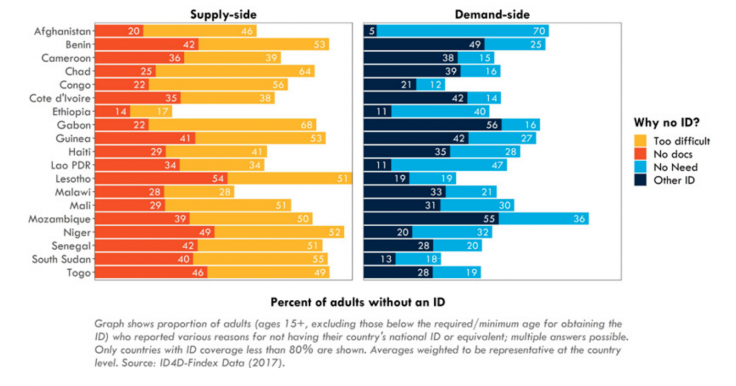
In addition to the (perceived) lack of IDs, there are other possible barriers to the take up of welfare programs:
- Lack of information may mean that beneficiaries do not know the program exists or what the benefits are of joining;
- Behavioral biases, such as procrastination, may mean that individuals keep putting off registration to another day and not end up registering on the specific platform; and
- Costs can discourage the take-up of a program. Beneficiaries not only face monetary costs when deciding whether to take up a program (such as registration fees, transport, and printing costs for documents), but they also face non-monetary costs such as the time it takes to register or the costs associated with being away from work.
Mass rollout of digital IDs and digital payment systems offer a possible solution. A coordinated effort, with an associated information campaign, can be effective in overcoming some of the barriers to take up and in increasing coverage of welfare programs. Many countries have already started implementing nationwide ID systems for this very reason. For example, between May and December 2017 approximately 9.1 million Malawi citizens were registered with their biometric attributes and obtained a digital ID. The Malawi National Registration Bureau achieved the target for near-universal coverage. Although Malawi is seen as a success, Figure 1 shows the more systematic problem of lack of ID coverage. Digital payment systems could also allow direct benefit transfers to beneficiaries and better targeting, reducing many of the barriers to accessing welfare benefits.
How could digitization help to reduce the barriers to take up?
Improving beneficiary experience: Reduction in costs, administrative barriers and increase in possible benefits
Digitization reduces administrative barriers. The ability to link beneficiary data across departments allows for a potentially less bureaucratic process with fewer forms and less redundancy. In addition, digitization, such as access to a digital ID, allows for registration online or remotely with fewer in-person requirements. The remote nature could have a large effect on the ease of operations from a beneficiary perspective and also increase their willingness to engage with the platform. For example, governments could consider mobile money payment options for subscribers to process their annual renewal fees. This shift to digital payments would reduce transaction costs for both the government and beneficiaries by eliminating the need to appear in person to complete this task.
For example, the Togolese government, in response to the COVID-19 pandemic, implemented the Novissi digital transfer program for informal workers. Individuals could apply for the transfer using their mobile device and also received their disbursements through mobile money. The digital system allowed for a smooth, safe implementation with less need for in-person disbursement and more transparent transfers of funds. Further, this program used the voter ID database from the February 2020 presidential elections, which contained precise location and occupation information, to identify beneficiaries. Hence, beneficiaries did not need to jump through several administrative hoops to prove their eligibility because of the government’s ability to use pre-existing data.
A more digitized and streamlined process could also allow for reductions in processing time for individuals registering for the digital ID or payment platform. There is some initial evidence from India, which suggested that the digitization assisted with improving implementation efficiencies and in decreasing the time spent in line waiting to receive the program benefits.
Improving communication: Overcoming information and behavioral biases
A review of literature regarding the take up of social programs in the United States and United Kingdom highlights that lack of information, in addition to complicated eligibility requirements, can limit the collection of social protection payments. Technology has the potential to improve these information flows between government and citizens.
Mobile technologies provide a channel through which to easily send reminders to beneficiaries, especially for programs with multiple steps for enrollment. ID enrolment, for example, is often a two-step process—first users register, then they collect their physical card. Mobile technologies can be leveraged to remind individuals to collect the digital ID card once the card has been printed. This reminder could assist with overcoming potential behavioral biases and nudge individuals to complete enrollment processes. For example, a Digital Identification and Finance Initiative (DigiFI) funded study plans to explore whether mobile pension payment coupled with the inclusion of a national digital identification card and voice messages, explaining the importance of pensions, can nudge pension contributions in Ghana.
It is worth noting that while information delivered via mobile technology can assist with take-up for those who are literate, it will not assist the most vulnerable who are unable to read (as evidenced by a study in India). However, information plus enrollment assistance was more effective in increasing application rates and encouraged more vulnerable women (e.g. those who were illiterate, politically disadvantaged, and who lacked autonomy in their households) to apply. Some social programs may remain complex and require additional thinking regarding the registration process. Digital registration alone is not always the most constructive pathway.
Improved implementation: Managing beneficiary trust in the system
Effective implementation of government systems is important on many levels, including in ensuring citizen trust in the state, which may impact their likelihood of taking up government welfare programs. Information interventions that leverage technology to improve engagement with the program—such as providing information through technology platforms that currently exist—may be able to bolster trust and hence take-up of programs.
However, the malfunctioning of technology could backfire and reduce trust in institutions leading to adverse outcomes. Researchers found that the text message campaign led to a small increase in voter turnout but significantly decreased trust in the functioning of the electoral commission, especially among voters linked to the party that lost the election for president.
Filling the gaps to improve program take-up
DigiFI is interested in a number of open questions on the registration and use of digital IDs and payment systems to improve the coverage and take-up of welfare schemes. Specifically, we are interested to learn more about how policymakers and NGOs can use data generated through digital ID and payment schemes to reduce administrative barriers and decrease transaction costs, with the goal of ultimately improving the take-up of underutilized programs? To learn more, read the DigiFI framing paper for information on our research agenda and other open questions.
Authors Note: This is the seventh blog in the DigiFI series on the various aspects of their research and policy priorities. The next blog will focus on high-frequency process monitoring systems that leverage digitally collected data.

Employee effectiveness is a key driver of productivity and economic development in the public sector. But how does one motivate public sector employees to perform and deliver services? Understanding what drives these employees to work hard, and how different (dis)incentives can energize (or reduce) effort, is key. With this in mind, how can public sector institutions leverage digitization to monitor, motivate, and retain the best employees?
Positive and negative incentives: The carrot and the stick
Incentives are tools used to motivate employees to act in ways that align with the interests of the organization. Incentives are often thought of as economic goods, such as money, that are used to shift behavior. Pay for performance, where individuals receive additional payment for work completed, has been studied across a wide range of organizations, from schools to tax collection and procurement agencies. Studies have shown these schemes can be effective in improving civil servants' performance (for example, leading tax collectors to collect significantly more revenues), though are not a panacea for improving efficiency and may have some unintended consequences.
Yet providing monetary incentives can be expensive and/or politically difficult to implement. These barriers may lead one to look at non-financial incentives, such as favorable job postings based on prior performance, or an extrinsic reward such as gold stars based on performance. In addition, organizations might also consider negative incentives such as “punishment goods,” including reductions in payment, delayed promotions, or demotions.
There are many dimensions that influence the effort put in by employees. Innate characteristics, such as intrinsic motivation, may influence the success of certain incentive tools. Some tasks individuals would happily do voluntarily, without the need for an incentive. In addition, non-financial incentives may complement intrinsic motivations. In Zambia, the impacts of non-financial incentives were stronger for the most intrinsically motivated public sector workers. Thus, understanding which incentive works best in a specific environment and with a specific group of people is essential when designing effective programs.
Digitization to shift or enhance incentives
Various incentive approaches have differing merits or drawbacks based on the context in which they are implemented. Overall, digitization could help public sector institutions make better decisions by collecting better monitoring data and improving the delivery of incentives. Monitoring is central to implementing incentives, as these data are used to understand the level of performance and to allocate the associated reward (negative or positive) accordingly. Digital tools have the power to simplify data collection and make these systems more effective and efficient.
Digitization has the potential to enhance the way public sector employees’ performance is monitored. Digital systems using biometrics can be used to uniquely identify and accurately authenticate an employee at the workplace. These data can be verified by the employer remotely, who can make real-time decisions accordingly. Other digital tools, such as GPS and phone-based tracking, could also be used to monitor the performance of public sector employees.
Biometric monitoring
Several studies examine biometric monitoring systems of public sector employees. In India, researchers looked at biometric tracking of healthcare workers and patients. Health workers and patients identified themselves with biometric finger scanners, linked to a computer system, when they came to a health center. Biometric tracking increased the likelihood that patients adhered to recommended tuberculosis treatment, improved healthcare worker attendance, and reduced misreporting of patient data by health workers. The biometric data collected made the healthcare workers more efficient, as it digitized their data systems and improved the ease of operations.
Another study in India tested whether a monitoring system that recorded employees’ fingerprints at the beginning and end of each day could improve staff attendance and patient health in primary health centers in Karnataka. The monitoring system increased attendance among medical staff, such as nurses and lab technicians, but not higher-tier medical staff such as doctors. However, absence penalties were not widely enforced. Implementation issues and the willingness to apply the attendance sanctions were key challenges—the combination of complex administrative processes for deducting leave plus difficulty in recruiting doctors to work for public sector salaries in rural health centers hindered penalty enforcement by administrative staff. The imperfect enforcement illustrates the limits of technological monitoring solutions when they are not combined with changes in the broader rules governing health workers.
GPS and phone-based monitoring
Researchers partnered with the Government of Paraguay to measure the impact of a new monitoring technology—GPS-enabled cell phones—on the job performance of agricultural extension agents. Overall, cell phones improved agricultural extension agents’ performance by increasing the share of farmers visited, and researchers found that supervisors possessed useful information regarding which agricultural extension agents’ performance would improve the most from phone-based monitoring.
In Telangana, India, researchers conducted a study to test the impact of a cell phone-based monitoring system on the delivery of government-issued payments for farmers. The phone-based monitoring scheme significantly improved the likelihood of farmers ever receiving their payments as well as receiving them on time, indicating improved performance by on-the-ground service providers in delivering payments to farmers.
Digitization has the potential to transform the way monetary incentives are delivered. The growth in digital technology, especially mobile money, allows governments to extend incentives and payments to employees who previously may have been inaccessible. For public sector workers who live in remote areas, the ability to receive money directly through mobile money wallets, rather than going to town to collect their payments, could decrease the time lost due to travel and waiting in queues. Digital identifications (IDs) allow for work to be tracked in a more precise way, for the allocation of incentives to be more accurately measured, and for benefits to be disbursed in a more predictable manner.
Ongoing work in Afghanistan examines the impacts of the modality of payments to public sector workers. In partnership with the Ministry of Education, researchers are conducting a randomized evaluation to study whether mobile salary payments, compared with the status quo of cash payments, improve learning by increasing teacher attendance and morale.
While digitization can have substantial cost implications, it can be cost-effective. Digital technology can be used to monitor performance and improve the delivery of incentives, but a central question remains on the cost-effectiveness of these investments.
In the study of biometric monitoring of health workers in India, the implementation and enforcement challenges meant that the technology was not effective in its intended role. The choice not to scale the program saved taxpayers an estimated US$604,000 in the initial equipment costs alone of providing all the Primary Health Centers with the devices. However, there are cases where the implementation of technologies has been cost-effective. For example, the India cellphone-based monitoring of a government payment program was highly cost-effective, costing 3.6 cents for each additional dollar delivered. These results suggest that phone-based monitoring can be implemented by governments at a large scale and deliver significant improvements in service delivery across millions of beneficiaries in a quick and cost-effective manner.
Open questions
Managing incentives is central to the delivery of services. What design features and incentive structures can be built into public sector wage payments to boost the productivity of front-line public servants? Can the expanding formal economy be an avenue to increase the tax base through incentives and simplified processes introduced by payments and digital IDs? These are all questions that fall within the Digital Identification and Finance’s (DigiFI) research agenda. For more information, please see our framing paper.
Author’s note: This is the sixth blog in the DigiFI series on the various aspects of their research and policy priorities. The next blog will explore to what extent digitization can improve take-up.
Corruption and ineffective program implementation often result in leakages, which are particularly concerning when it comes to social welfare programs, including cash transfers. But with rapid technological innovation and increasing connectivity, does digitization have the potential to help reduce leakages?
Government expenditure can be a poor indicator of the quality and quantity of public goods citizens receive, especially in low- and middle-income countries. Corruption and ineffective program implementation often claim large portions of public resources, also known as leakages. These leakages are difficult to quantify due to limited data but existing evidence shows that leakages can represent over half of the total budget. For example, in Tanzania, a 1997 Public Expenditure Tracking Survey (PETS) found 57 percent leakage in education and 41 percent in health spending; and in Ghana, a 2000 PETS found 50 percent leakage in education and 80 percent leakage in health.
Leakages are particularly concerning when it comes to social welfare programs, such as cash transfers, as these programs usually target vulnerable groups. Evidence shows that 87% and 78% of benefits for some social assistance programs did not reach intended beneficiaries in Uganda and Indonesia, respectively. Such leakages in social welfare programs directly impact the intended beneficiaries by reducing the amount of resources they have access to, with potentially substantial consequences on their lives. It also leads to mistrust of the government, which can have further downstream effects on electoral participation, civic engagement, and tax compliance.
Why do leakages arise?
Leakages in public expenditure can arise due to a number of reasons. Weak institutions, inadequate payment infrastructure, and poor accountability can make it easier for local officials to divert money from the intended beneficiaries. Differences in information available to stakeholders—the beneficiaries receiving the grant, the local official implementing the grants, and the government officials overseeing the grant - could also contribute to leakages.
- Without a strong ID or identification system, it can be difficult for government officials who oversee the system to know if the payments are being distributed to real people or to made-up, “ghost” beneficiaries. In such a situation, local officials could inflate the number of individuals on the list of beneficiaries and keep the additional benefits for themselves. The result would be a long list of beneficiaries who receive payments, when in reality these individuals don’t exist and the benefits are going directly into the pockets of a few implementing officials.
- It is difficult for beneficiaries to keep implementers accountable when they have limited information about what they are entitled to and questionable records of the transactions. Implementing officials may skim off benefits from each genuine beneficiary and keep a percentage of the transfer for themselves. The lack of information and awareness from the beneficiary allows the implementing official, with perverse incentives (obstructive motives), to misreport and take advantage of beneficiaries.
The role digitization can play in curbing leakages
Rapid technological innovation and increasing connectivity present new opportunities to fight corruption and leakages in social programs. Digitization has the potential to reduce leakages by: reducing officials’ discretion through improved monitoring and auditing; cutting out intermediaries by automating processes; improving payment infrastructure and improving identification and authentication through the use of digital identification or biometrics.
A study in India, for example, found that technological improvements in monitoring, through the use of biometric data, not only discouraged local officials from engaging in corrupt behavior due to improved availability and accessibility of information but also improved last-mile service delivery and welfare outcomes for beneficiaries. Another study found that the digitization of social protection payments and the use of fingerprint biometrics as a tool to authenticate beneficiaries assisted in reducing payments to ghost beneficiaries.
Potential challenges
The application of digital solutions to social protection payments isn’t guaranteed to curb leakages, especially if the solution does not directly address the source of fraud.
For example, in India, researchers found that the implementation of biometric authentication in a subsidized food program not only led to serious exclusion problems, where beneficiaries were prevented from receiving their entitlements despite meeting eligibility criteria, but more importantly failed to reduce leakages. This was because the main source of leakages in this case was not identity fraud, but “quantity fraud,” whereby local officials gave beneficiaries a little less than beneficiaries were due and kept the rest for themselves. Implementing biometric authentication did not address this problem, and thus had little impact on leakages. This highlights the importance of collecting local data, understanding local contexts, and the need to combine digital identification with other mechanisms, such as digital payments, to appropriately address issues prior to implementation.
Furthermore, even if digitization manages to reduce leakages in welfare programs, the continued use and effectiveness of these solutions can be weakened if they are contested by government officials or local officials. More precisely, digital reforms run the risk of being subverted if they: threaten the rents (illegitimate benefits) of officials; punitively increase the administrative burden for officials, or are not aligned with the realistic expectations of work behavior given the context. This indicates the importance of the political economy challenges in determining the success of digitization within social welfare programs.
In conclusion, it is important that a holistic view is taken when evaluating the potential impacts digitization will have on leakages, as well as the quantity and quality of service provision given a region’s specific economic and social context. While there is some evidence on the extent of leakages in some public programs in Africa, little is known about to what extent digitization will help curb leakages in different contexts.
The Digital Identification and Finance Initiative in Africa (DigiFI Africa) is exploring whether and how digital ID and payment systems can reduce corruption and leakages, while improving the overall efficacy of social welfare programs. Learn more about DigiFI Africa.
Authors Note: This is the fifth blog in the DigiFI Africa series on the various aspects of their research and policy priorities. The next blog will focus on one of the barriers to public service delivery, namely on the importance of aligning incentives.
The G7 partnership on women's digital financial inclusion in Africa, of which J-PAL Africa’s Digital Identification and Finance Initiative is a participant, recently held its first annual event focused on Catalyzing Digital Financial Services for Women Across Africa: Supporting Recovery, Resilience, and Innovation During COVID-19.
“We must focus on the infrastructure to digitize, direct and deliver this economic support to the women who need it most.” -Melinda Gates
The G7 Partnership on Women's Digital Financial Inclusion in Africa, of which J-PAL Africa’s Digital Identification and Finance Initiative (DigiFI Africa) is a participant, recently held its first annual event focused on Catalyzing Digital Financial Services for Women Across Africa: Supporting Recovery, Resilience, and Innovation During COVID-19.
The session brought together Melinda Gates; H.M. Queen Máxima of the Netherlands; Cyril Ramaphosa, President of South Africa; H.E. Nicolas de Rivière, Permanent Representative of France to the United Nations; as well as a panel of leaders in the public, private, and academic sectors to discuss financial inclusion and economic resilience for women in Africa.
The event highlighted how the COVID-19 pandemic has disproportionately impacted women, particularly across the African continent, and the need for African governments and donors to accelerate investments in digital financial inclusion to support women, many of whom are among the most marginalized.
Queen Máxima, attending in her capacity as the UN Secretary-General's Special Advocate for Inclusive Finance for Development, highlighted the importance of prerequisite infrastructure to facilitate women’s economic empowerment.
Melinda Gates spoke about the way that women’s economic empowerment is linked to digital financial services. In particular, she highlighted the importance of emergency cash transfers to women as a government response during the pandemic—with digital payment systems and digital IDs at the core—to ensure that these transfers end up in women’s pockets, not their husbands or other male family members.
Commitments were made from South Africa’s President Cyril Ramaphosa to ensure women’s digital financial inclusion. South Africa made a commitment of $500,000 to the South African Women Impact Fund, which seeks to empower women financially. In addition, the President announced that 40 percent of all public procurement will be reserved for women-owned businesses.
A strong country contribution was echoed by the H.E. Nicolas de Rivière, who made a call to action for the donor community in the women’s empowerment space.
Digital money plays an important role in poverty alleviation and economic resilience.
Based on her seminal work on digital money and poverty and recent study on the impact of digital cash transfers, Tavneet Suri, DigiFI’s chair, highlighted key research findings on digital money. She discussed her work on mobile money (MPESA) in Kenya, which finds that MPESA strengthens the ability of households to overcome unexpected adverse events, for example a drought, floods or a child falling ill. In addition, when a household is less vulnerable to these adverse events, they make higher return investments because they know they are protected against the unexpected risk.
On average, the researchers saw an overall reduction in poverty with effects larger for female-headed households. These gender effects were driven by women switching occupations, largely moving from farming to small-scale retail.
Similar resilience effects have been documented in Uganda, Mozambique, Tanzania and Bangladesh.
Tavneet also spoke about her work in the context of COVID-19 in Kenya. Early findings of her research show that individuals receiving digital transfers through mobile money were able to improve their food security, and physical and mental health, prior to and even in the wake of the pandemic.
In order to financially include women, governments, and service providers need to focus on access, quality of usage, and value-add for women.
As Dr. Benno Ndulu, co-director of the Pathways for Prosperity Commission and member of the World Bank’s ID4D High-Level Advisory Council, highlighted, governments must design digital public goods and regulations based on women’s needs.
Dr. Ndulu illustrated his points by featuring the needs of cross-border traders, who are mostly female. In order to trade in a different country, traders need a widely recognized ID, and digital transactions should be easy to understand and convenient. Her transactions can be made wherever she does business, facilitated by a low-cost payment system that can work across vendors, and the transaction needs to be reliable and secure.
Despite its devastating effects, COVID-19 has also opened the door for innovative and lasting solutions—accelerating new digital approaches across the continent.
Many African countries have expanded their government social transfer programs to limit the economic hardships caused by the pandemic.
Cina Lawson, Minister of Posts, Digital Economy, and Technical Innovation for the Republic of Togo, detailed the success of the country’s recent emergency cash transfer program, Novissi. This transfer was 100 percent digital and was targeted to households in the informal sector.
In order to serve women successfully, she highlighted the importance of gender disaggregated data, digital ID, and social registry systems. She emphasized the need for governments to establish trust with the recipients through value-add services, consistent communications, and a redressal mechanism to address grievances. Novissi used the national voter ID database from the February 2020 elections, which included location and occupation of voters, to identify beneficiaries of the program, and early next year the government is looking to roll out a national biometric ID, with links to mobile money wallets, to assist with a more sustained system of identification to better target social protection programs in Togo moving forward.
A regulatory environment that protects consumers, interoperable payment systems, and inclusive financial regulations and policies are critical to reducing the digital divide and safeguarding the use of new technologies.
Having the right regulation and consumer protection policies in place are essential to mitigating risk. In addition, there is a need to garner consumer trust, and help guarantee that the use of and access to digital financial services does not further gender inequity.
With nearly 90 percent of women in sub-Saharan Africa working informally, often across borders, Dr. Eyob Tekalign Tolina, State Minister, Ministry of Finance, for Ethiopia emphasized the importance of accelerating the use of digital interoperable payment infrastructure that considers cross-border traders and merchants and enables them to transact with others, regardless of the service provider.
Cross-sector collaboration is essential for developing innovative digital solutions.
Patricia Obo-Nai, CEO of Vodafone Ghana, underscored the need for more cross-sector collaboration to broaden the digitization of services and expand mobile networks.
In particular where financial inclusion rates are high, Ms. Obo-Nai emphasized the importance of the role governments can play to support greater usage by encouraging wage digitization, digitizing government services, and delivering value to consumers through access to affordable credit.
DigiFI Africa is excited to be a pillar of the G7 partnership and looks forward to unpacking more evidence on the impacts of digital financial services on women in sub-Saharan Africa.
Watch the full event recording below, and contact us to learn more about our research agenda and the potential for collaboration.