

Earth Day 2022: Evidence for climate-resilient food systems and nutrition
This Earth Day marks an important opportunity to examine the immediate and looming effects of climate change, as well as potential solutions.
The effects of climate change will worsen over the next thirty years and will disproportionately impact the world’s poorest people. While climate change threatens many areas essential to life, the IPCC’s recently released Impacts, Adaptation, and Vulnerability report finds that food systems, food security, and nutrition are particularly vulnerable through increased pressure on food production.
Evidence-informed adaptation strategies are urgently needed to address this challenge, which is a growing area of focus for J-PAL’s King Climate Action Initiative (K-CAI). With generous support from King Philanthropies, K-CAI generates evidence and works with decision-makers to scale high-impact solutions at the nexus of climate change and poverty alleviation.
Similarly, J-PAL and Center for Effective Global Action’s (CEGA) Agricultural Technology Adoption Initiative (ATAI), with support from the Bill & Melinda Gates Foundation and the UK Foreign, Commonwealth, & Development Office, funds randomized evaluations testing the impact of farmers’ adoption of many climate-resilient technologies in South Asia and sub-Saharan Africa on their productivity, income, and welfare.
Climate change’s threat to food and nutrition
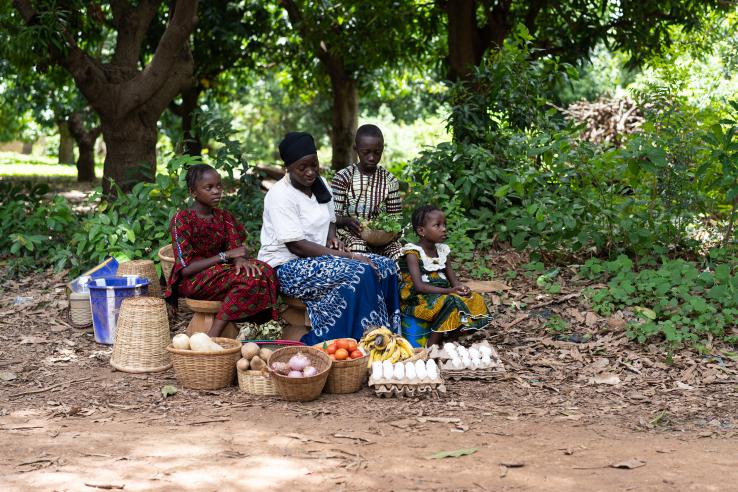
Child malnutrition in the form of wasting and stunting, or when a child has low weight or height respectively, is prevalent in low- and middle-income countries—both causing and exacerbating poverty. This results in higher child mortality rates, harms cognitive development, and impairs education and economic productivity. While stunting has declined over the last two decades, wasting rates have remained persistent and almost half of all deaths in children under five years old are still caused by malnutrition.
Through increased frequency and severity of droughts, floods, and heatwaves and ongoing sea-level rise, food systems are threatened and food insecurity may increase—and children in low- and middle-income communities will have even less access to nutritious food. To prevent these risks, it’s critical to generate evidence and scale solutions that will secure food systems in the face of climate change.
Aligning agricultural yields and climate adaptation
Increasing agricultural yields is an important component of food security. However, agricultural productivity is often at odds with climate change adaptation and resilience strategies. There are two common means of increasing agricultural productivity, both of which can harm the environment in different ways:
- Extending existing production to uncultivated lands, which often requires cutting down trees to clear land.
- Intensifying production through intercropping or higher frequency planting, which can lead to depleting soil of micronutrients and more water use; and new or increased amounts of inputs (e.g., fertilizer and pesticide) on land already under cultivation, which can lead to runoff and water contamination when improperly applied.
There has been substantial research into intensifying agricultural productivity through high-yielding or biofortified crop varietals; high-efficiency inputs, such as fertilizers and pesticides; and less labor-intensive agricultural practices. However, a more recent focus is on the importance of feeding the growing world population in the face of climate change through strategies such as modified crops that can withstand climate disasters, resource sustainability, and the development of practices and technologies that can improve productivity while helping farmers adapt to climate change.
Evidence from randomized evaluations on real-world adaptation strategies
Researchers in the J-PAL network have evaluated the effectiveness of agricultural technologies and strategies to understand their real-world impacts on food security and yields through randomized evaluations.
Coping with risk
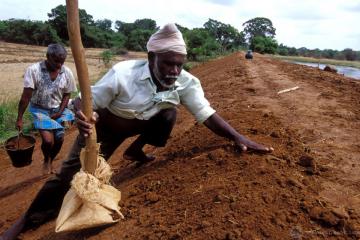
One way to strengthen food systems is to help farmers cope with climate change-induced risks, such as extreme weather events. Adopting new technologies can be effective in helping farmers cope with more extreme weather, but research has shown that risk can be a barrier to farmers’ ability and decision to change their existing practices or adopt new technologies. Sustainable crop management techniques that have been rigorously evaluated include two ATAI-funded studies focused on pit planting in Malawi and building demi lunes in Niger, as well as planting trees to combat land clearing in Malawi. Overall, these studies found that providing incentives and information to farmers, or allowing farmers to self-select into the program, respectively, increased farmers’ adoption of these more sustainable farming practices.
Additionally, there has been a substantial body of research on inputs and financial tools, like weather index insurance to protect farmers from the economic risks associated with extreme weather events. Research shows that weather index insurance protects farmers against losses, but low demand at market prices suggests that alternative approaches are still needed. Stress tolerant crops are a promising way to help mitigate weather risk for farmers. In an evaluation of flood-tolerant seed varieties in India, researchers found that risk-reducing seeds had a clear advantage over traditional seeds during floods and there was no difference in yields between the seed varieties even in unflooded areas.
Resource management
Although low- and middle-income countries are among those least responsible for climate change, their resources, such as water and land, are often the most threatened. Strategies for conservation and effective resource management can help small-scale farmers cope with these climate impacts.
Ongoing K-CAI and ATAI-funded research is evaluating the impacts of leveraging price incentives for voluntary groundwater conservation among small-scale farmers in Gujarat, India, and rehabilitating irrigation tanks in Telangana, India. ATAI has also funded an evaluation focused on subsidizing experimentation with irrigation pumps among interested farmers in Kenya. Previous evaluations have tested strategies like disincentivizing crop burning in India and encouraging the adoption of rainwater harvesting tanks in Kenya. In this last example, researchers found that asset collateralized loans helped farmers purchase water tanks in order to harvest rainwater and better adapt to climate uncertainty. K-CAI is currently funding a scale-up project building on these results.
Improving nutrition of staple crops
In the face of potentially diminishing yields, ensuring that the crops that are available are nutrient-dense is especially important. Staple crops, such as beans, maize, wheat, sweet potato, and rice, make up a large part of people’s diets. But traditional varietals of these crops lack critical nutrients humans need to grow and maintain healthy lives.
One means of addressing this is through biofortification, which is the process of making crops more nutritious. Scientists have been increasing the nutrients of crops and food for decades, and in many parts of the world, people have been eating micronutrient-fortified foods for years, including iodized salt, Vitamin D-enriched milk, and iron-enriched flour.
One of the main challenges to improving nutrition through biofortified crops is farmers’ and households’ decisions to grow and eat these more nutritious crop varieties. For example, in Ethiopia, ATAI-funded researchers evaluated the effect of encouraging families to grow and earmark a more nutritious maize variety for children's consumption. They found that households improved grain storage and cooking practices, and children in those households ate more of the improved maize. However, there were no effects on markers of undernutrition, such as height-for-age and weight-for-age, six months after harvest. This suggests that the length of the program or amount of maize was not sufficient to observe changes in children’s nutrition, or there may have been impurities in the grain that reduced its efficacy.
Similarly, evaluations in India on fortified salt and wheat to reduce anemia have found that while uptake increased initially, it was not sustained and ultimately did not reduce anemia or impact the health of the populations studied in either evaluation. These results underscore the need for further research, particularly in the face of climate change.
Bundling agricultural services
Finally, an approach that is gaining more interest among policymakers is connecting small-scale farmers to agricultural services simultaneously, or “bundling,” to alleviate multiple constraints that farmers face when making investments to increase their productivity or mitigate the effects of climate change.
While there has been some research on bundling products together, including in Ghana, Malawi, and Ghana, the studies have not shown consistent effects on farmers’ demand for services, welfare, or productivity, suggesting that more research is needed. Digital technologies or bundles may affect the sustainability of various steps in the value chain. This could be through systems such as:
- Distributing payments more quickly to allow farmers to buy food for their households;
- Providing weather index insurance and weather advisory services through an app;
- And linking farmers to buyers on an e-commerce or e-marketing platform to reduce post-harvest losses, more efficiently route crops to a stable buyer, and reduce transport costs for farmers taking their products to public markets.
J-PAL and CEGA’s new Digital Agricultural Innovations and Services Initiative, generously funded by the Bill & Melinda Gates Foundation, will generate new research to answer some of the lingering questions around digital service provision and bundling on improving small-scale farmer outcomes, bolstering farmers’ resilience to climate change, and connecting farmers to markets in sub-Saharan Africa and South Asia.
Investing in evidence
More rigorous evidence on the effectiveness of climate adaptation policies on food security and nutrition is urgently needed. Earth Day is the time for us all to refocus our efforts.
Researchers need to focus on developing more evidence at the nexus of climate change, food security, and nutrition—particularly on adapting food systems to extreme weather, finding sustainable and local sources of nutritious food, and bundling services to help farmers overcome their productivity constraints. Simultaneously, policymakers need to prioritize evidence-informed decision-making and invest in further evidence generation to determine what approaches are most effective in real-world settings.
These topics are a growing area of focus for K-CAI. If you are interested in partnering with us to support evidence generation or scale policies proven to work in real-world settings within climate adaptation, food systems, and nutrition, please contact us at [email protected].
J-PAL Policy Manager Tanya Kak explains the links between food security and climate change
IPCC’s recent climate report urges rapid action to produce deep reductions in emissions and adapt to climate change in the coming decades. We highlight key takeaways for poverty alleviation efforts.
The UN Intergovernmental Panel on Climate Change (IPCC) recently released the Working Group I Sixth Assessment Report: The Physical Science Basis, a major update to the state of knowledge on the science of climate change. The report is also an urgent call to action. Rapid large-scale reductions in greenhouse gas emissions and adaptation solutions are needed to avoid the worst effects of climate change.
The implications of the report extend beyond the world of climate science to J-PAL and others focused on poverty alleviation. Climate change’s impacts, such as heatwaves, heavy rainfalls, and droughts, disproportionately affect people experiencing poverty worldwide and threaten to reverse decades of progress in poverty alleviation.
The report concludes that human-induced climate change is already affecting weather and climate extremes in every region, and projected increases in the frequency and intensity of these events will only exacerbate pressure on vulnerable communities.
To develop high-impact solutions that reduce emissions and strengthen communities’ ability to adapt to climate change, we need more evidence on policy and technology solutions at the nexus of climate change and poverty alleviation and must ensure that existing evidence informs policy decisions.
Act urgently and effectively to reduce greenhouse gas emissions
In order to prevent the worst effects of climate change, greenhouse gas emissions need to be deeply reduced as soon as possible. Low- and middle-income countries produce the fewest greenhouse gas emissions, yet they also feel the sharpest effects of climate change.
The report considers five different carbon dioxide (CO2) emissions scenarios, including the associated temperature increases and impacts for each. Under all scenarios, temperatures will increase until at least 2050, and in only two scenarios are increases below 2.0°C. We have a short window to achieve these two now best-case scenarios. Although some consequences of climate change can no longer be avoided, significantly reducing emissions can help us avoid the direst effects, such as rising sea levels and increased frequency and intensity of extreme weather events.
For solutions to be effective, it is crucial to test them in real-world settings. Proven solutions to mitigate greenhouse gas emissions already exist. For example, a randomized evaluation led by J-PAL affiliated professor Seema Jayachandran and coauthors tested the effectiveness of a program that paid Ugandan landowners to not cut down their trees. The evaluation found that the program reduced deforestation in the areas covered by the contracts, without increasing deforestation in neighboring forests. The program was able to pause CO2 emissions at less than US$1 per metric ton, making it a potentially cost-effective solution.
Still, further evidence to abate emissions and mitigate climate change is needed. A current randomized evaluation, led by Robert Metcalfe and supported by J-PAL’s King Climate Action Initiative (K-CAI), is measuring how changing management practices can impact fuel efficiency and possibly reduce CO2 emissions in the shipping industry. By continuing to generate evidence, we can learn how to best achieve large emission reductions even in sectors where abatement is challenging, and contribute to both slowing climate change and alleviating poverty.
Build resilience of communities most harmed by climate change
No matter how much we manage to reduce emissions, the impacts of climate change are guaranteed to increase over the next 30 years. We need to find effective adaptation solutions that benefit those most vulnerable to climate change. The findings from IPCC’s 2014 report on adaptation and vulnerability highlights that “Climate-related hazards exacerbate other stressors, often with negative outcomes for livelihoods, especially for people living in poverty.”
A major addition to IPCC’s Sixth Assessment Report, compared to previous reports, is a better understanding of how climate change will differ across regions. The report’s interactive atlas shows climate change impacts across geographies, highlighting areas that are more exposed to climate change. Across all regions, low-income communities have fewer resources to adapt and be resilient to climate change.
Efforts in international development and poverty alleviation should integrate a climate lens into their work to help develop a toolkit of evidence-informed solutions that build resilience for vulnerable communities. For example, an evaluation led by J-PAL affiliated professor Karen Macours and coauthors studied how conditional cash transfers could help households in rural areas in Nicaragua diversify their income and, in turn, increase their resilience to weather shocks.
Still, like for reducing emissions, further evidence is needed. K-CAI is supporting India’s first randomized evaluation of a flood early warning system for low-income communities, led by J-PAL affiliate Rohini Pande and Maulik Jagnani. By generating new evidence on adaptation strategies, we will be better equipped to help low-income communities and countries become more resilient to the effects of climate change.
Learn more
Given the findings of IPCC’s latest climate report, and in anticipation of the Impacts, Adaptation, and Vulnerability and Mitigation of Climate Change reports to be released next year, we need to continue generating research and scaling climate solutions proven to be effective in real-world settings, to both mitigate climate change and increase resilience to its increasing impacts.
If your agency or organization is interested in evaluating a program or policy, the K-CAI team is glad to facilitate connections with potential partners and J-PAL’s network of affiliated researchers. Please contact us at [email protected].
To stay up to date with environment, energy, and climate change research, updates on K-CAI funded projects, and related policy lessons, subscribe to our mailing list and mark “Environment, Energy, and Climate Change” as a sector interest area.
Earth Day presents an opportunity for citizens, policymakers, and the private sector alike to take stock of the state of our planet and our progress in fighting climate change. This Earth Day, we must also acknowledge climate change's disproportionate impact on people experiencing poverty. To address this effective, evidence-informed policy solutions are needed.
Earth Day presents an opportunity for citizens, policymakers, and the private sector alike to take stock of the state of our planet and our progress in fighting climate change. However, we cannot evaluate the impact of climate change without also acknowledging its disproportionate impact on vulnerable populations, particularly people experiencing poverty.
Since last Earth Day, the Covid-19 pandemic has underscored the inequality of existential threats. Many in low- and middle-income communities are already feeling the harmful effects of climate change. As we assess our ability to combat climate change and the solutions we’ve developed thus far, we must bear this in mind and prioritize solutions that effectively reduce emissions while addressing disproportionate impacts for people living in or at risk of falling into poverty.
The state of the planet and impact on low-income communities
The year 2020 corresponded with an unprecedented decline in CO2 emissions, in part as a result of global lockdowns. However, as economies begin to reopen, this drop is already proving to be temporary, with emissions two percent higher in December 2020 than they were in December 2019.
Although greenhouse gas emissions are predominantly emitted by high-income countries, the impacts will be felt most strongly by people in low- and middle-income countries. Fortunately, there has been a significant increase in recent commitments to reach net-zero emissions from both corporations and governments. While these commitments are essential, they must translate to meaningful climate action.
In order to address climate change and help governments and corporations achieve their commitments to net-zero emissions, corresponding and effective policy solutions are needed.
Focusing on evidence-informed solutions
Although it’s easy to feel daunted by the manifestations of climate change since last Earth Day, we need to keep an eye on the future and focus on evidence-informed policy solutions. For innovations to effectively combat climate change and address poverty and disproportionate impacts of climate change, they need to be tested in real-world settings.
While there is much research that still needs to be conducted in this space, there are also existing evidence-informed solutions that can or already have helped inform policy decisions.
Mitigation
In order to mitigate climate change, we must urgently reduce greenhouse gas emissions, and solutions that reduce emissions at the lowest cost per ton are needed for the greatest impact. Reducing and avoiding deforestation presents one opportunity to abate emissions. A randomized evaluation in Uganda, for example, examined the effectiveness of a Payments for Ecosystem Services program, which paid landowners not to cut down trees. The evaluation found that deforestation declined, and CO2 emissions were abated at less than US$1 per ton delayed from entering the atmosphere. While this evaluation examines the impacts of just one small-scale program, it has great potential to scale in other settings given the demonstrated cost-effectiveness.
Pollution
Activities that produce greenhouse gas emissions also produce local pollutants which have harmful impacts on human health and the environment. Local pollutants often disproportionately impact low-income communities, who are more likely to live near sources of pollution. Balancing this inequality by lowering air pollution and improving respiratory health is even more important in the face of respiratory viruses, like Covid-19. This was of particular concern in India, which struggles with some of the worst air pollution globally. One solution that has already been scaled in Gujarat, India is improving third-party audits by changing incentives for industrial pollution auditors.
Adaptation
Many are already experiencing the effects of climate change—spotlighting the need for strategies to improve resilience to climate change for vulnerable populations. In low- and middle-income countries, the income and agriculture outputs of smallholder farmers are particularly vulnerable to extreme weather events. The adoption of new technologies can be a helpful solution. One example of this occurred in India, where researchers evaluated the impact of flood-tolerant rice. Adoption of the new rice variety reduced risk and encouraged additional investment in smallholder farms, resulting in increased yields and resilience to climate shocks.
These results offer promising guidance for similar programs in other rice-growing countries.
Energy efficiency
Ensuring that energy use is efficient is essential to a low-carbon future. To promote energy conservation in the United States, researchers evaluated the impact of home energy reports on energy conservation. The evaluation found that receiving reports led to reduced household energy consumption. Initially, energy savings were driven by immediate response to the report, but eventually, households made long-term changes to energy consumption habits even after they were dropped from the program after two years. Based on these findings, home energy reports may have the potential to scale in similar contexts and further contribute to increasing energy efficiency.
Looking to the future
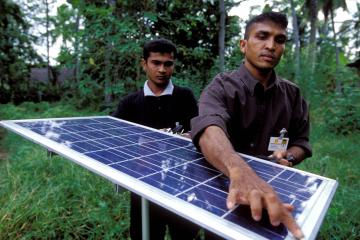
These demonstrated solutions are significant steps for evidence-informed policy addressing the global climate challenge, and more research is underway. J-PAL affiliated researchers are evaluating an array of interventions to address climate challenges and its effects on vulnerable populations, from reducing emissions through increased ride-sharing, to the adoption of off-grid solar power among small retailers, to rainwater harvesting techniques for small scale farmers.
However, many popular climate technology and policy solutions have not been evaluated in the real world to measure their impacts on emissions and people's lives. Although there is much evidence on the impacts of climate change and abundant promise in technological innovations, more research is needed for decision-makers to scale solutions that are effective in real-world settings.
To address this, the King Climate Action Initiative (K-CAI) at J-PAL is dedicated to designing, piloting, evaluating, and scaling innovations that not only tackle climate change but benefit people living in poverty. Through K-CAI, our focus will remain on developing climate solutions with demonstrated effectiveness that address both the urgent need to reduce global emissions and protect low- and middle-income communities.
To stay up to date on environment, energy, and climate change policy solutions and research, subscribe to our mailing list and mark “Environment & Energy” as a sector interest area.
Video: Celebrating Earth Day
One of the goals of COP26 is to mobilize climate finance, but funding alone cannot guarantee effective climate mitigation and adaptation strategies. Because technological and policy innovations do not always achieve their desired effects in the field, climate financing should be informed by real-world evidence to ensure solutions are effective prior to being scaled.
Last week, the United Nations Framework Convention on Climate Change kicked off the 26th Climate Change Conference of the Parties, or COP26, in Glasgow. Members of J-PAL’s King Climate Action Initiative (K-CAI) staff team are on the ground at the conference, speaking at events, hosting meetings with potential partners, and learning from our climate colleagues.
K-CAI, in partnership with King Philanthropies, supports evidence generation and catalyzes the scale-up of high-impact policy solutions at the nexus of climate change and poverty alleviation, aiming to improve the lives of 25 million people over the next decade. At COP26, K-CAI staff are meeting with partners to innovate, test and scale evidence-informed climate solutions to help reach this goal.
Every year, the COP brings together global leaders to discuss ambitious policy and technological approaches to mitigate and adapt to climate change. This year, though, the conference is more significant than ever—marking five years since the historic Paris Agreement.
Now, countries are being asked to submit new climate action plans, or Nationally Determined Contributions (NDCs). 2021 is described as a “make or break” year for climate action by the World Meteorological Organization, and with climate impacts continuing to worsen and the dire findings of the IPCC’s latest report on climate change, the urgency for significant climate strategies has never felt greater.
A large component of success at COP26 is mobilizing climate finance. In 2015, as part of the Paris Agreement, high-income nations pledged $100 billion a year by 2020 to low- and middle-income countries to support achieving their NDCs. It was recently announced that high-income nations have failed to meet this financing commitment and will likely be three years late to deliver these funds. Climate finance will be key for rebuilding trust between nations in order to effectively address climate change.
But financing alone cannot guarantee effective climate mitigation and adaptation action. Technological and policy innovations do not always achieve their desired effects when they are implemented in the field. Although there is substantial evidence about the causes of climate change and its effects, evidence on the impacts of climate solutions on people and the planet is lacking. Following COP26, decision-makers will be looking for the best climate strategies to invest in—it is critical that financing goes towards and is informed by evidence generation so that we can know the outcomes of climate innovations in real-world settings prior to scaling and have the greatest impact possible.
Investing in climate solutions that work
In order to avoid the worst impacts of climate change, we need to abate as many tons of greenhouse gas emissions as possible, as soon as possible. Leaders will undoubtedly renew or increase their emissions reduction commitments at COP26, but this is easier said than done.
For example, in a randomized evaluation focused on reducing energy consumption, low-income households were randomly assigned to receive encouragement and assistance to apply for a fully-subsidized residential energy efficiency program in order to test whether these strategies were effective. Despite the intervention, only a small percentage of the eligible households enrolled, and the energy savings of those who did was only around half of the upfront cost of the efficiency improvements. This study exemplifies how factors such as low take-up and savings not matching projections in real-world settings can impact the cost-effectiveness of climate innovations, underscoring the need to evaluate investments in the field before they are scaled.
Reducing greenhouse gas emissions will help everyone avoid the worst effects of climate change, which are locked in to intensify over the next thirty years. People in low- and middle-income communities and countries who have the fewest resources to adapt will likely bear the brunt of global inaction.
Adaptation strategies are also an important goal at COP26, but like reducing emissions, simply investing in innovations is not sufficient—climate finance must support their evaluation in the field.
An ongoing randomized evaluation in India, funded by K-CAI, is measuring the impact of payments as incentives to reduce groundwater depletion among smallholder farmers. As climate change threatens precipitation and surface water supplies in many regions, effective groundwater management is a key climate adaptation strategy for rural communities. Studies such as this have the potential to contribute essential knowledge to climate investments and which policies are scaled up—but much more practical evidence is needed.
Success at COP26
As global leaders renew and increase their emissions reduction commitments and work to mobilize climate finance at COP26, it’s critical for evidence from rigorous randomized evaluations of potential solutions to guide policy decisions. Without evidence, climate financing and other resources may be squandered on strategies to address climate change that are not effective in the real world.
At J-PAL, K-CAI works to bridge the gap between evidence and policy. Through this work and collaboration between researchers and decision-makers, we can learn and generate new evidence as we take action in order to avoid the worst effects of climate change.
To learn more about partnership opportunities, please contact us at [email protected].