


Reaching the most vulnerable: Can digitization improve social assistance targeting?
Globally, developing and transition economies spend an average of 1.5 percent of GDP on social assistance. While social assistance has helped reduce poverty, there has been a clear failure in targeting the poorest populations.
Social assistance schemes are non-contributory interventions (i.e. the government or other providers pay the full amount of the assistance) designed to help individuals and households cope with chronic poverty, destitution, and vulnerability. Examples include unconditional and conditional cash transfers, non-contributory social pensions, food and in-kind transfers, school feeding programs, public works, and school fee waivers. Across developing countries, estimates from available household survey data show that on average 7 percent of people escape absolute extreme poverty because of receiving social assistance transfers.
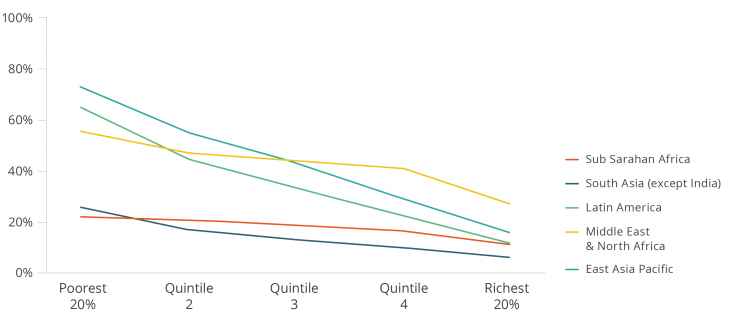
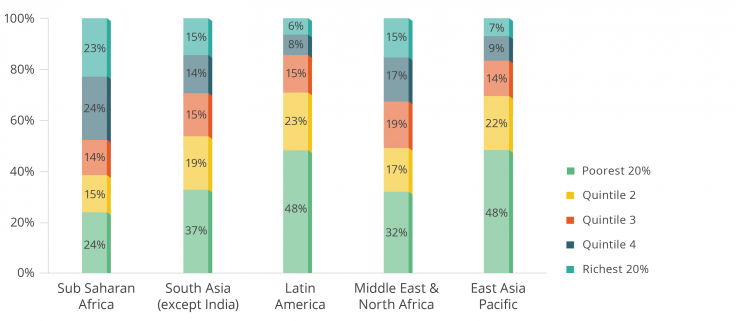
But the most vulnerable are often left behind. According to the World Bank’s ASPIRE database, only 22 percent of the poorest households in sub-Saharan Africa receive any form of social assistance, and only 24 percent of all expenditure on social assistance reaches the poorest quintile on the continent (see Figures 1 and 2). This implies that 78 percent of the poorest people in sub-Saharan Africa receive no form of social assistance from the government. Further, the poorest and richest quintiles receive similar proportions of social assistance transfers making social assistance programs in sub-Saharan Africa the least progressive compared to other regions (Figures 1 and 2).
Source: Parekh & Bandiera, 2020
Accurate targeting is fundamental to successfully implementing social assistance programs. The benefits of social assistance programs are often aimed to reach the poorest people of the country--as typically measured through a means-test or an income-test--but in reality programs that effectively find these beneficiaries can be extremely hard to design and implement. When people are involved in informal or agricultural jobs, they often lack documentation of their wealth making it difficult to accurately measure or verify the income of potential recipients. This challenge is intensified by the absence of advanced social security or tax records. This lack of information can cause some undeserving beneficiaries to enter the program (what we refer to as “inclusion error”) or leave other vulnerable households outside the safety net (known as "exclusion error”). The inadvertent denial of benefits to legitimate participants can lead to potentially dire consequences for these individuals and can also undermine public support for such programs, as well as other state-led income redistribution systems. To what extent and how can biometric IDs and digital financial services (DFS) address both inclusion and exclusion errors?
Improved data & identification
With limited access to banks and formal financial institutions, administrative data (i.e. routine information collected, used, and stored by governments and other organizations primarily for operational, rather than research purposes) on the wealth and income of households remains lacking for poor populations. The introduction of digital identification (ID) systems and DFS provides an alternate and, possibly more precise, solution to this identification barrier.
Digital ID systems can potentially alleviate this lack of accurate income data by facilitating improved record-keeping and generating administrative data on individuals in the country. Digital financial services enables documentation of a person’s financial transactions that can be used to create indices for eligibility. Further, digital government-to-person (G2P) payments could also provide a trove of data that would be linked through identifying factors to create a more robust dataset on beneficiaries. This would allow programs to leverage data collected by other programs. For example, in Togo a digital cash grant targeted to households in the informal sector (Novissi) used the voter ID database—from February 2020 presidential elections—which contained precise location and occupation information, to identify beneficiaries. Of course, centralized detailed datasets could also lead to state surveillance and misuse of data if adequate security measures are not in place.
To support the claim that digital IDs improve targeting, a difference-in-differences study in India found that the introduction of a new technology that allowed for the direct deposit of transfers into a beneficiary’s account in a government transfer program reduced leakages to ghost-beneficiaries (i.e. beneficiaries who did not really exist).
Improved monitoring systems
Further, digitization of payments can lead to more effective process monitoring, which enables implementers to make real-time decisions based on incoming data. This is particularly crucial during unexpected shocks, such as the on-going COVID-19 pandemic. Currently, governments are using innovative digital solutions such as satellite imagery and alternative data sources to reach those most affected by the pandemic. The existence of a mature digital payment and ID system could have greatly helped governments respond to the crisis as seen in the above example from Togo. In a context where there is a reliable identification system in place, digital data collection can make policy decision making easier and more responsive to the needs of the people on the ground.
However, the risk of technology failures leading to exclusion of eligible beneficiaries remains if access to biometric IDs is not universal or systems are not well implemented or managed. This could especially be a problem if more vulnerable populations are left out of the ID system. Further, issues around privacy and data misuse remains a major concern when data is collected and held centrally.
What about stateless groups?
Some populations, including refugees, migrants, and other ‘stateless’ groups, may be particularly challenging to reach or may inherently be excluded from specific ID systems on the basis of nationality/citizenship. In such cases, complementary ID systems may be necessary to reach these populations, in order to facilitate access to social services and increase economic integration.
For example, in Kenya, UNHCR has established a biometric database of refugees and asylum seekers that runs parallel to their national registration system. Elsewhere, efforts are in place to introduce regional ID systems that extend beyond national identity. In West Africa, for example, the West Africa Unique Identification for Regional Integration and Inclusion (WURI) program is being piloted in Côte d’Ivoire and Guinea to provide identification to citizens and non-citizens alike, with the goal of reaching vulnerable populations and facilitating access to services at both the country and regional level.
A word of caution
The integration of ID systems with payments is not, however, a fool-proof solution to targeting problems. Collusion to siphon a portion of the transfers could occur due to imbalanced power dynamics. For example, local bureaucrats may establish sharing agreements where a cash transfer is approved in return for a proportion of the transfer.
Collusion could also occur at the central level through state capture or conscious efforts by administrators or the state to exclude beneficiaries from certain groups, particularly if the ID system is linked to voting rights. Empirical evidence of detecting such collusions is limited and there is tremendous scope to explore and document its existence, as well as possible solutions.
Moreover, if beneficiaries are unable to navigate digital G2P payment systems, they may not be able to access their grants even when eligible, as seen in Jharkhand, India. Here, the use of Aadhaar—a digital biometric identification card—as a digital tool to authenticate beneficiaries, reduced the benefits for those who had not registered for an ID. Given that more vulnerable populations are often also those who have less access to knowledge on technology, this could mean the most vulnerable are particularly susceptible to exclusion when shifting to a digital payment mechanism.
What’s next?
The Digital Identification and Finance Initiative (DigiFI) is currently funding projects on various aspects of targeting using digital systems.
- In Malawi, researchers are exploring whether digital IDs can reduce poverty;
- In Kenya, a study is evaluating the inclusion and exclusion effects of linking digital IDs to social protection programs; and
- In Ghana and Kenya, researchers are studying how digital social transfers can help citizens during the COVID-19 pandemic.
You can read more about our research agenda and existing projects. Yet there is an urgent need for more evidence in sub-Saharan Africa on whether digital systems help achieve accurate targeting and efficiency in public programs and whether such systems ensure more equality for hard to reach and/or marginalized citizens. If you are interested in pursuing research on these topics, please reach out to our team at [email protected].
Author’s note: This is the fourth blog in the DigiFI series on the various aspects of their research and policy priorities. The next blogs will explore to what extent digitization can help tackle corruption and other leakages, better incentivize public administrators, and improve take-up.
The Digital Identification and Finance Initiative (DigiFI) is excited to announce a blog series that looks at the various facets of digital identification (ID) and payment systems.
As of 2019, 469 million people across sub-Saharan Africa used mobile money. In 2019 alone, 50 million sub-Saharan Africans created a new mobile-money account, a 12 percent increase from 2018. Across Africa, governments are exploring new ways of digitizing financial services and identification to reform policies. While there is a big push to go digital, our knowledge of its potential impacts are limited, particularly in the African context. These reforms may have transformative impacts for citizens through improved governance and public service delivery. But they also have the power to exclude marginalized groups or violate privacy rights.
The Digital Identification and Finance Initiative (DigiFI) in Africa aims to generate rigorous evidence on the impacts of these technologies for both governments and citizens in sub-Saharan Africa. For example: How should digital identification (ID) systems be designed to maximize benefits while minimizing costs in a specific context? When is it appropriate to link a social protection program to a digital ID system? To what extent can digital ID systems and digital payments reduce leakages and improve targeting of social protection programs? Can digital ID systems and digital payments assist in building incentive systems to motivate public servants? For more information on DigiFI Africa’s research agenda, please see our framing paper.
We are excited to launch a further exploration of these questions in DigiFI Africa’s new blog series. Over two months, this series will unpack key policy questions on digital ID and payments systems while also exploring a subset of the academic literature provided in our framing paper. This series includes posts on:
- The benefits, challenges, and unknown impacts of digital IDs,
- Digitization of government-to-person payments,
- Mobile money and person-to-person payments, and
- Possible barriers to effective public service delivery (e.g. targeting, leakages, incentives, and take-up) and opportunities for digitization to improve these processes, including high frequency process monitoring.
You can read about DigiFI’s ongoing studies. These include, but are not limited to, research on the impacts of linking the national biometric ID system in Kenya to social protection schemes, the relationship between digital IDs and poverty alleviation in Malawi, how digital tax systems can aid revenue collection in Uganda, and the role of digital cash transfers in responding to the COVID-19 pandemic in Ghana and Kenya.
If you’re a policymaker or researcher thinking about the design of a digital financial or ID system or evaluating new reforms in the DigiFI research agenda, we encourage you to get in touch! We can be found on [email protected] and would love to hear from you.
Does universal basic income (UBI) help vulnerable populations respond to large-shocks, such as COVID-19? J-PAL affiliated researchers recently followed up on a 2017 study to assess the program's impact.
COVID-19 and the resulting economic recession have disproportionately affected already vulnerable individuals. Governments across the world have responded with an unprecedented expansion in their social protection programming.
There is also a push towards digital transfers to be able to safely transfer cash while curbing the spread of the disease. While there is evidence on the efficacy of grants during non-pandemic times, we know little about the effect of transfers during large shocks.
For example, during COVID-19, cash grants might prove inadequate in stimulating the supply of goods and services as it is a demand-side intervention. So, are cash transfers helpful in responding to the pandemic? More specifically, to what extent could a pre-existing universal basic income build resilience to future shocks?
J-PAL Africa’s Digital Identification and Finance Initiative (DigiFI) was launched in 2019 to fund innovative research to help answer questions like this. In 2020, we funded follow-up surveys to a 2017 study on universal basic income in Kenya to identify whether the program helped recipients adjust to shocks resulting from the COVID-19 pandemic.
The study: The effects of a universal basic income (UBI) in Kenya
In 2017, Abhijit Banerjee, Michael Faye, Alan Krueger, Paul Niehaus, and Tavneet Suri, in collaboration with Innovation for Poverty Action (IPA) and GiveDirectly, launched a randomized controlled trial in Kenya to test the effectiveness of a UBI in eradicating extreme poverty.
A UBI is a specific form of social protection: an unconditional cash transfer large enough to meet basic needs and delivered to everyone within a community. One of the arguments put forth by advocates of UBI is that the transfers provide a form of insurance against uninsurable or unpredictable risks (read a more extensive discussion of the potential benefits of UBI here).
Responding to the need for rigorous large-scale experimental evidence to support the debate, researchers designed and launched a field experiment evaluating the impacts of UBI in 2017 in Bomet and Siaya counties of Kenya.
Participants in the study were randomly assigned into four groups, three of which received digital cash transfers with varying frequency and size:
- One group received a large lump-sum transfer at the beginning of 2018,
- One group was assigned a smaller long-term transfer scheduled to be received regularly for twelve years,
- One group was assigned a short-term transfer for two years that had largely been concluded prior to the COVID survey, and
- A final group was assigned not to receive any transfer and is the comparison group.
Assessing UBI in light of COVID-19
The COVID-19 pandemic unfortunately served as a unique opportunity to examine to what extent a UBI can mitigate the impact of a large shock.
Against this backdrop, the researchers conducted (and will continue to conduct) phone surveys in May 2020 to measure the effects of the pandemic and how they were mitigated by a UBI. To assess how outcomes in the COVID survey have changed since the onset of the pandemic, they compared this to data from the standard endline survey of households conducted between August and December of 2019.
It is unclear if the positive effects of social protection transfers found during “normal times” (Bastagli et al., 2019) will hold during the pandemic. Concerns around supply chain disruptions may limit the effectiveness of demand-side interventions such as a cash grant. In addition, when examining non-material outcomes such as depression, the negative psychological impacts may have been too great for the cash transfer to have had any meaningful effect.
Results from this project provide some of the first evidence of the impacts of social protection programs during the pandemic.
The UBI led to modest but statistically significant improvements in well-being
Reduced hunger and physical and mental illness
There were modest (though significant) impacts of the UBI on recipients’ personal well-being in all three groups that received cash transfers (lump-sum, long-term transfer, and short-term transfer).
Roughly two-thirds of households (68 percent) that did not receive the UBI experienced hunger. Recipients of the UBI were 4.9–10.8 percentage points less likely to report experiencing hunger during the last thirty days prior to the COVID survey.
Recipients of the UBI were also 8–13 percent less likely to have had a household member sick during the thirty days prior to the May 2020 survey. Given the very low prevalence of the coronavirus in the areas studied at the time of the surveys (twelve cases total), these illnesses were almost certainly not COVID-19 cases.
Finally, recipients were significantly less depressed in the short-term and long-term arm, though not the lump-sum arm.
No harmful impact of UBI on public health and some evidence that it was helpful
Recipients of the UBI were significantly less (10–16 percent) likely to seek medical attention in the last thirty days, as they were less sick. This would have resulted in a decreased burden on hospitals and could have been helpful in freeing up public health system capacity which is vital during the pandemic.
In addition, there is some evidence that the UBI reduced social interactions—such as visiting friends or relatives—which could reduce COVID-19 infections in the future.
Mixed effects on resilience to large aggregate shocks
Regular and long-term transfers are likely to affect investment decisions and hence resilience to large shocks. On one hand, a long-term transfer could allow the individual to buy assets to buffer against any income shocks. On the other hand, the long-term transfer may encourage recipients to increase their exposure to riskier choices, such as starting a business.
It is particularly interesting to compare the impacts of the UBI before and during COVID times to see how beneficiaries coped with the pandemic. An important caveat is that these results could be driven by seasonality and not the pandemic. As the researchers learn more, we will update the results.
-
No effect on incomes: Long-term, regular transfers led to an increase in risk-taking commercial activities. Pre-COVID, beneficiaries had diversified their income streams by creating new non-agricultural enterprises, which resulted in an increase in profits without substantial changes in labor or agricultural earnings.
However, when the pandemic hit these enterprises were not spared and the income gains they witnessed pre-COVID were wiped out but they did not close down.
-
Higher resilience to hunger in the agriculture lean season: The UBI provides households with a safety net and hence a reduced risk of hunger. This allows them to take on more income risk. As discussed above, beneficiaries of the UBI were more likely to not go hungry during the pandemic.
This was also seen prior to the pandemic during the lean season (the season between planting and harvesting), which saw a significant reduction in the number of households who experienced hunger in the UBI transfer group.
However, during the harvest season (August–December 2019), there were no significant differences in hunger between the groups that did and did not receive the transfers.
UBI: Unlikely tool of choice to respond to unanticipated shocks
While access to a UBI prior to and during a large shock improves well-being in the wake of said shock, it is an unlikely choice of tool to respond in such contexts. This is because the income gains from the UBI pre-pandemic are wiped out during the pandemic. This fits well with the theory that a UBI encourages risk-taking by providing a safety net. Hence, it is likely that recipients of a UBI have increased exposure to shocks.
Further, it would likely be more effective to use a targeted response tailored to protect those worst affected by a crisis. This is by no means a criticism of UBI but rather a remark on its appropriateness in different contexts.
Another key message from these results is the importance of supplemental income during large shocks such as the COVID-19 pandemic. These results highlight the need for infrastructure that allows cash grants to be provided universally or to a large proportion of the population in response to unanticipated crises.