Catalyzing new partnerships for gender equality in South Asia
Gender inequality is global and pervasive. Amartya Sen estimates that over 200 million women are “missing” worldwide. Moreover, women and girls experience disproportionate levels of intimate partner violence and economic, political, and social discrimination across the world.
Launched in 2018, J-PAL’s Gender sector addresses these disparities by producing cross-cutting insights on promoting gender equality and women and girls’ empowerment, and on how norms related to gender affect the outcomes of social programs. In South Asia, the Gender sector will identify research gaps, establish an initiative to fund new research, and synthesize and disseminate evidence to a variety of stakeholders including policymakers.
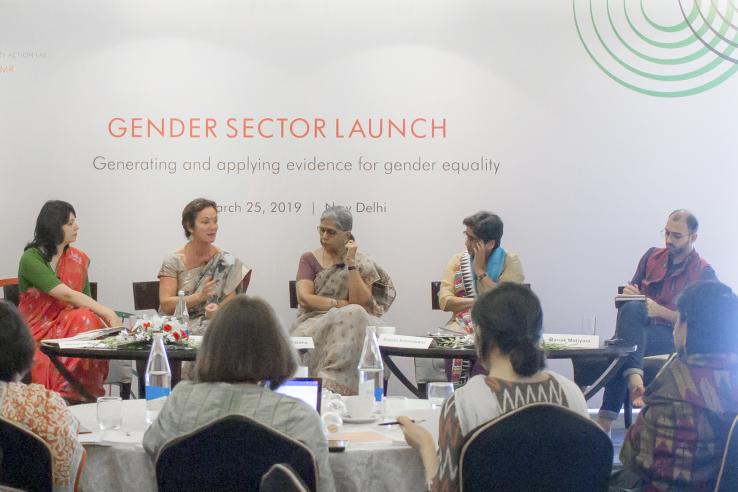
On March 25, 2019, 75 program implementers, evaluators, and donors convened in New Delhi to formally launch J-PAL’s gender sector in South Asia and discuss the current context and future priorities for the sector.
Shagun Sabarwal, Associate Director of Policy and Training, welcomed the audience with an overview of the goals of the J-PAL South Asia office’s gender sector team: to think about gender in an intentional and strategic way, to build on the innovative work already happening in the region on gender equality, and to catalyze new evaluations by establishing a fund for gender research in South Asia.
In the keynote address, Seema Jayachandran (Northwestern University), chair of J-PAL’s gender sector, spoke about the recent evaluation of Breakthrough’s school-based gender attitude change program, and also highlighted J-PAL’s practical guide to measuring women’s and girls’ empowerment.
The first panel of the day, moderated by Shobhini Mukerji, Executive Director of J-PAL South Asia, was titled “What we are measuring, what we are missing.” The session focused on identifying gender-related problems in South Asia and the challenge of measuring certain constructs. Rohini Mukherjee of the Naandi Foundation provided a succinct description of her work on the Teen Age Girls (TAG) report, which presents new information about an underserved group. Seema Jayachandran discussed the role of impact evaluations in building a knowledge base for the gender sector as well as her current work on measuring women’s agency. J-PAL affiliate Sharon Barnhardt (CESS Nuffield - FLAME University) elaborated on her study on better policing in response to intimate partner violence.
Moving from problems to solutions, the second panel, titled “Innovative and Intersectional Programming,” focused on community-oriented approaches to addressing emerging challenges in gender. Shagun Sabarwal moderated this panel, and Meagan Fallone started off the discussion with a powerful description of Barefoot College’s work on gender, with a particular focus on how NGOs can harness technology for progress. Harvinder Palaha described the comprehensive model used by SNEHA to address maternal and newborn health disparities in Mumbai. Manak Matiyani then presented on The YP Foundation’s work, urging the audience to focus on the larger goal of gender-transformative programming—that is, programming which challenges and transforms unequal power structures—and to think beyond commonly used indicators of progress. Sujata Khandekar of CORO concluded with a reflection on the significance of community-led programs in gender, as both innovation and intersectionality are contingent on cultural context.
The closing panel, “Investing in Equality, Empowerment and Agency at Scale,” was moderated by Iqbal Dhaliwal, Executive Director of J-PAL Global, and laid out strategies for investing in new research and programs. Naghma Mulla of Edelgive Foundation explained how the organization identifies innovators and takes chances on small organizations doing excellent work. Navsharan Singh discussed IDRC’s focus on producing knowledge on institutional and structural violence, and making institutions work for women. Mamta Kohli reflected on how DFID uses evidence and data to make the right decisions and improve people’s lives. Yamini Atmavilas of the Gates Foundation spoke about the value of a formal commitment to a sector in mobilizing investment and creating a channel for intentional and meaningful work on gender.
It was a day of incisive discussion and the forging of new partnerships. Participants left thinking about the power of collaboration, the significance of cultural context, and the need to include men and boys in the narrative on gender.
The day ended with a surprise appearance by Abhijit Banerjee, J-PAL co-founder and director, who concluded by reflecting: “Our strength is in being a network where many people can take responsibility. There is value in us coming together and pooling knowledge, and applying the gender lens to existing evidence”
To learn more about the Gender sector’s work in South Asia, contact Shruti Jagirdar ([email protected]) or Moulshri Mohan ([email protected]).
“Do you agree with the statement, “Men are better suited than women to work outside the home”?”
Seema asked parents in India this question as part of a research study to understand how a school-based program designed to change attitudes about gender roles could help reduce gender bias in Haryana, India.
According to recent World Bank estimates, only 27 percent of women in India currently participate in the labor force—a steep ten percentage point decrease from 2005 rates. This large decrease is notable because, according to analysis by J-PAL affiliate Rohini Pande (Harvard) and Charity Troyer Moore, about one-third of women who work primarily in housework would like to have a job but seem to be prevented by traditional gender norms that restrict women’s mobility.
Bringing rigorous evidence to bear in understanding how gender norms affect everyone, in India and around the world, can help inform and improve policy to reduce poverty and gender inequality.
At J-PAL, the launch of a new Gender sector represents our commitment to further expand the base of policy-relevant evidence.
The Gender sector, chaired by Seema, will address a range of issues important to citizens, policymakers, and practitioners around the world: How can we most effectively address gender disparities and inequality at scale? Are existing development programs closing the gender gap in human development? How do gender dynamics in families and society affect the impact of these programs? And how can we best measure changes in areas like agency and empowerment?
In addition to Seema's own research, J-PAL affiliated professors have investigated these and other related questions for many years, conducting more than 130 evaluations that focus on the impacts of programs and policies on women and girls or men and boys. Some examples include:
Lori Beaman (Northwestern University) and co-author Andrew Dillon researched the consequences of targeting agricultural technology information to different parts of social networks among farmers in Mali. They found that, since different types of people are located in different parts of the network, the choice of targeting strategy may leave out the periphery, including women.
Esther Duflo (MIT), Pascaline Dupas (Stanford) and Michael Kremer (Harvard) researched the impact of full, need-based scholarships on secondary school enrollment and the returns to secondary education in Ghana over more than ten years. Women who won full secondary school scholarships married later and delayed childbirth, particularly unwanted pregnancies, relative to women who did not win scholarships.
Rohini Pande (Harvard), Erica Field (Duke), and Simone Schaner (Dartmouth) along with co-authors Natalia Rigol and Charity Troyer Moore, are researching the impact of offering women individual bank accounts on women’s financial control. Linking earnings from a government workfare program (that offered welfare payments in exchange for work) to women’s bank accounts led to increased employment. Women who had previously been the least involved in the labor market and whose husbands expressed the most opposition to women working experienced the largest impacts, suggesting that more control over earnings increased women's influence and agency.
With a new academic chair (Seema) and dedicated policy staff (Lucia), J-PAL’s initial sector efforts will focus on:
1. Identifying open research questions and working with funders, implementing organizations, and J-PAL affiliates to determine opportunities for new randomized evaluations with the potential to generate policy-relevant evidence that promotes gender equality.
While J-PAL’s current grantmaking initiatives already address many questions related to gender, we are exploring opportunities to develop a new grantmaking initiative that will generate new research in the sector, contribute to learning, and provide opportunities for partners and donors to collaborate on testing innovative new approaches.
2. Creating practical tools for policymakers, practitioners, and researchers to better incorporate analysis of gender dynamics and impacts into existing randomized evaluations.
To do this well, researchers need better tools for measuring concepts that are hard to quantify, like empowerment. Stay tuned for a forthcoming practical guide on measuring women’s empowerment in M&E and impact evaluation, co-authored by Rachel Glennerster, Claire Walsh, and Lucia.
3. Continuing J-PAL’s work in gender analysis and sharing these results as public resources on the J-PAL website.
We will focus on understanding the impact of policies and programs in all regions of the world that: 1) specifically seek to empower women and girls; 2) don’t necessarily have gender-specific goals but have different results by gender when impacts are disaggregated; and 3) have program impacts that are mediated by gender dynamics in society.
In the study of the attitude-change program in India, for example, Seema and co-authors found that the changes in attitudes were similar for boys and girls. Yet, behavior changes were larger among boys, perhaps because girls faced more barriers to acting on their changed attitudes. This highlights how, even when programs achieve promising results, social contexts might continue to constrain women and girls’ options and choices differently than those of men and boys.
4. Producing topic-specific and cross-cutting policy lessons.
We already have policy lessons on topics like how to increase girls’ school enrollment and the impact of gender quotas on community decision-making. Moving forward, we will continue producing new policy lessons focused on gender equality. Broadly, this gender analysis can also help us understand the mechanisms behind how and why programs work—and for whom. This work, we hope, will inform future policies and programs. As in other J-PAL sectors, we will build partnerships with governments and implementing organizations to put this evidence into practice.
Since women and girls make up half of the world’s population and face different preferences, constraints, and trade-offs compared to men and boys, J-PAL affiliated professors are continuing to prioritize understanding how development policies interact with gender. With the launch of the Gender sector, we will further this cross-cutting research and work to ensure that policies and programs are informed by evidence.
What are open questions related to gender you’d like to see addressed in randomized evaluations? Let us know on Twitter (@JPAL_Global, @seema_econ) or via email at ldiazmartin[at]povertyactionlab[dot]org.
J-PAL’s newest research resource, A Practical Guide to Measuring Women's and Girls’ Empowerment in Impact Evaluations, gathers insights from the experiences of J-PAL affiliated researchers around the world and offers practical tips for how to measure women's and girls’ empowerment in impact evaluations.
As part of the formative research that my research team and I (Rachel) conducted for a randomized evaluation on adolescent girls’ empowerment in Bangladesh, we interviewed young women about their daily lives, aspirations, and what they wanted to do that they were prohibited from doing. We also interviewed local NGOs and community partners, asking: “What does an empowered girl do differently than a girl who is not empowered?”
Some of the most frequent answers were, “she can go where she likes,” “she can negotiate with her parents,” “she is not the last to eat at home,” and “she thinks differently about what girls can do.” Distilling these rich conversations into a set of indicators that could be measured in a survey questionnaire was not simple or straightforward.
For example, many people we spoke to said that empowered girls had the ability to travel in their communities. Yet, when we talked to girls, we quickly learned that a general question like “how far away from your home can you travel alone?” would not accurately capture how their mobility was constrained, because the answer depended on what they were doing and for whom. Adolescent girls could travel to and from school alone, but they could not travel alone to do things that only had value to them, like going to local fairs.
Since empowerment is about people’s ability to make choices that matter to them, we decided to survey young women about whether they could travel alone to a list of common locations and activities, including some that were for no one’s benefit but the girl herself. Yet, by using a question and indicator that was so locally tailored, we lost the ability to compare our findings with data on women’s mobility in other contexts.
Researchers face many such tradeoffs and challenges in measuring empowerment.
How can we measure women's power to make choices that matter to them when we rarely observe decision-making directly? How can we combine outcomes like education, health, or income with measures of agency like decision-making power or self-efficacy to better measure the process of empowerment? When should we use internationally standardized survey questions and when is it better to develop locally tailored ones? Can non-survey instruments pick up useful information that surveys can’t, and when should we think about using them?
J-PAL’s newest research resource, A Practical Guide to Measuring Women's and Girls’ Empowerment in Impact Evaluations, tackles these questions and more. Gathering insights from diverse disciplines and from the experiences of J-PAL affiliated researchers around the world, the guide offers practical tips for how to measure women's and girls’ empowerment in impact evaluations. It is designed to support the work of monitoring and evaluation practitioners, researchers, and students.
Throughout the guide, we emphasize the importance of conducting in-depth formative research to understand gender dynamics in the specific context before starting an evaluation, developing locally tailored indicators to complement internationally standardized ones, and reducing the potential for reporting bias in our instruments and data collection plan. Some highlights from the guide include:
-
Seven key challenges that evaluators face in measuring women’s empowerment, along with tips for how to address them (pages 7-10).
-
Five different approaches to measuring decision-making power, a key component of empowerment, when we can rarely observe decision-making directly (pages 21-24).
-
Tips for conducting formative research before designing an evaluation to gain a deeper understanding of gender relations and the barriers that women face in a specific context (pages 13-17).
-
Tips for pretesting and piloting survey and non-survey instruments to make sure they make sense to participants and pick up relevant information (pages 37-40).
-
Tips for deciding who collects the data, when and where to interview people, and approaches and technologies that give participants options to answer privately (pages 41-44).
-
A bank of hundreds of survey questions related to women’s empowerment that J-PAL affiliated researchers have used in the past (Appendix 1).
-
A catalog of non-survey instruments that can be useful in measuring women’s empowerment and tips for when and how to use them (Appendix 2).
Recognizing that women's and girls’ aspirations and constraints are deeply tied to their specific context, the guide does not provide a single set of ready-to-go survey instruments for measuring empowerment. Instead, we outline a process for developing indicators appropriate to an individual study along with extensive examples.
In this way, we hope the guide can provide researchers and practitioners the tools to select or develop indicators of empowerment that are right for their impact evaluations.
Sustainable Development Goal 5 provides a rallying call to achieve equality and empowerment for all women and girls. To make progress towards this vision, we need a better understanding of effective policies to empower women and girls. And for that, we need to know how to measure empowerment well.
See more of J-PAL's research resources and learn more about J-PAL’s work supporting gender analysis in impact evaluations.
Some text in this post is excerpted from A Practical Guide to Measuring Women's and Girls' Empowerment in Impact Evaluations. The views expressed here are those of the authors and do not necessarily reflect those of research funders or the UK Department for International Development.
Gender inequality is an issue across all societies and it is particularly challenging in many low-income countries. In India, researchers evaluated the impact of interactive classroom discussions about gender roles and gender discrimination on adolescents’ gender attitudes, aspirations, and behaviors. The program impacted participants’ attitudes and made them more supportive of gender equality. In addition, the program led students, particularly boys, to enact more gender-equitable behavior. These short-run effects were still present two years after the program had ended.
الموضوع الأساسي
Gender inequality is an issue across all societies and it is particularly challenging in low-income countries. Economic development alone seems unlikely to achieve gender equality, as many gender gaps persist despite economic progress. Increasingly, researchers are considering the role of cultural norms in perpetuating gender inequality as research shows that even long-held norms can be changed. Addressing gender norms at an early age may have an impact not only on adolescents throughout their life but also on their parents and future generations. Can interactive classroom discussions about gender roles and gender discrimination change adolescents’ gender attitudes, aspirations, and behaviors?
سياق التقييم
According to the last government census in 2011, the state of Haryana had the most male-skewed sex ratio among all Indian states, with 861 girls for every 1,000 boys. Sparked by the Government of Haryana’s interest in evaluating policies to reduce gender inequality, researchers partnered with Breakthrough, a human rights organization based in India that works to promote social change. Breakthrough designed and implemented a curriculum around promoting gender equality among adolescents.
Breakthrough’s program, titled Taaron ki Toli (Gang of Stars), was centered around classroom discussions about gender equality in secondary schools, with a 45-minute session held every three weeks for two and a half school years. Sessions included interactive classroom discussions on household chores and learning skills like communication. Outside of the classroom, students completed homework assignments, such as writing stories or discussing gender with family members, in addition to activities like optional Breakthrough clubs.
معلومات تفصيلية عن التدخل
In partnership with Breakthrough and the Government of Haryana, researchers evaluated a school-based program to test if adolescents’ gender attitudes, aspirations, and behaviors can change through discussion and persuasion. From a sample of 314 government schools, researchers randomly selected 150 in which to implement the program, while the remaining 164 served as a comparison group. The program began in the 2014-2015 academic year and targeted secondary school students between 11–15 years old, as adolescence is believed to be a critical time for development when students are still forming their own attitudes and are mature enough to reflect on complex issues. Over two and a half years, Breakthrough facilitators conducted 27 45-minute long sessions during the school day.
Researchers surveyed students four to nine months before the program began and one to six months after the program ended. They aggregated survey responses into indices that captured students' gender attitudes, aspirations, and behaviors.
To measure the program’s medium-term impacts, researchers surveyed the students again two years after the program ended, when the students were, on average, 17 years old. In addition, they distributed application forms for a college scholarship program to female participants to determine whether the program increased girls’ aspirations and thus made them more likely to apply for a scholarship. Finally, researchers also informed participants about a petition to end the dowry system, with the names of signatories to be published in the local newspaper, to evaluate whether participants would be willing to publicly support a gender-progressive position.
Researchers are measuring long-term impacts of the program into adulthood. They are surveying the students and their parents five years after the program ended to gather information on participants' education, employment, and marriage status.
See author Seema Jayachandran explain the intervention and results:
النتائج والدروس المستفادة بشأن السياسات
The Breakthrough program made students’ gender attitudes more progressive, or aligned with more gender-equal views. Both boys and girls changed their behavior to be more gender equitable, but girls may have faced greater external constraints to enacting change. These effects persisted two years after the program had ended.
Gender attitudes: A few months after the program ended, students expressed more progressive gender attitudes and continued doing so two years later. In the short term, the program led to a 0.18 standard deviation increase on the gender attitude index, with equal impacts for boys and girls. To put this in context, students who initially held gender discriminatory attitudes changed their views to be more gender-equal in 16 percent of cases. The largest impacts were on attitudes towards employment, gender roles, and education. Two years after the program, there continued to be an increase in the gender attitudes index of 0.16 standard deviations, indicating that the short-term effects had persisted two years after the program ended.
The program also changed students’ perceptions of social norms about women’s employment. Students’ perception that others in the community held gender-progressive views related to women’s employment increased by 5.2 percentage points from 34 percent. In the medium term, participants continued to view the community as more supportive of female employment, but there was no longer an effect on perceived norms about female education.
Despite these impacts on attitudes, boys and girls were no more likely to sign a public petition to end the dowry system two years after the program ended.
Aspirations: The program had no impact on girls’ reported educational and professional aspirations in the short term or medium term. This may have been because girls’ aspirations, as measured in the surveys, were already high and comparable to boys before the program. However, in the medium term, girls were 3.1 percentage points (or 8 percent) more likely to apply to the college scholarship, indicating a change in their educational intentions.
Gender-equitable behaviors: As a result of the program, participants’ behavior became more aligned with gender-progressive norms by 0.20 standard deviations in the short term. This effect was greater for boys than girls: a 0.26 standard deviation increase for boys compared to 0.14 for girls. In practice, this meant that boys reported doing more household chores, while girls did not reduce their number of chores, for example. These results suggest that although both boys and girls changed their behavior, girls may have faced greater external constraints to enacting change. Participants continued to exhibit more gender-equitable behaviors two years after the program ended, with a 0.23 standard deviation increase on the gender-equitable behaviors index. Even in the medium term, the impact on behavior was more pronounced for boys than girls.
These results suggest that programs that attempt to directly shape individuals’ gender attitudes can make adolescents’ attitudes and, in turn their behavior, more gender-progressive. They also highlight the importance of including boys and men in programs aimed at altering gender norms, given that boys and men might have more freedom to act on their gender-progressive views.