Image

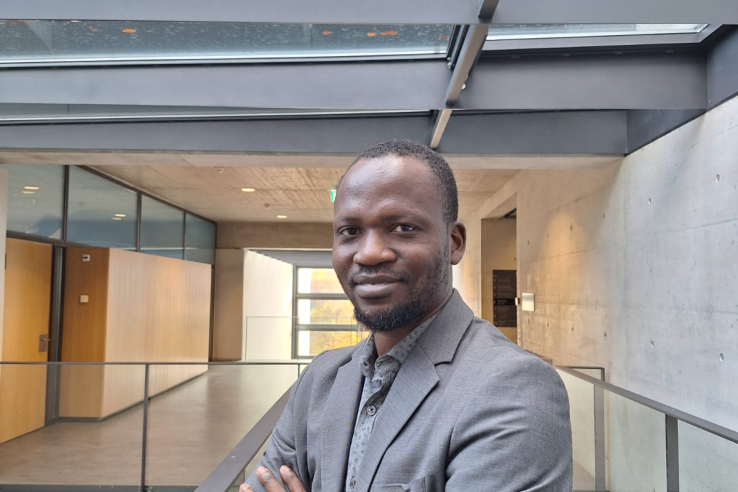
This post is part of our ongoing series showcasing the work and perspectives of economists from the African continent who are leading randomized evaluations. Through our African Scholars Program, we create opportunities for African researchers to advance the research agenda on the continent through randomized evaluations. In this spotlight, we speak with Dr. Gildas Magbondé of the University of Cape Town.
What drew you into the field of development economics and in particular, working with impact evaluations?
My interest in development economics is deeply shaped by my lived experience. As a child, I witnessed my grandparents’ struggles with serious health problems, worsened by the absence of health insurance and the limited availability of medical facilities. Their situation as poor and uneducated farmers exposed me early on to the broader structural challenges faced by vulnerable rural households.
Later, during the presidential election in Benin in 2006, pre-election debates centred on issues such as democracy, constitutional reform, unemployment, public debt, and economic growth, revealing that to truly understand politics, one must grasp the principles of political economy.
Guided by this conviction, I pursued studies in economics and political science, eventually becoming an economist. I soon recognized that I lacked the practical tools needed to design and evaluate effective development policies, which led me to embrace development economics, a field that provides rigorous and impactful instruments to address real-world challenges.
My interest in impact evaluation was sparked by Catherine Guirkinger’s course on the Evaluation of Public Interventions at the University of Namur, Belgium. To deepen my understanding, I undertook additional training through the African Econometric Society, J-PAL Africa, and Economic Research Southern Africa, where I strengthened my skills in both the econometrics of impact evaluation and development project design.
What are your broad research interests?
My research interests span two complementary areas. In macroeconomic analysis, I focus on the drivers and effects of foreign direct investment (FDI) in the Global South—particularly in Africa, with an emphasis on the role of institutions. My research explores how stronger institutions could enable African economies to better harness inward FDI flows, technological transfer, and long-term economic growth.
As a microeconomic analyst, I am interested in the wellbeing of rural households. My research examines how the expansion of basic services, particularly water and electricity, both grid and off-grid, affects household welfare, with a special focus on women in rural settings. I also study in education and employment, exploring pathways to enhance children’s learning outcomes and promote youth employment opportunities.
What are you using J-PAL initiative funds to do? What research questions are you trying to answer?
I am using the J-PAL initiative funds for two projects in Benin. I received funding from the Jobs and Opportunity initiative to pilot an intervention titled “Leveraging Soft Skills and Job Placement to Unravel the Myth of Youth Unemployment: A Field Experiment from Benin,” which tests whether combining soft skills training with job placement assistance produces greater impacts on youth labor market outcomes than either program alone. The findings may also highlight the need to incorporate soft skills training into tertiary education curricula, ensuring a smoother transition from university to the workforce.
I also received funding from the Learning for All initiative for a proposal development grant for the project titled “Can Optimal Teacher Oversight Improve Pupils’ Learning Outcomes? Empirical Evidence from a Field Experiment in Benin.” Existing evidence suggests that school and class inspections can enhance teachers’ pedagogical skills, improve classroom management, and boost students’ learning outcomes. However, given the stress that inspections can impose, they may also have unintended negative effects on pupils. Through this exploratory phase, I aim to gather information on school inspection practices, which will inform the design of a subsequent intervention, ultimately enabling me to propose an optimal class inspection policy for Benin.
What do you see are the big unanswered research questions that RCTs may be able to help answer? Does this relate to any projects you are excited to work on in the future?
I believe Africa holds immense untapped opportunities for growth and social progress. I see randomized controlled trials as a tool for designing effective policies to identify solutions to address Africa’s challenges.
There remain many unanswered research questions regarding labor markets in most African countries. African youth face unprecedented unemployment and limited opportunities, often forcing them either to struggle under difficult conditions or to seek prospects abroad. RCTs can play a crucial role in designing and evaluating both active and passive labor market policies.
Finally, as evidence highlights technology as a critical driver of economic growth and shared prosperity, attention must be directed toward medium and small enterprises, which are often the backbone of local economies. RCTs can play a significant role in identifying the most effective interventions to promote technological adoption, enhance productivity, and support inclusive growth.
By rigorously testing policies and programs in these firms, we can generate actionable insights that help policymakers design strategies to stimulate innovation, create jobs, and foster sustainable development across Africa.
How can organizations like J-PAL continue to build on the support they provide to local researchers in running randomized evaluations?
J-PAL has made significant contributions by building the capacity of young scholars through targeted training programs and, importantly, by providing initiative funds that enable projects to progress from early-stage development to full-scale RCTs in developing countries. However, there is still significant room to deepen and localize capacity, particularly when it comes to strengthening the research-to-policy pipeline.
I think there’s an opportunity for J-PAL to help enhance local African researchers' capacity in policy communication and evidence translation, necessary for effective engagement with ministries and NGOs. Second, it would be useful to have local policy fellowships where African researchers spend time embedded in government departments and co-designing RCTs that address national priorities.
What advice would you give to scholars who are considering applying to J-PAL for funding?
Earning a place as a J-PAL Scholar requires effort and unwavering commitment. First, be inquisitive. Aspiring scholars should cultivate a deep curiosity about how impact evaluation works and develop a solid understanding of policy evaluation.
Second, be ambitious and think critically and creatively. When developing your proposal, focus on addressing a policy-relevant question with an innovative approach. Draw inspiration from careful reading, observation, lived experiences, and active engagement with policymakers. These interactions can help uncover real-world policy challenges that lend themselves to rigorous evaluation.
Finally, be flexible. J-PAL offers three main grant funding opportunities, for proposal development, pilots, and full RCTs. You do not need to begin with a full-scale RCT. Securing a proposal development grant is an excellent starting point, especially if your research idea is still in its formative stage. This grant has two key advantages for emerging researchers: it helps establish partnerships with implementing organizations, and it allows you to gain a deeper understanding of the policy issue you aim to address.
What surprised you the most about how the funding process works?
I was surprised by how much time and coordination (within my team and between my team, implementing partners, and reviewers) went into the grants I had applied to. Between refining proposals, adjusting budgets, and responding to reviewers’ feedback, the process was quite demanding. But it is also a valuable exercise in project design and communication.
What also struck me is how much the funding process values clarity of purpose and feasibility over purely academic merit. A strong research idea alone is not enough; reviewers look for a clear implementation plan, realistic budgeting, and measurable outcomes. This helped me realize that securing J-PAL funding is as much about communicating the “how” and “why now” as it is about the intellectual contribution.
Do you have advice to offer other young aspiring African scholars thinking about a career in economic research?
My advice to young aspiring African scholars is to approach a career in economic research with passion, dedication, and a commitment to building capacity. Economic research is not just about mastering technical tools; it's about curiosity, persistence, and the desire to generate evidence that can shape better policies for our societies.
I encourage scholars to invest in strong analytical and communication skills, seek mentorship, and take advantage of collaborative research opportunities, both within Africa and beyond. Most importantly, they should believe that rigorous, locally grounded research has the power to influence change and improve lives across the continent.