The hidden cost of menstrual stigma on learning, and the evidence on what works
May 28 marks Menstrual Hygiene Day, an annual reminder to governments, NGOs, and communities to confront the barriers that still surround menstruation like limited access to products, inadequate sanitation facilities, and a lack of basic information. But one of the most persistent barriers girls face is invisible: the silence and shame that surround menstruation. Menstrual stigma undermines girls’ confidence, deepens their social isolation, and takes a toll on their education, health, and overall well-being.
It is also, we are learning, something that can be measurably reduced with thoughtfully designed interventions. In Madagascar, a team of researchers found that addressing menstrual stigma in schools improved girls' grades, test scores, and well-being. The results were strong enough to turn the evidence into policy and formed the basis for a formal collaboration between J-PAL Africa, its affiliated researchers, and the Ministry of Education to explore the scaling up of this program across more regions of the country.
The program, designed and implemented by CARE, is called KILONGA. It started in the Amoron’i Mania region of Madagascar in 2021 and sheds light on how menstrual stigma can affect girls’ daily experiences at school. In many communities in this region, menstruation remains a taboo subject, something that is rarely discussed openly. Before the project started, 39 percent of the girls surveyed believed menstruation should not be discussed openly, contributing to widespread gaps in girls’ understanding of menstruation, its management and their menstrual health. They may feel embarrassed, isolated, or anxious when they begin menstruating, particularly at school where such stigma can sometimes create a stressful learning environment for girls.
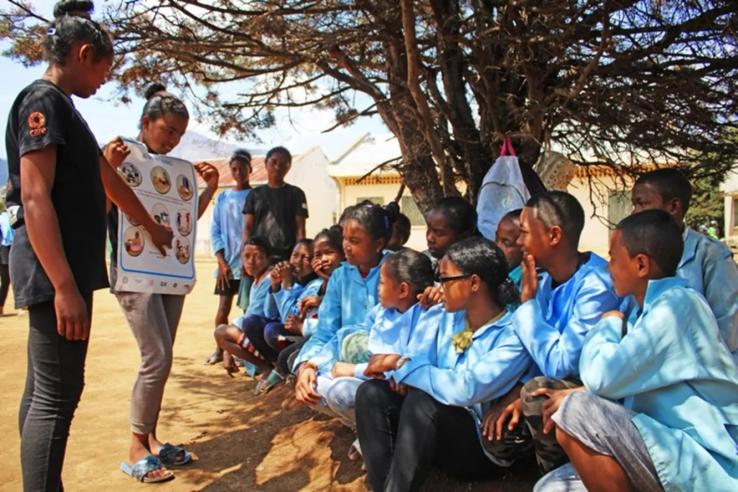
The KILONGA program was designed around an important insight: menstrual stigma is a shared social norm, not a problem any girl can solve on her own. So, rather than targeting girls in isolation, the program engaged the entire school community. Teachers were trained to deliver menstrual hygiene education; WASH (water, sanitation, and hygiene) committees involving parents were created; sanitation facilities were improved; local seamstresses were mobilized to produce reusable sanitary pads, and girls received vouchers to acquire the pads.
It also has a peer-to-peer sensitization component, through an innovative “Young Girl Leaders” approach that drew on the idea of positive deviance: that change often spreads through individuals who challenge harmful social norms. KILONGA identified the girls willing to talk openly about menstruation despite the stigma and supported them to lead and influence their peers. Across all these components, the goal was to create a safer and more supportive school environment for girls by improving knowledge, strengthening WASH practices and behaviors, reducing stress, and enabling girls to speak more openly about menstruation.
The evaluation found that the program's reach went beyond attitudes. Results show that girls' education outcomes improved, with grade progression rates rising from 51 to sixty percent, as did their well-being, with lower stress and greater social cohesion at school. In other words, reducing menstrual stigma was not a peripheral addition to academic programming; it was part of what helped girls learn. These findings reinforce a broader lesson, that the psychosocial environment in schools matters for learning, and addressing menstrual stigma is one practical way to improve girls' education.
Since 2024, we have been working with CARE and the Ministry of Education to translate these findings into policy and practice. This collaboration has included dissemination events, technical discussions with Ministry stakeholders, training sessions on evaluation, and the signing of a Memorandum of Understanding that lays the foundation for scaling up KILONGA in Madagascar.
The goal now is to reach more girls, particularly in rural secondary schools, so that menstruation no longer acts a barrier to learning and participation.
About KILONGA
KILONGA is a school-based program in Madagascar that addresses menstrual stigma as a barrier to girls' education. The program was implemented by CARE and ran as a joint partnership with J-PAL, whose affiliated researchers Karen Macours and Duncan Webb evaluated it with the support of FID and Madagascar's Ministry of Education, with whom the partners are now working to extend it to more schools. The evaluation found improvements in girls' education outcomes and well-being.
For more information, please contact Yvan Andriameva Assany at [email protected].