

Encouraging Covid-19 preventive behaviors via celebrity messages
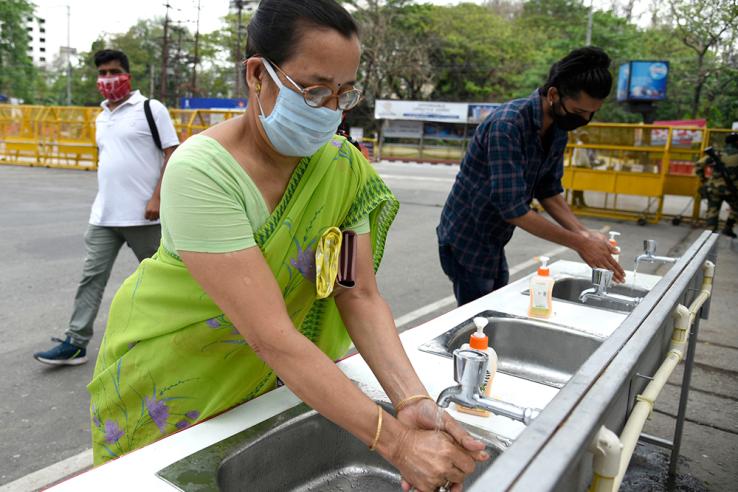
During widespread health crises, people can feel bombarded by public health messages from multiple sources and may not know whom to trust or how to act. At the outset of the Covid-19 pandemic, J-PAL affiliated researchers partnered with the state government of West Bengal, India to test whether health messaging delivered by a well-known public figure could drive behavior change more effectively than standard government communications. In a large randomized evaluation, inspired by previous research in Indonesia, people who received a video via text message from a trusted figure were more likely to stay home, wash their hands, and report symptoms than those who received a link to the government's Covid-19 website. Based on these results, the government expanded the program to reach a total of 32 million people.
The Problem
Healthy behaviors and knowledge about disease symptoms are vital for preventing diseases from spreading. But it is challenging to get people who are overwhelmed by public health messages to absorb and act on public health guidance.
At the outset of the Covid-19 pandemic, governments faced the need to rapidly inform their populations about the new disease and how to limit its spread. Policymakers sought to increase hygienic behaviors, such as handwashing, social distancing, and mask-wearing.1 In the absence of widespread testing, they also needed to rapidly put in place an effective system for reporting Covid-19 symptoms.
In West Bengal, India in 2020, the state government wanted to inform its 91.3 million citizens about the illness and how to contain it. Throughout India, messages about distancing and hygiene were shared on television, radio, public signs, local government notifications, and even a short jingle accompanying outgoing mobile phone calls.
Yet absorbing and acting on a flood of information can be challenging. A survey in West Bengal found that over the course of two days, citizens reported hearing about mask-wearing 17 times, social distancing 20 times, and handwashing 17 times.2 Despite widespread messaging and a nationwide lockdown, many were still not following the guidance: 37 percent of respondents left their village at least once every two days and 32 percent did not wash their hands upon returning home.
The Research
J-PAL affiliates drew from previous research to advise the government of West Bengal on designing a celebrity messaging campaign to encourage healthy behaviors during Covid-19.
At the start of the pandemic, the West Bengal government invited J-PAL’s Director Abhijit Banerjee (MIT), who is originally from West Bengal, to lead the newly-formed Global Advisory Board for Covid-19 Response Policy. Abhijit invited a team of J-PAL affiliates to help the government respond to the crisis.
Abhijit, Marcella Alsan (Stanford University), Emily Breza (Harvard University), Arun Chandrasekhar (Stanford University), Esther Duflo (MIT), and Benjamin Olken (MIT), together with Paul Goldsmith-Pinkham and Abhijit Chowdhury, designed an intervention informed by previous research from Indonesia on encouraging healthy behaviors.
From 2015 to 2016, Arun and Ben, together with Vivi Alatas, Markus Mobius, and Cindy Paladines, conducted a randomized evaluation in Indonesia to test the impact of celebrity Twitter endorsements for a child immunization campaign on the public’s opinion and behavior about vaccines.
They found that celebrity endorsements increased engagement with the immunization campaign, especially when celebrities shared messages in their own voice, without directly citing public health sources. The celebrity endorsement of the campaign led to increased communication and knowledge about health behaviors in individuals’ communities, though there was no impact on an individual’s immunization decisions for their own children.3 For more details, see the evaluation summary.
From Research to Action
A randomized evaluation showed that a text message campaign featuring celebrity video messages increased citizens’ healthy behaviors, motivating the Government of West Bengal to expand it to reach 32 million people with the campaign.
Researchers used the evidence and lessons learned from Indonesia to help the government of West Bengal design a similar program to encourage healthy behaviors during the pandemic. Commitment from the government enabled researchers to quickly design an intervention and implement it at scale.
In May 2020, during a nationwide lockdown, 25 million cell phone users received a text message containing a link to one of eight possible 2.5-minute video clips featuring Abhijit, who had received widespread local media coverage due to his research in India and recent Nobel Prize win.
While all eight video messages encouraged viewers to report symptoms to a community health worker, they varied in their content and framing. Each emphasized one healthy behavior (social distancing or handwashing) and one motivation for action (effects on everyone or just on oneself). Some also included a social norm message stating that ostracizing Covid-19 victims is unacceptable and should be reported to the authorities. A separate comparison group of three million people received a text message with a link to the government Covid-19 website, similar to the many such messages they had already received.
People who received a video message from Abhijit were more likely to report a variety of healthy behaviors. Within five days of getting a message, recipients reported more cases of fevers and coughing than the comparison group. They were also 20 percent less likely to travel and washed their hands more often after traveling. The content of the video mattered less than expected: handwashing and social distancing both improved by about the same amount, even when the video specifically targeted one or the other.
These behavioral changes spread through communities. Not only did video recipients adopt healthier habits—their neighbors did too. Non-recipients reduced their travel and close interactions, and washed their hands more frequently, likely because they observed video recipients changing behaviors. For more details on the research, see the evaluation summary.
These findings informed subsequent government communications in West Bengal. The October festival Durga Puja, which typically draws large crowds, posed a significant risk for viral spread. As part of his work on the Covid-19 advisory board, Abhijit recommended replicating the text messaging campaign to prevent mass infections over the holiday.
Given the campaign’s proven efficacy and low cost, the government agreed, partnering with telecom company Airtel to send 7.3 million new cell phone users a video message in October 2020, ahead of the festival.
References
Alatas, Vivi, Arun G. Chandrasekhar, Markus Mobius, Benjamin A. Olken, and Cindy Paladines. 2024. "Do Celebrity Endorsements Matter? A Twitter Experiment Promoting Vaccination in Indonesia." Economic Journal 134, no. 659 (April): 913-933. doi: https://academic.oup.com/ej/article/134/659/913/7455875
Banerjee, Abhijit, Marcella Alsan, Emily Breza, Arun G. Chandrasekhar, Abhijit Chowdury, Esther Duflo, Paul Goldsmith-Pinkham, Benjamin A. Olken. 2024. "Can a Trusted Messanger Change Behavior When Information is Plentiful? Evidence from the First Months of the COVID-19 Pandemic in West Bengal." The Review of Economics and Statistics 1-33. doi: https://doi.org/10.1162/rest_a_01500
Lewnard and Lo, 2020; Prather et al., 2020; Kissler et al., 2020
Banerjee et al., 2024
This study in Indonesia also helped inform an evaluation in the United States, testing whether a Facebook ad campaign would impact preventive health behaviors and Covid-19 infection rates. https://www.povertyactionlab.org/case-study/communicating-covid-19-messages-scale-social-media