

Using machine learning and mobile phone data to improve the speed and cost-effectiveness of social protection
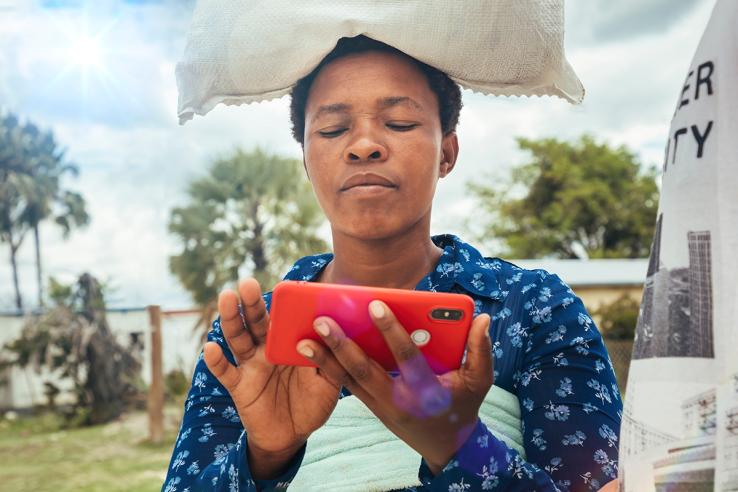
During the Covid-19 pandemic, when many governments lacked up-to-date data to identify those in need, J-PAL affiliates partnered with the Togolese government to use machine learning to target emergency cash transfers. Trained on survey, satellite, and mobile phone data to predict wealth, the approach helped identify and enroll 138,500 vulnerable recipients for emergency cash transfers, improving food security and mental health. Evidence suggests this “digital targeting” method is highly cost-effective. The model has since been adapted in Malawi, Bangladesh, and the DRC, accelerating delivery and reducing costs relative to traditional approaches.
The Problem
Without up-to-date census data, governments struggle to quickly identify vulnerable households to provide them with targeted social assistance.
The Covid-19 pandemic pushed an estimated 150 million people into extreme poverty. 1 To address the sharp decline in living standards and high food insecurity that followed, governments around the world turned to social assistance programs targeting the worst-affected households. Cash transfers are a common form of social assistance, often used by governments to provide direct payments to households during crises.
Traditional cash transfer programs identify households to target by using income and wealth measures from household surveys, social registry, or administrative data. However, these measures are costly to collect and slow to update, and many governments rely on databases that are five to eight years old. As this data becomes less accurate over time, governments face significant gaps in their ability to respond quickly during emergencies.23
Prior to the pandemic, poverty in Togo was already widespread, with 44 percent of the population living below the national poverty line and nearly 59 percent in rural areas.4 When the pandemic hit, the government launched the “Novissi” (“solidarity” in Ewe) cash transfer scheme in April 2020.
With mobile phone access reaching 85 percent of households,5 Novissi used mobile money infrastructure to send monthly cash transfers to vulnerable individuals and families, enabling quick and low-contact distribution of aid. Building a new social registry to identify recipients would have been costly and time-consuming. Instead, the initial phase of Novissi targeted self-identified informal workers in the Greater Lomé region (which includes Togo’s capital and largest city).6 Between April and September 2020, US$22 million in mobile money (US$20–22 per month) was transferred to 600,000 informal urban workers.7
Since extreme poverty is most severe in Togo’s rural areas, the government decided to expand the program beyond the Greater Lomé region. Due to budget constraints, the government wanted to focus on the least well-off individuals within the poorest cantons (of which there are 397 in the country). However, they didn’t have household-level data, making precise targeting challenging.8
The Research
Researchers used a machine learning approach and combined satellite imagery, mobile phone data and traditional surveys to target vulnerable households in Togo. This was a rapid and cost-effective way to target cash transfers when up-to-date census data was unavailable.
The Togolese government partnered with J-PAL affiliated researchers to identify new targeting approaches. J-PAL affiliates Joshua Blumenstock (University of California, Berkeley), Dean Karlan (Northwestern University), and Christopher Udry (Northwestern University), together with Emily Aiken and Suzanne Bellue, tested an approach that combined traditional survey data with newer data sources like satellite imagery and mobile phone records to improve targeting. This built on Aiken and Blumenstock’s previous research, which showed that this combined method identified ultra-poor households more accurately than relying on a single data source.9
With funding support from J-PAL’s Innovation in Government Initiative (IGI), researchers designed a strategy to identify the poorest 10 percent of households in the poorest 100 cantons to distribute US$4 million in cash transfers, funded by GiveDirectly.
Researchers implemented a two-step machine-learning method. First, using data from a nationally representative survey, they trained a deep-learning model on high-resolution satellite images to estimate wealth for very small geographic areas (about 2.4 square kilometers). This allowed them to distinguish poorer from wealthier cantons using visible features such as roofing materials, roads, and terrain.
Second, with support from the World Bank, they conducted a nationally representative phone survey on living conditions, and linked responses to anonymized mobile phone records, such as call patterns and airtime purchases. This data was used to train an algorithm that predicted consumption for all mobile subscribers and identified the most vulnerable 57,000 households within the poorest cantons.
Compared with a simple geographic “blanketing” approach—where all households in selected villages receive benefits—the machine learning approach reduced exclusion errors (people inaccurately excluded from cash transfers) by 4–21 percent. (This estimate comes from comparing exclusion error rates using survey data to identify poor households.)
Further, the approach did not unfairly disadvantage women or any ethnic, religious, or age group. However, researchers noted that the Novissi mobile transfers would miss households without a mobile phone (roughly 15 percent of households), and that more traditional methods (like proxy means tests or community targeting) may perform better when more time and data are available.
In a subsequent follow-up study that used data from four developing countries, researchers found that call and text metadata were more effective at estimating more stable measures of poverty (such as asset-based wealth) than more dynamic outcomes like food security and mental health, helping explain why this approach performed well for targeting poor households.10
Researchers also highlighted an important tradeoff: Traditional household surveys tend to be more accurate for targeting smaller-scale programs, but for large programs that need to screen many people quickly, phone-based targeting offers a more cost-effective alternative. Once a prediction model is developed, assessing more people using mobile data costs very little. This allows governments with limited budgets—often around US$10–50 per household screened—to direct a greater share of resources towards the cash transfers themselves.11
Taken together, the results suggest that the machine learning approach is a rapid and cost-effective way to target aid in the absence of up-to-date and detailed household surveys. At the same time, researchers note that it should complement, not replace, traditional targeting methods when sufficient data and more time are available.
Beyond targeting performance, evidence from the Novissi program shows that these transfers improved key measures of well-being. Recipients experienced gains in food security, mental health, and self-perceived economic status, with positive effects across a broader welfare index, indicating the program effectively reached vulnerable households.12
See more information about this research and GiveDirectly's case study.
This was not just an operational success—it was a systems innovation. It showed that a data-driven, government-led urban safety net is possible.
GiveDirectly on the Malawi expansion
From Research to Action
Governments and GiveDirectly have adapted machine-learning-assisted and digital targeting approaches informed by this research to support emergency cash transfer programs reaching more than 300,000 vulnerable households and individuals worldwide.
Based on evidence that machine-learning-assisted targeting could improve the accuracy and speed of beneficiary identification during large-scale crises, the government of Togo and GiveDirectly used the approach to support the rural expansion of the Novissi cash transfer program. The system helped identify and enroll more than 138,500 vulnerable recipients across the country’s poorest cantons. The broader emergency response distributed approximately US$32 million in transfers and reached roughly 820,000 people nationwide. Over three phases, the Novissi program registered approximately 1.6 million individuals,13 with earlier urban phases primarily relied on voter registration data and later rural expansion phases incorporated machine-learning-based targeting. Novissi also helped increase national mobile money penetration by seven percent, creating more than 170,000 new mobile money accounts.
The platform is now a central building block of the World Bank’s US$29 million Safety Nets and Basic Services Project, a national initiative to build a permanent social protection system and expand access to basic services.
Building on Togo’s success, GiveDirectly adapted digital targeting to respond to urban emergencies globally, often partnering with the original research team to test and refine the model as it scaled. While the core approach of combining mobile phone data, satellite imagery, and survey data remained, the team adjusted it based on local data availability and program needs.
In a 2025 pilot in Mzuzu, Malawi, digital targeting reduced aid delivery timelines from nine months to just 3.5 months and lowered operational costs by 40 percent. With a US$1.5 million budget, the pilot reached 12,800 low-income households and provided emergency support during the agricultural lean season. In Bangladesh, GiveDirectly used the same approach to target transfers to 22,000 low-income households in host communities affected by the Rohingya refugee crisis.14
Digital targeting approaches have also been adapted in fragile settings. In the Democratic Republic of the Congo, the government-led STEP-KIN emergency cash transfer program used a broader digital-first targeting and delivery system to support approximately 280,000 direct beneficiaries.15 As part of this effort, GiveDirectly used its MobileAid platform and related digital targeting tools to support transfers to approximately 50,000 recipients. As of mid-2022, the broader program had disbursed US$41 million. In Nigeria, high-resolution poverty maps were used to geographically target emergency transfers to one million recipients.
Researchers have now applied similar machine-learning methods to satellite and connectivity data to generate high-resolution wealth estimates for all 135 low- and middle-income countries.16 These global poverty maps lay the groundwork for faster, more cost-effective targeting of social assistance in response to floods, droughts, and other humanitarian crises.
The next frontier is moving from static snapshots of poverty to systems that can detect changes in people’s economic conditions in near real time, which could enable more adaptive and responsive social protection.
Emily Aiken
References
Aiken, Emily, Suzanne Bellue, Dean Karlan, Chris Udry, and Joshua E. Blumenstock. "Machine learning and phone data can improve targeting of humanitarian aid." Nature 603, no. 7903 (2022): 864-870.
Aiken, Emily, Anik Ashraf, Joshua Blumenstock, Raymond Guiteras, and Ahmed Mushfiq Mobarak. 2025. “Scalable Targeting of Social Protection: When Do Algorithms Out-Perform Surveys and Community Knowledge?” NBER Working Paper Series No. 33919 (June).
Aiken, Emily, Anik Ashraf, Joshua Blumenstock, Raymond Guiteras, and Ahmed Mushfiq Mobarak. 2025. “Scalable Targeting of Social Protection: When Do Algorithms Out-Perform Surveys and Community Knowledge?” NBER Working Paper No. 33919 (June). https://doi.org/10.3386/w33919
Aiken, Emily L., Guadalupe Bedoya, Joshua E. Blumenstock, and Aidan Coville. 2023. “Program Targeting With Machine Learning and Mobile Phone Data: Evidence From an Anti-Poverty Intervention in Afghanistan.” Journal of Development Economics 161 (March): 103016. doi: https://doi.org/10.1016/j.jdeveco.2022.103016.
Aiken, Emily, Suzanne Bellue, Joshua E. Blumenstock, Dean Karlan, and Chris Udry. 2022. “Machine Learning and Phone Data Can Improve Targeting of Humanitarian Aid.” Nature 603, no. 7903 (March): 864–870. doi: https://doi.org/10.1038/s41586-022-04484-9.
Aiken, Emily, Suzanne Bellue, Joshua E. Blumenstock, Dean Karlan, and Christopher Udry. 2025. “Estimating Impact With Surveys Versus Digital Traces: Evidence From Randomized Cash Transfers in Togo.” Journal of Development Economics 175 (May): 103477. doi: https://doi.org/10.1016/j.jdeveco.2025.103477.
Aiken, Emily, Joshua E. Blumenstock, Sveta Milusheva, and M. Merritt Smith. 2026. “Predicting Well-Being With Mobile Phone Data: Evidence From Four Countries.” AEA Papers and Proceedings 116 (May).
Aiken, Emily, Joshua Blumenstock, and Tim Ohlenburg. 2023. “Moving Targets: When Does a Poverty Prediction Model Need to Be Updated?” Proceedings of the 6th ACM SIGCAS/SIGCHI Conference on Computing and Sustainable Societies (August): 117–117.
Blumenstock, Joshua, Gabriel Cadamuro, and Robert On. 2015. “Predicting Poverty and Wealth From Mobile Phone Metadata.” Science 350, no. 6264 (November): 1073–1076. doi: 10.1126/science.aac4420.
Blumenstock, Joshua E. and Isabella S. Smythe. 2022. “Geographic Microtargeting of Social Assistance With High-Resolution Poverty Maps.” Proceedings of the National Academy of Sciences 119, no. 32 (August): e2120025119. doi: https://doi.org/10.1073/pnas.2120025119.
Lakner, Christoph, Nishant Yonzan, Daniel Gerszon Mahler, R. Andres Castaneda Aguilar, and Haoyu Wu. “Updated Estimates of the Impact of COVID-19 on Global Poverty: Looking Back at 2020 and the Outlook for 2021.” World Bank, January 11, 2021.
Aiken, Emily, Joshua Blumenstock, and Tim Ohlenburg. 2023. “Moving Targets: When Does a Poverty Prediction Model Need to Be Updated?” Proceedings of the 6th ACM SIGCAS/SIGCHI Conference on Computing and Sustainable Societies (August): 117–117.
To learn more about targeting approaches before and during the pandemic, see this J-PAL blog post.
World Bank. “Togo – Poverty and Inequality Platform.” World Bank, 2021. https://pip.worldbank.org/country-profiles/TGO
Marchenko, Anya, and Han Sheng Chia. “How MobileAid & Machine Learning-Based Targeting Can Complement Existing Social Protection Programs.” The Center for Effective Global Action (CEGA), April 13, 2021.
These workers were identified through a voter database last updated in late 2019 in which voters self-identified as employed in the informal sector.
Gharib, Malaka. “The Pandemic Pushed This Farmer Into Deep Poverty. Then Something Amazing Happened.” NPR, February 15, 2021
There are five regions with populations ranging from 620,000 to 2.6 million.
Aiken, Emily L., Guadalupe Bedoya, Joshua E. Blumenstock, and Aidan Coville. 2023. “Program Targeting With Machine Learning and Mobile Phone Data: Evidence From an Anti-Poverty Intervention in Afghanistan.” Journal of Development Economics 161 (March): 103016. doi: https://doi.org/10.1016/j.jdeveco.2022.103016.
Aiken, Emily, Joshua E. Blumenstock, Sveta Milusheva, and M. Merritt Smith. 2026. “Predicting Well-Being With Mobile Phone Data: Evidence From Four Countries.” AEA Papers and Proceedings 116 (May)
Aiken, Emily, Suzanne Bellue, Joshua E. Blumenstock, Dean Karlan, and Christopher Udry. 2025. “Estimating Impact With Surveys Versus Digital Traces: Evidence From Randomized Cash Transfers in Togo.” Journal of Development Economics 175 (May): 103477. doi: https://doi.org/10.1016/j.jdeveco.2025.103477
Aiken, Emily, Anik Ashraf, Joshua Blumenstock, Raymond Guiteras, and Ahmed Mushfiq Mobarak. 2025. “Scalable Targeting of Social Protection: When Do Algorithms Out-Perform Surveys and Community Knowledge?” NBER Working Paper No. 33919 (June).
Aiken, Emily, Suzanne Bellue, Joshua E. Blumenstock, Dean Karlan, and Christopher Udry. 2025. “Estimating Impact With Surveys Versus Digital Traces: Evidence From Randomized Cash Transfers in Togo.” NBER Working Paper No. 31751
The 1.6 million figure reflects total registrants across all phases of Novissi, while approximately 820,000 individuals ultimately received transfers. Initial urban phases relied primarily on voter registration data, while later rural expansion phases incorporated machine-learning-based targeting
Aiken, Emily, Anik Ashraf, Joshua Blumenstock, Raymond Guiteras, and Ahmed Mushfiq Mobarak. 2025. “Scalable Targeting of Social Protection: When Do Algorithms Out-Perform Surveys and Community Knowledge?” NBER Working Paper Series No. 33919 (June)
STEP-KIN is a government-led emergency cash transfer program implemented by the DRC Social Fund with support from World Bank and GiveDirectly. Mukherjee, Anit, Laura Bermeo, Yuko Okamura, Jimmy Vulembera, and Paul Bance. 2023. “Digital-First Approach to Emergency Cash Transfers: STEP-KIN in the Democratic Republic of Congo.” World Bank Social Protection & Jobs Discussion Paper No. 2302.
Smythe, Isabella S. and Joshua E. Blumenstock. 2022. “Geographic Microtargeting of Social Assistance With High-Resolution Poverty Maps.” Proceedings of the National Academy of Sciences 119 (32).