

Developing Students’ Holistic Skills Through Theater-Based Learning in India
- Children
- Secondary schools
- Students
- Enrollment and attendance
- Student learning
- Self-esteem/self-efficacy
- Aspirations
- Gender attitudes and norms
- Cognitive development
- Mental health
- Socio-emotional development
- Soft skills
- Soft skills
- Pedagogical innovation




National education policies increasingly emphasize critical thinking over rote learning amid growing evidence that these “holistic skills” are associated with better life outcomes. However, educators have little evidence on how to teach these skills effectively in schools. Theater-based learning offers one option: a trained teacher or facilitator uses acting, role-play and drama games to help students develop holistic skills by exploring ideas together. In partnership with Rang Kaarwaan, researchers conducted a randomized evaluation to test whether theater-based instruction in secondary school could improve students’ self-efficacy, emotional regulation, empathy, time management, critical thinking, and other holistic skills in India.
Policy issue
In 2020, India released a new national education policy that directed schools to move away from rote learning and toward a more holistic education. “Holistic skills” often include critical thinking, creativity, emotional regulation, empathy, communication, and collaboration.1,2 These skills are associated with better life outcomes such as staying in school, retaining a job, earning higher wages, and staying healthy. Despite major policy shifts, there is little evidence on how schools can teach these skills effectively, especially in low-income and resource-constrained settings.
In theater-based pedagogy, trained facilitators use role-play, dialogue, active engagement, and group reflection to build holistic skills, with promising results in policing and domestic violence prevention in India. Secondary schools are a largely untested, critical setting: adolescents form the skills and aspirations that shape their later education and job prospects at a time when depression and anxiety also begin to rise. Can carving out time in the school day for theater-based pedagogy improve secondary school students’ holistic skills, and therefore their classroom engagement and their test scores in academic subjects?
Context of the evaluation
This study takes place in Champawat, a rural district in India where students have limited access to education. Fewer than half of schools are accessible by all-weather roads, and only about 60 percent offer classes through grade 12. By secondary school, ten percent of girls and fifteen percent of boys drop out. Additionally, only 38 percent of girls continue their education beyond 10th grade. As a result, women’s literacy and labor force participation trail behind men’s (68 versus 92 percent and 30 versus 46 percent, respectively).
Parents of the surveyed students also had limited formal schooling: 20 percent of mothers and 14 percent of fathers never attended school, and less than half of students (48 percent) aspired to attend college.
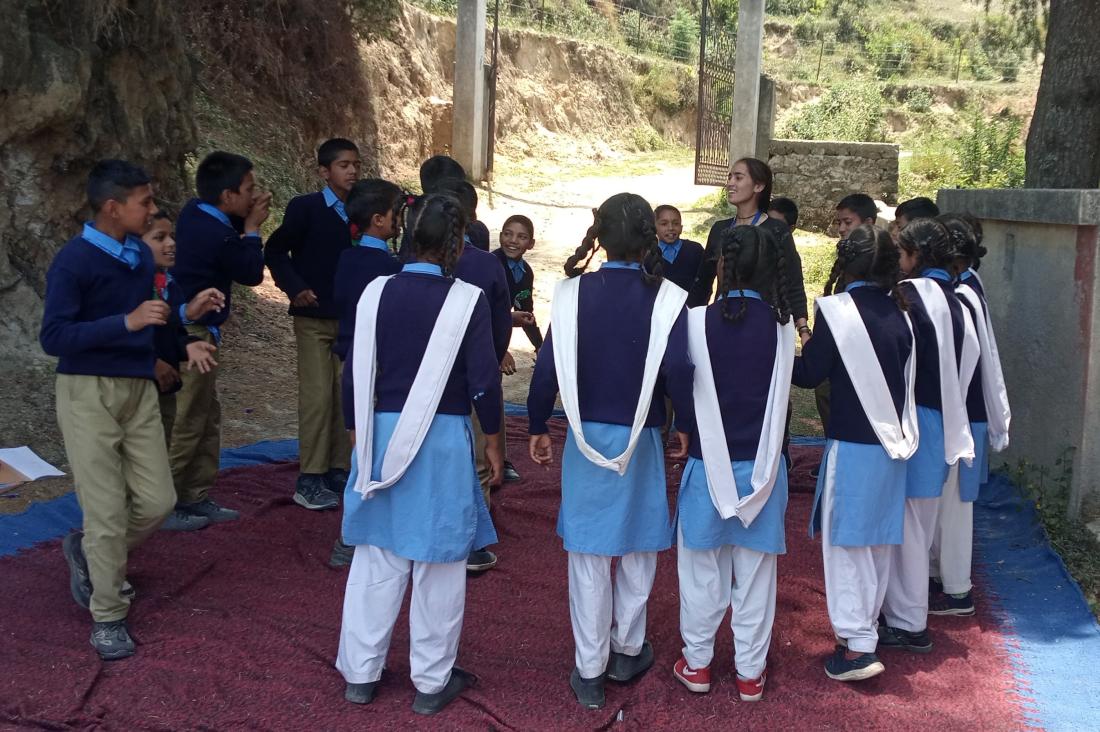
Details of the intervention
In partnership with Rang Kaarwaan, researchers conducted a randomized evaluation to test whether carving out time in the school day for theater-based pedagogy could improve secondary school students’ holistic skills, and therefore their classroom engagement and their test scores in academic subjects. Researchers randomly assigned 96 public schools with 3,909 students in grades 6 to 8 to one of two groups:
- Theater-based instruction (48 schools): For six months, local, trained facilitators led ten, 90-minute sessions, each targeting a different social-emotional skill, like teamwork or goal setting. Interactive games and exercises were designed to encourage collaborative, problem-solving dialogue among students. Sessions replaced physical education about once every two weeks.
- Comparison group (48 schools): Schools continued regular physical education and well-being periods, which students typically treated as free time to talk to friends or walk around the school.
Researchers surveyed teachers and students to measure the key skills the program targeted: self-efficacy, emotional regulation, empathy, time management, and critical thinking. Researchers also used a combination of surveys, games, recordings, and administrative data to measure friendship, bullying, negotiation, conflict resolution, active listening, public speaking anxiety, reading fluency and confidence, collaboration, gender attitudes, student engagement, well-being, test scores, attendance, punctuality, and aspirations. The curriculum ran between July and December 2024, and researchers measured endline outcomes shortly afterward in January-February 2025.
The study received approval from institutional review boards. To avoid taking time away from core academic instruction, sessions replaced physical education and well-being periods, which a scoping exercise found students largely used as free time. For more on the researchers' discussion of ethical considerations, see page 11 of the pre-analysis plan.
Results and policy lessons
Forthcoming.
Constantino, Sara M., Nishith Prakash, Shantanu Khanna, Ritam Chaurey, Raisa Sherif, and Abhiroop Mukhopadhyay. “Shaping Minds: The Transformative Effects of Theater-Based Learning.” Pre-results analysis, January 27, 2025.