

The Family Planning Impacts of Equipping Women for Better, Male-Dominated Jobs in Senegal
- Job seekers
- Students
- Women and girls
- Adults
- Dropout and graduation
- Earnings and income
- Employment
- Enrollment and attendance
- Empowerment
- Fertility
- Self-esteem/self-efficacy
- Aspirations
- Gender attitudes and norms
- Attitudes and norms
- Business investment
- Fertility/pregnancy
- Labor
- Information
- Training
- Subsidies


Access to better-paying jobs has the potential to shape women’s family-planning decisions by empowering women to influence reproductive choices and expanding life paths available to them beyond unpaid work. In Senegal, researchers are testing whether encouraging women to join vocational training through scholarships and supportive information from past participants and their families can shape women’s work and family aspirations, their employment decisions, and their families’ perspectives on women’s work.
Policy issue
Economic opportunity has the potential to help women align their fertility decisions with their preferences. For example, higher earning potential may give women more leverage in household decisions and help them resist pressure to have children before they want to. When jobs are accessible, women and their families may also see more options for how women can use their time, making delayed childbearing both more realistic and appealing.
However, in low- and middle-income countries, many lucrative jobs are often concentrated in male‑dominated sectors that women usually struggle to access, such as mechanics, electricity, and construction. Women may hesitate to enter these fields because earning the requisite job skills is financially costly, and/or because they see these careers as unfeminine and harmful to their marriage prospects.
Can expanding women’s access to training in male‑dominated fields help them enter these higher‑earning jobs—and, in turn, reshape household decision‑making around work, marriage, and family planning?
Context of the evaluation
This study is taking place in Dakar, the capital of Senegal. Across the country, traditional gender roles are strong, likely shaping family expectations around women’s work and reproductive choices. Fertility control is closely tied to women’s employment but remains limited: employment is one of the top factors associated with contraceptive use in the country, yet only 32 percent of women of reproductive age used modern contraceptives in 2023.1
The study will focus on young women who are interested in vocational training (VT) for male-dominated fields such as mechanics, electricity, and construction, but who face financial and social barriers to entering these sectors. Focus group discussions suggest that participants worry that entering male-dominated jobs could harm their marriage prospects and make it harder to balance paid work with household responsibilities like childcare, as these roles come with stricter schedules than other fields with available opportunities, like garment‑making.
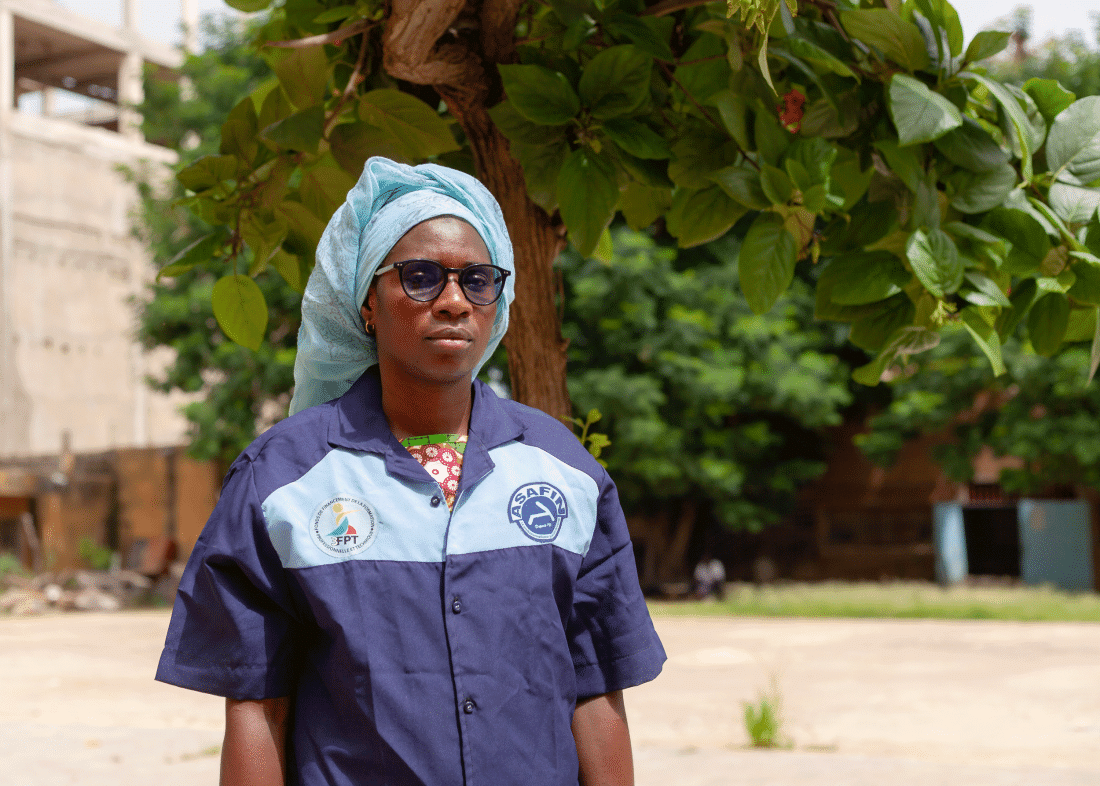
The implementing partner, the Senegalese Association for Training and Job Integration (ASAFIN), is a private vocational training school in Dakar that offers programs in male-dominated fields. ASAFIN has reported growing interest in VT programs from women who recognize the higher earning potential in such jobs, in contrast to low female enrollment rates in low-income countries.
Details of the intervention
In Senegal, researchers are partnering with ASAFIN to test two questions: whether information that addresses common non‑financial barriers to participating in VT increases how much women value VT, and whether offering VT scholarships increases women’s participation in VT and future employment prospects, as well as the attitudes of women and their families about women’s work and family formation.
The study will include two phases. In the first phase, researchers will ask 800 women how much they would pay for VT without receiving any information on the VT program. Women are then randomly offered information addressing non-financial barriers to joining VT—or a neutral placebo message—and then asked again how much they would pay. Information is provided verbally by enumerators and includes: anecdotes highlighting family support for women working in male-dominated sectors to address concerns about family approval; stories from women who had previously taken the program about marriage and work–family balance to ease concerns related to marriage prospects and care responsibilities; and testimonials from women graduates about their first jobs after training to counter doubts about employment prospects. By comparing willingness to pay across these two groups, researchers will estimate whether women value VT more when they receive information addressing non-financial concerns about enrollment.
Finally, researchers provide each woman with the type of message she had not yet received—either information addressing non‑financial barriers to joining VT or the placebo message—so that all women hear both. Researchers will ask women for a third time how much they would pay for VT to find out how they value it when they are fully informed.
In the second phase, the same 800 women will open a sealed envelope with a pre‑determined random number that assigns them to one of two groups:
- Scholarship group: Women will be offered a three-month full scholarship for ASAFIN’s VT program if the random number in their envelope is above their maximum willingness to pay for VT.
- Comparison group: Women will not be offered a scholarship if the random number in their envelope is below their maximum willingness to pay for VT.
By using pre‑determined random numbers, women know that the price of VT is set independently of their willingness to pay for it. Scholarships will be distributed across two cohorts beginning in November 2025 and May 2026. Four months and one year after the intervention, researchers will track participants’ enrollment in and completion of ASAFIN’s training; perceived work prospects; norms about women working in male-dominated fields; employment outcomes including job type, hours worked, and earnings; their influence over decisions about household finances and their children’s education; how many children they want; and how they feel towards balancing work in male-dominated fields with marriage and family responsibilities. In addition, they will interview women’s family members to hear their views on women joining the program and working in male-dominated fields.
Results and policy lessons
Research ongoing; results forthcoming.
Endale, Hiwot T., Hiwot K. Negash, Worku Tesfaye, Fekadu S. Hasen, Tadesse Asefa, Dessalegn T. Gelaw, et al. 2025. “Utilization of Modern Contraceptive Methods among Women of Reproductive Age in Senegal: A Multilevel Mixed-Effects Analysis.” PLOS ONE 20 (5): e0323899. https://doi.org/10.1371/journal.pone.0323899.