

Understanding Fertilizer Access in Côte d’Ivoire: Insights from Farmers and Market Actors
Smallholder farmers in Côte d'Ivoire's Poro Region face persistent barriers to accessing fertilizers needed to improve agricultural productivity. While fertilizers are available, many farmers struggle to obtain them because of limited access to input markets, financial constraints, and information gaps. This results in the “last mile” problem, whereby farmers face difficulties accessing agricultural inputs and services despite their availability.
To better understand these challenges and test potential solutions, UM6P-J-PAL Applied Lab for Agriculture (UJALA) is supporting the project “Last Mile Extension and Market Access Solutions: Impact Evaluation of OCP School Lab and Village Input Fairs in Côte d'Ivoire.” The randomized controlled trial is led by J-PAL affiliates Andrew Dillon and Tanguy Bernard, in collaboration with CAPEC and in partnership with OCP Côte d'Ivoire (as part of the OCP Africa and OCP Nutricrops ecosystem).
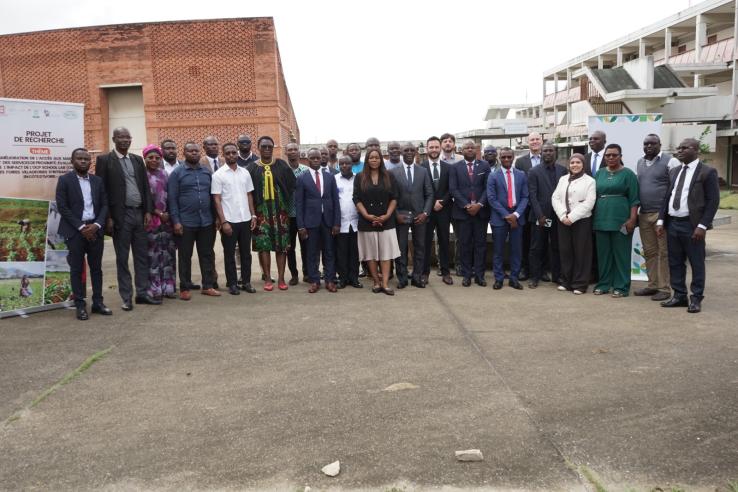
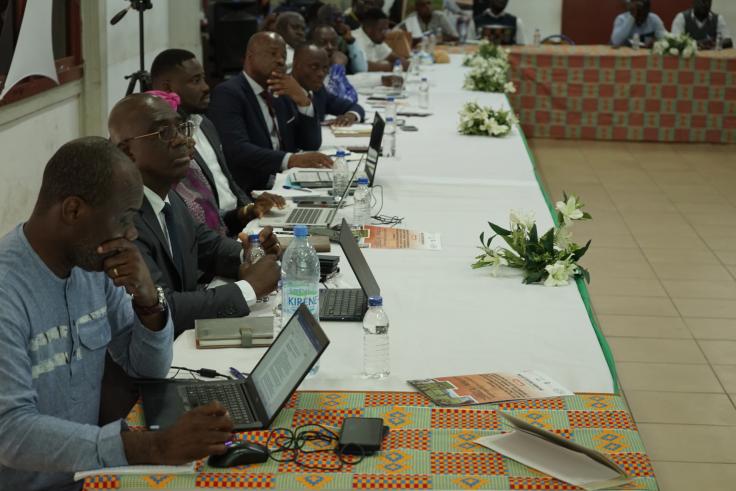
On 3 June 2026, Université Félix Houphouët-Boigny in Abidjan hosted a workshop discussing baseline findings from the RCT and the subsequent phases of the project. The workshop brought together researchers, UJALA staff, policymakers, representatives from OCP Côte d'Ivoire, government agencies, agro-dealers, and agricultural cooperatives to offer recommendations to inform the future steps of the evaluation.
Key baseline findings
The baseline survey provided several important insights into fertilizer access and farmers' decision-making.
- Access to fertilizers is inequitable within and across villages. About three-quarters of villages had inequitable access to fertilizers. Even in the remaining 24 percent of villages, where input markets were present, up to 70 percent of residents still had unequal access. These findings suggest that village-level interventions such as Village Input Fairs (VIFs) will not automatically reach every household, as liquidity, financial resources, and social network constraints extend beyond market presence.
- Distance and income compound each other. Farmers living farther from input markets were much less likely to purchase fertilizers. Low income further limited fertilizer purchases, indicating that geographic and financial barriers jointly constrain access.
- Climate concerns are shaping farmers' investment decisions. Farmers worried about climate variability tended to shift spending away from NPK and urea toward pesticides and herbicides. While this may reduce short-term production risks, it may come at the expense of long-term soil health. These findings highlight the importance of not only improving access to inputs through VIFs, but also strengthening farmers' confidence to plan and invest for the longer term.
- Liquidity is the binding constraint for the poorest farmers. Wealthier farmers were generally able to pre-order fertilizers when given the opportunity, whereas poorer farmers often could not commit despite recognizing their value. This points to a timing and cash-flow constraint rather than a knowledge gap, which the VIF microfinance component is designed to address.
- Farmers' perceptions of soil fertility influence demand. About 65.5 percent of farmers believed that their soil fertility was below the ideal agronomic reference level. Rather than representing a barrier, this creates an opportunity: farmers who perceive their soils as depleted may be more motivated to adopt fertilizers. The in-situ soil testing conducted through the OCP School Lab (OSL) aims to provide farmers with objective information to support more informed fertilization decisions.
Stakeholder perspectives
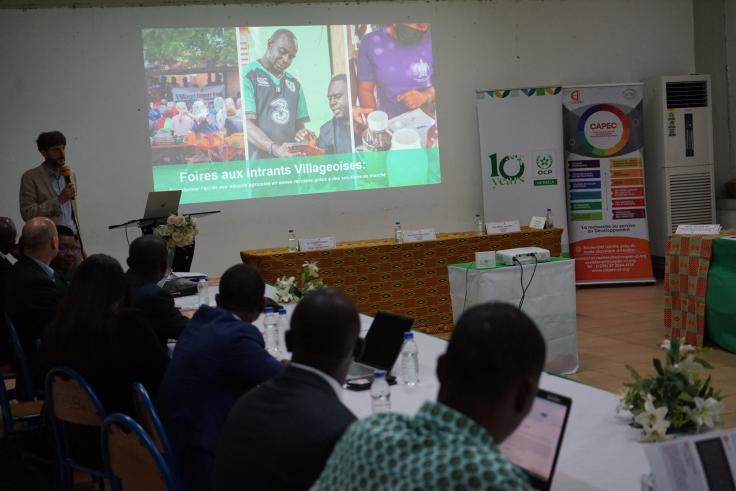
Two panel discussions complemented the presentation of the baseline findings. The first focused on farmers' adoption of extension services and fertilizer recommendations. Panelists emphasized the importance of trust in extension agents, practical demonstrations, and peer learning through cooperatives, while identifying high input costs and uncertainty about fertilizer recommendations as continuing barriers. They also highlighted the value of soil testing in providing tailored fertilizer recommendations and supporting more informed decision-making.
The second examined fertilizer market access from the perspectives of government agencies, OCP Côte d'Ivoire, and agro-dealers. Discussions highlighted logistical bottlenecks, financing constraints, seasonal demand fluctuations, and the importance of coordination among suppliers, cooperatives, and producers to improve fertilizer distribution. Panelists also discussed how the Village Input Fair (VIF) model could be made more sustainable by addressing payment risks and demand uncertainty, while combining improved input access with advisory services and tailored soil health recommendations.
Looking ahead
The OCP School Lab and Village Input Fair interventions have already reached farmers across 120 villages in three districts of the Poro Region. To date, across 90 localities, 60 OCP School Labs and 60 Village Input Fairs have trained 5,730 farmers on good agricultural practices and provided 1,279 soil analyses with tailored fertilizer recommendations. The interventions also facilitated 28.1 tonnes of fertilizer orders through the post-harvest payment scheme, alongside 11.6 tonnes purchased through direct cash payments, with 53% of purchases made through installment payments.
Looking ahead, workshop participants emphasized the need to generate stronger evidence on the scalability, sustainability, and inclusiveness of the interventions, including their potential to benefit crops other than maize and different farming contexts. They also highlighted the importance of longer-term follow-up, better understanding of impacts on women, youth, and vulnerable groups, and strengthening engagement with agro-dealers and producers to support future implementation and scale-up.
To learn more about UJALA’s work and events, visit our webpage.