


Treating water with chlorine can prevent child deaths caused by unsafe water. The challenge is getting chlorine into homes so families can use it regularly.
Make chlorine free and easy for families to obtain. Treating drinking water with chlorine is simple. But charging even small prices means people who can benefit but don’t have a lot of money often end up without it.
Design delivery systems that reduce the cost of reaching families. Tools like redemption vouchers can achieve similar levels of use as door-to-door distribution at lower cost, while community engagement may help encourage regular use.
Governments should lead efforts to learn how to deliver chlorine at scale. How best to ensure widespread access to free chlorine products is still an open question, and the right model depends on local systems and constraints. Funders can support governments as they test and adapt different approaches.
Hundreds of thousands of children continue to die each year because of unsafe drinking water. Around two billion people don’t have reliable access to safe drinking water, including over 400 million in Africa, leaving them at risk of getting sick from contaminants and germs in the water. These contaminants can spread diarrheal disease, which killed 233,000 children under five in Africa in 2023.
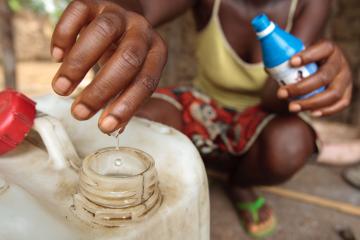
Treating water with small amounts of chlorine is a simple, well-established, and low-cost way to save children’s lives. Families may add it at home from a small bottle or tablet, take it from a dispenser at the well or tap where they collect water, or get it already mixed into piped water. Pooling findings from a group of randomized evaluations, research shows that water treatment like chlorine can reduce the odds of death among children under five by about one-quarter (24 to 27 percent). Water treatment is a cost-effective way to save a child’s life, comparable to other preventive health products.
Making chlorine free allows many people to access it, and smart delivery design can reach a similar number of people at a lower cost. In Kenya and Malawi, charging even very small prices for chlorine sharply reduced demand, meaning families chose to go without it. Meanwhile, vouchers that let families claim free chlorine from local shops achieved chlorine use as high as door-to-door delivery, at a lower cost.
Governments can now use this evidence to embed sustainable programs. J-PAL Africa's Scaling Access to Safe Water in Africa (SASWA) is working with governments on how best to expand chlorine access through routine maternal and child health services. Pregnant women and families with young children already use these services, which makes them a promising place to try. Governments and their partners should likewise test and adapt other approaches before scaling, looking at how many families water treatment reaches and how regularly they use it.
The Evidence
"In a context of limited resources, Guinea’s Ministry of Health and Public Hygiene is firmly committed to working with J-PAL, GiveWell, and other strategic partners to generate and use rigorous evidence to bring about lasting improvements in access to safe drinking water for mothers and children in the Republic of Guinea. Our goal is clear: to direct every resource toward the most effective interventions, to turn evidence into real impact at scale, and to give every family the chance to live a healthier life."
—Dr. Dieney Fadima Kaba, National Director of Family Health and Nutrition, Ministry of Health and Public Hygiene, Republic of Guinea
Cost and design considerations
Providing chlorine for free increases its use far more than charging for the product. Chlorine itself is relatively cheap, but programs also cost money to transport, give out, stock, and promote its use. As with many preventive health products, even very small user fees substantially reduce uptake. Providing chlorine free of charge is therefore critical to reaching families who would otherwise go without it.
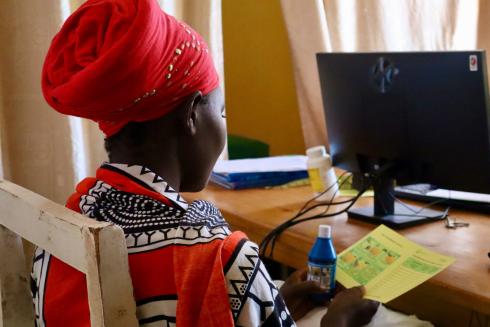
A voucher system combines free access for households with lower-cost delivery for the government. In Malawi, families could collect free chlorine from nearby shops using vouchers rather than having it delivered to every home. This approach was nearly twice as cost-effective at increasing chlorine use and four times as cost-effective at preventing child illness: vouchers cost US$2.69 per child illness averted, compared with US$10.62 for universal home delivery.
Delivery innovations also look at how to encourage regular use. Reliable stocks, convenient places to obtain chlorine, and clear instructions all matter. In Nigeria, a community demonstrations program let families learn about E Coli contamination in their local water, see how chlorine is used, and try treated water themselves. Ongoing research is testing how this can increase willingness to use chlorine.
In urban areas, building pipe infrastructure and introducing in-line chlorination can guarantee access to safe water. Planners working on such infrastructure programs should be forward-looking, taking into account how people are moving from rural to urban parts of a country as the economy develops.
A voucher system combines free access for households with lower-cost delivery for the government.
Implementing Partners and Role of LMIC Government
Government leadership is essential for scaling safe water access. Responsibility can span ministries of health and water, utilities, and local governments, through investments in water infrastructure, chlorination, procurement, maintenance, and service delivery. For household chlorine programs specifically, health systems offer one promising route to reach families with young children through services such as antenatal care, immunization, and community health workers. Assessing how chlorine fits within these systems is key for governments to set up delivery approaches that are feasible, cost-effective, and sustainable.
Many organizations run or help design and implement evidence-informed water chlorination programs, including the following (listed in alphabetical order); this list is not exhaustive.
- Development Innovation Lab
- Evidence Action
- J-PAL Africa (SASWA)
- Ministries of Health in partner countries (e.g., Rwanda, Guinea)
- Partners in Health
- World Bank Group
- UNICEF
The role of foreign assistance and philanthropy
Philanthropy, multilateral, and bilateral assistance have been key to building the evidence base for chlorine subsidies and supporting early implementation. Organizations including GiveWell and the Weiss Asset Management Foundation have funded rigorous research, systematic evidence synthesis, and government partnerships such as J-PAL Africa’s SASWA portfolio, helping turn evidence into new policy approaches for health impact. External funding for long-run studies, data access, meta-analysis (a method to combine the results of multiple independent studies addressing the same research question), and cost-effectiveness analysis has been especially important. For example, Dioraphte Foundation and GiveWell funded the meta-analysis that helped establish the potential for water treatment to cost-effectively reduce deaths among young children, inspiring the launch of SASWA.
Development partners also help governments strengthen delivery before national scale-up. This includes financing pilots, strengthening procurement and supply systems, and supporting rigorous evaluation of different delivery approaches before national scale-up.
Discover more from J-PAL
Initiative
Layout Page
SASWA Partnership: Rwanda’s Ministry of Health
Initiative
Layout Page
J-PAL Africa: Scaling Access to Safe Water in Africa (SASWA)
Discover more from other sources
Chlorine Vouchers
GiveWell
Water as Health Policy
DIL, World Bank, Center for Global Development
Photos:
(1) Mother and daughter fetch water together in Embu, Kenya. Credit: Simplice, Shutterstock.com
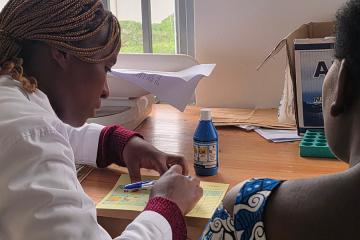
(2) A beneficiary receives information on the water treatment program in Rwanda. Photo credit: J-PAL