

Strengthening Employment and Family Planning through STEM Career Support in India
- Job seekers
- Men and boys
- Women and girls
- Adults
- Earnings and income
- Employment
- Empowerment
- Sexual and reproductive health
- Violence
- Fertility
- Age of marriage
- Women’s/girls’ decision-making
- Self-esteem/self-efficacy
- Gender attitudes and norms
- Age of childbearing
- Fertility/pregnancy
- Gender-based violence
- Maternal health
- Mental health
- Soft skills
- Health
- Training

Having a career in STEM may affect women’s family planning decisions by making smaller or later families more compatible with their career goals, strengthening their voice in household, fertility-related decisions, enabling them to move freely and seek care, and giving them more income to spend on contraception and health care. In urban India, researchers are testing whether helping women and men start STEM careers through a job training program improves their employment and earnings, and, for women, enhances economic empowerment and shapes family planning choices.
Policy issue
Women’s ability to decide whether and when to have children remains constrained worldwide: across 57 countries, nearly half of in‑union women aged 15–49 lacked decision‑making power over their sexual and reproductive health in 2020.1 Increasing women’s access to high‑quality jobs could help shift this by strengthening their influence within the household, giving them greater control over resources to purchase contraceptives, and expanding their ability to move freely and seek care privately. Better job opportunities may also open up life trajectories that were preferred but previously out of reach, such as choosing to have fewer children to pursue a career.
STEM fields offer strong, well‑paid job opportunities, but women are often excluded from them due to gaps in technical and soft skills, limited professional networks, and gender‑based discrimination. Skills development programs may help address these barriers by enhancing women’s capabilities, expanding their networks, and improving their expertise signaling to employers through certification. Job placement support, in turn, might help women identify and secure positions that better match their skills.
This study examines whether pairing STEM training with added soft‑skills training and job placement assistance improves women’s career trajectories, and, in turn, their reproductive agency. It also considers potential unintended consequences, including household backlash to women’s economic independence in the form of increased intimate partner violence.
Context of the evaluation
In India, graduates from lower‑tier colleges often struggle to secure employment due to weaker academic preparation and limited professional networks. Women from these backgrounds face additional hurdles, including more restricted access to networks and role models, as well as lower confidence in navigating the job market.
This evaluation will focus on low-income engineering and computer science graduates from such institutions in urban Delhi and Maharashtra. Participants will include both men and women to allow researchers to compare program impacts across genders. Women in the study will be at ages when marriage and childbearing decisions are ongoing, within a national context where sterilization remains the most common method for women but 44 percent of married adults do not use contraception—suggesting scope for changes in fertility and family planning outcomes.
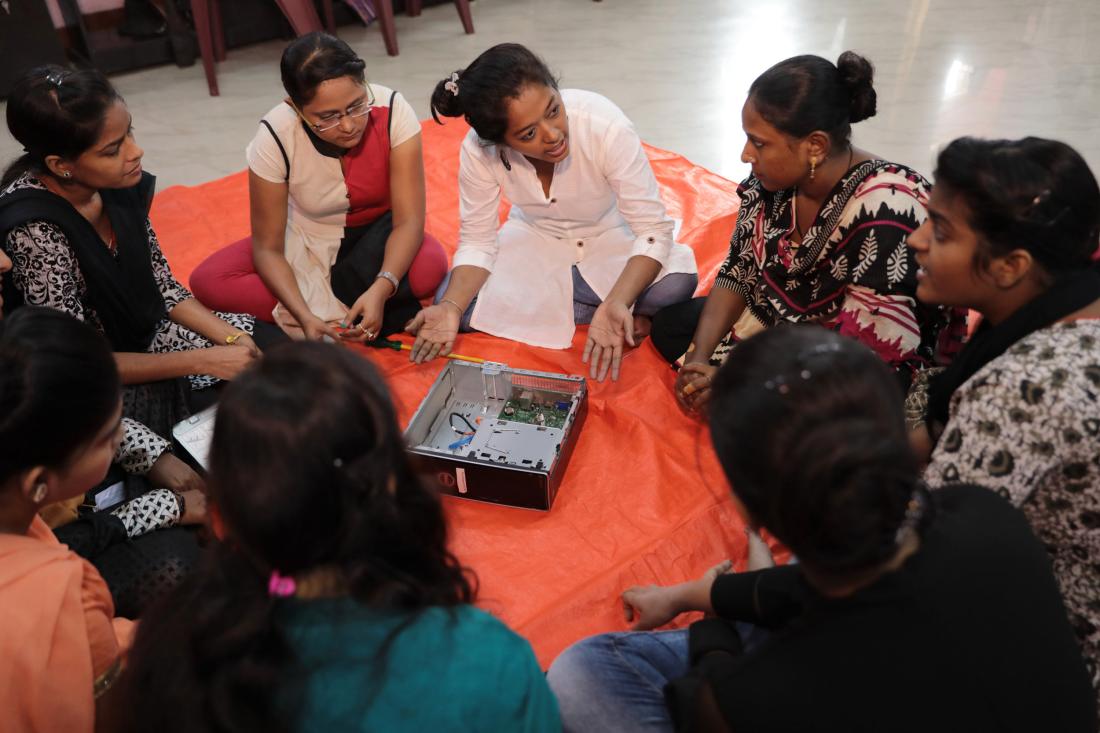
The study will examine DeepTech, a five-month job training program offered by NGO Anudip that prepares engineering and computer science graduates from lower‑tier colleges for STEM careers. DeepTech participants learn technical skills like programming languages alongside soft skills in communication, resume writing, interviewing, and professional etiquette. The program also awards merit certificates to top performers to strengthen signaling to employers. Each cohort enrolls 30–50 students, with 70 percent of instruction delivered in person and the remainder completed through self-paced online modules.
After training, Anudip helps match participants with jobs at major tech companies, primarily in STEM and IT roles. Since 2021, Anudip has trained nearly 8,000 people, and about 50–70 percent have gone on to secure STEM jobs. Everyone in this study has applied to Anudip’s DeepTech program and passed the entry exam.
Details of the intervention
Researchers will partner with Anudip and J-PAL South Asia to test DeepTech’s impact on participants’ employment status and earnings in India. Among women, the study will also measure effects on empowerment and family planning choices. Researchers will randomly assign 3,333 college graduates (2,333 men and 1,000 women) to one of two groups:
- STEM job training group (1,633 men and 700 women): Participants in this group will be offered a spot in the DeepTech program.
- Comparison group (700 men and 300 women): Participants in this group will not be offered a place in DeepTech and will be unable to join the program for three years.
The job training program will be rolled out across four cohorts from July 2025 to June 2026. In 2026, some women will also be randomly offered a visit with a gynecologist and a contraceptive counseling session to help them more easily access reproductive health care.
Beginning in July 2026, J‑PAL South Asia will conduct three rounds of surveys—in July 2026, November 2026, and May 2027—to track whether participants completed the DeepTech program, their earnings, and whether they are working in STEM jobs. For women, the surveys will also measure empowerment outcomes, such as whether they have a bank account in their name, their confidence, their role in household decision-making, and their spouses’ views on gender roles at home and in the workplace. Additional questions will cover women’s marital status, age at marriage, experiences of violence, and the number of children they have and hope to have. Finally, the surveys will measure women’s contraceptive use, preferred methods, and access to reproductive healthcare, including how often they visit a gynecologist.
Results and policy lessons
Research ongoing; results forthcoming.
United Nations Population Fund (UNFPA). 2020. Tracking Women’s Decision-Making for Sexual and Reproductive Health and Reproductive Rights: SDG Indicator 5.6.1. New York: UNFPA. https://www.unfpa.org/sites/default/files/resource-pdf/20-033_SDG561-BrochureA4-v1.21.pdf.