

A Universal Program to Raise the Well-being of Rural Communities in Uganda
- Rural population
- Adults
- Families and households
- Earnings and income
- Asset ownership
- Attitudes and norms
- Profits/revenues
- Savings/deposits
- Take-up of program/social service/healthy behavior
- Business skills training
- Coaching and mentoring
- Fertilizer and agricultural inputs
- Training
- Water, sanitation, and hygiene
- Empowerment training
- Community-driven development



Many programs that aim to help people in poverty are tailored to specific households. But often, entire communities can be living in poverty. Researchers partnered with the NGO Raising the Village to conduct a randomized evaluation of a universal livelihoods program in Uganda that offered a bundle of services including trainings to entire villages. Households across wealth levels in villages offered the program became better off, increasing their income, wealth, and consumption.
Policy issue
700 million people around the globe lived in extreme poverty in 2024. Poverty can be very concentrated in certain regions, particularly in sub-Saharan Africa. Many programs aimed at reducing poverty provide specific households with resources like cash transfers. But different approaches focus on village-level programs and resources.
Universal programs provide services to entire communities. However, these programs may be costly and fail to help the poorest households if resources are divided among an entire community. Can a universal livelihoods program that supports an entire community, rather than certain households, increase each household’s income, wealth, and consumption? Can that same program avoid leaving the most vulnerable community members behind?
Context of the evaluation
This study took place in the Kagadi and Kyenjojo districts in rural Uganda. Almost half of the households in the study earned below US$2.15 PPP a day (extreme poverty line) and almost all households engaged in small-scale farming. There was also a significant wealth gap among the communities, with the wealthiest 25 percent of people having about nine times as much money as people in the lowest 25 percent income bracket. Wealthier households sold a more diverse range of crops and did not earn a large portion of their income from casual wage labor, which is temporary work that is typically irregular and informal. Households with the least wealth relied on a small set of staple crops and earned over a third of their income from casual wage labor. About half of the villages in the study had a primary school and one third had a mobile money agent (a shop or kiosk to dispense money), while almost none had secondary schools or health centers.
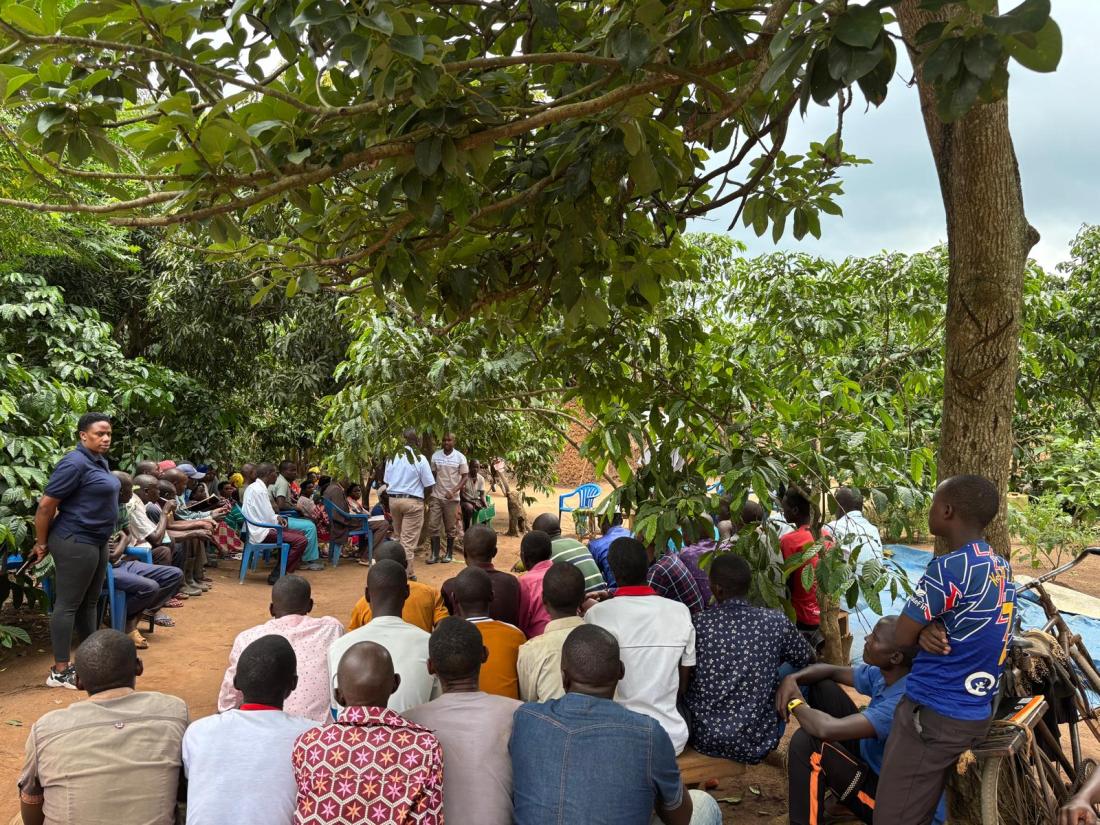
Raising the Village (RTV), an international NGO, operated in these communities, providing a number of practical trainings to everyone living in a village, as well as specific resources like agricultural tools and small livestock to each household. The program aims to raise the well-being of communities as a whole. The program is similar to the Graduation Approach in that it provides a bundle of services including an asset transfer and trainings. However, the asset transfer is smaller than that provided by the graduation approach, providing pigs instead of cows.
Details of the intervention
Researchers conducted a randomized evaluation to test the impact of the RTV program on people’s social and economic well-being, including their income, assets, and consumption. Researchers randomly assigned clusters (two to four villages in each cluster) into one of two groups:
- Raise the Village (RTV) group (1,905 households, 57 clusters): People were offered five core components:
- Agriculture inputs and training: Households were offered seeds and tools for farming specific to their village’s needs, along with some communal tools like wheelbarrows. They were also offered trainings on how to use the tools and farming techniques. Community members elected an agricultural committee to receive additional training to provide support and mentorship to the rest of the village.
- Livestock inputs and training: Households were offered training on livestock management, like feeding, sheltering, and caring for animals. Some people were given pigs, and the litters from these pigs were then given to other community members so that each household had a pig by the end of the first year. Households given the first round of pigs were required to attend training. Community members also elected a livestock committee for mentorship, support, and logistical coordination of medical care for the animals for the whole village.
- Savings groups: Households were offered Village Savings and Loan Associations (VSLAs) to facilitate the purchase of assets and livestock and provide support to people opening new small businesses.
- Sanitation, hygiene, and health access: Wells were constructed in each village to provide access to clean water, and villagers were offered training on hygiene practices. Committees then followed up on this training to ensure households were implementing these measures. Health workers also visited the village every two months, treating or referring patients.
- Mindset change trainings: Four training sessions were offered to villagers, each focused on a different aspect of mindset change: financial literacy, how to invest in, fund, and monitor a business, gender roles and discussions of domestic violence, and a fourth repeating one of the sessions depending on the villages’ needs.
2. Comparison group (1,948 households, 57 clusters): People were not offered any part of the RTV program.
The program was delivered in two rounds, one in October 2020 delivered to 50 clusters, and one in June 2021 to 64 clusters. Researchers surveyed participants before, during, and after being offered the RTV program to capture household incomes, wealth, labor supply, and consumption, with the first and last comprehensive surveys also including questions about community engagement, health, and crop production. Researchers also surveyed market vendors for information on prices.
Results and policy lessons
Across villages that were offered the RTV regardless of their starting income or constraints, households earned more income, increased their assets, and their consumption after three years.
Monthly income: Households offered the RTV program increased their monthly income by 25.7 percent relative to the comparison group’s average income of US$158.17. The rise in income for people in the lowest wealth quartile came from new income streams like shifting to selling perennial crops, livestock rearing, and running small businesses, which were the typical activities of more wealthy households. Wealthier households mainly increased income from expanding their already more diverse income streams.
Farming: The rise in income was in part because households who were offered the RTV program increased farm sales by 27 percent relative to the comparison group’s average of about US$78. Community members offered RTV used almost double the amount of fertilizer and implemented practices like having a compost pit from trainings. In turn, they increased their yields, planted crops on more land, and grew and sold more diverse crops.
Assets and wealth: While people were not offered large assets in RTV like cows, they still accumulated wealth through increased income and savings allowing them to purchase larger assets. Assets increased by 30.5 percent overall relative to the comparison group’s average of US$1,275.14. About half of this increase was due to ownership of large livestock like pigs and people selling more animals and animal products. The program also allowed households to save more money by about 30 percent relative to the comparison group’s average of US$207.11, mostly due to the expansion of savings groups.
Consumption and food security: People offered the program increased their consumption by 10.1 percent relative to the comparison group’s average of USD$583.228, and had a more diverse diet. They were able to eat more from an expansion of crops under the program, as well as purchasing more food outside of the harvest season. Typically, outside of harvest time, many families face hardships that cause them to fall back under the poverty line. In villages offered RTV, this increase in number of households facing poverty was 11 percentage points compared to 30 percentage points in comparison villages.
Health and education: People also reported better overall health, including mental and physical health, and stronger community ties. They did not change spending on education or school enrollment rates.
Market prices: There was no change in overall prices, which researchers suggest is because food markets work on a national level, with traders coming in to buy goods.
Cost-analysis: The RTV model is cost-effective. After three-years, the benefit-cost ratio of RTV’s program was 267 percent, about 2 to 11 times higher than other, similar programs like large lump-sum cash transfers and the Graduation Approach. This is largely due to lower costs. For example, the cost of livestock was lower in part because of the model of passing on litters of livestock.