

Structured Teaching and Targeted Remediation to Improve Reading Skills in Ghana
- Students
- Teachers
- School administrators
- Student learning
- Provider Performance
- Take-up of program/social service/healthy behavior
- Coaching and mentoring
- Monitoring
- Training
- Targeting
- Computer-assisted learning
- Pedagogical innovation
- Tailored instruction
- Technology







Many children in low- and middle-income countries struggle to develop foundational reading skills, and most education programs produce gains too small to close these gaps. Researchers conducted a randomized evaluation to test the impact of a structured teaching and targeted remediation program that combined semi-scripted lesson plans, student workbooks, a smartphone coaching and tracking app, and teacher training in evidence-based instruction on first-grade reading scores in low-fee private schools in Ghana. Students experienced large improvements in foundational reading skills after one school year, with low-performing students experiencing greater benefits.
Policy issue
Reading skills vary substantially around the world, with large disparities in literacy outcomes emerging early in childhood. In 2021, fourth-grade students in South Africa scored nearly 3 standard deviations (SDs) below their counterparts in Singapore on international reading assessments, a gap almost four times larger than the black-white reading gap among fourth graders in the United States. South Africa is among the richest countries on the continent, suggesting this estimate may understate the true gap for as a whole. In Ghana specifically, at the end of second grade, about 77 percent of students were unable to read a single word.
The average education program globally raises reading scores by 0.20 SDs, meaning that even a highly effective program would need to be repeated more than fifteen times to bring African reading scores to high-income country levels. While approaches like targeted instruction (e.g., Teaching at the Right Level) and structured pedagogy have achieved much larger gains, these have typically been implemented separately and have proven difficult to scale consistently. Can a structured teaching program that combines high-quality scripted lessons with targeted instruction and digital coaching tools produce large, scalable reading gains for first-grade students in Ghana?
Context of the evaluation
Enrollment in Ghana’s free primary education has increased over the past decade. However, basic learning outcomes, like reading, have not improved substantially. Many urban families opt for low-fee private schools, which are perceived to offer better learning environments particularly because they offer instruction in English, even though many students speak local languages such as Fante or Twi at home.
To help address this gap, Inspiring Teachers, an educational NGO, developed a program called Tools for Foundational Learning Improvement (TFLI). It is approved by Ghana’s National Council for Curriculum and Assessment and has the following components: .
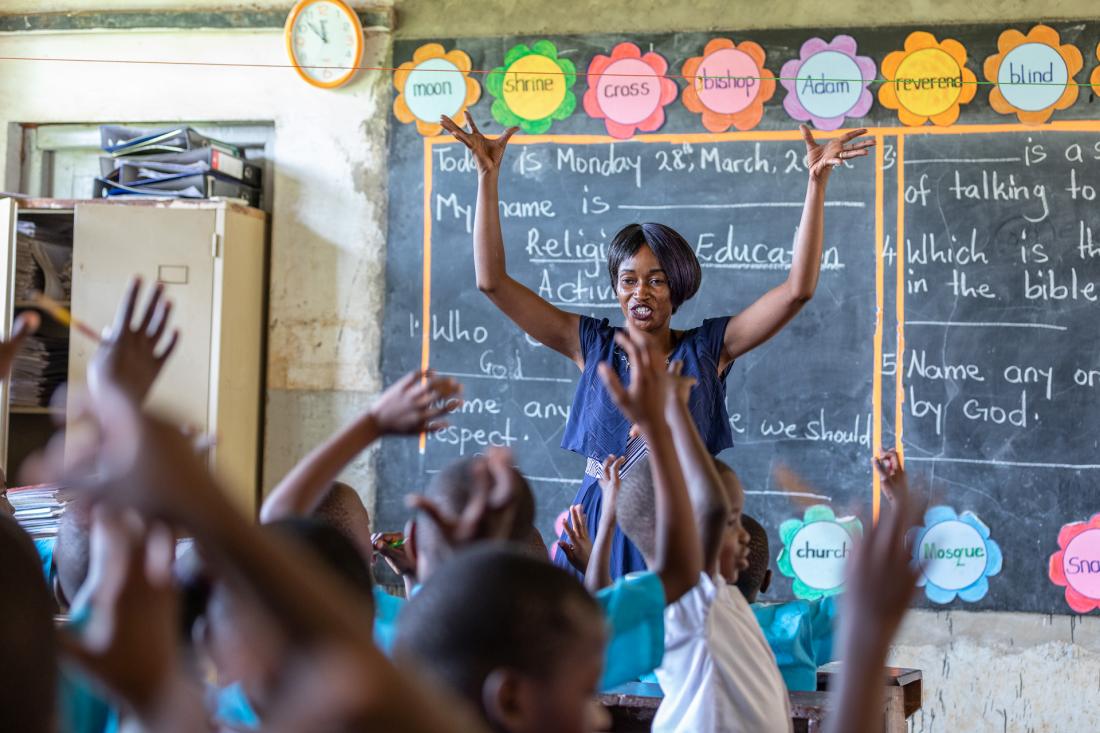
- Scripted Lessons and Workbooks: Each term, teachers receive a guide containing daily, semi-scripted lesson plans and a set of aligned student workbooks. Lessons follow a consistent five-day cycle: four days of structured literacy instruction around systematic phonics, and one day dedicated to whole-class assessment and targeted remediation.
- Digital Tracking and Coaching: Teachers and school leaders interact with a smartphone application called SmartCoach, which supports one-on-one oral reading fluency assessments, tracks student progress, and provides structured coaching tools for school leaders and field staff.
- Teacher Training: Teachers receive upfront training in evidence-based literacy instruction, including the "science of reading" principles underlying the program's twelve core pedagogical routines, with refresher training before each subsequent term.
The study took place in low-fee private schools in Ghana's Central Region, centered around Cape Coast, during the 2024–25 academic year. Students were 6.5 years old, on average and about 54 percent of students were male. Only 15 percent of students in the study spoke English at home.
Details of the intervention
Researchers partnered with Inspiring Teachers to conduct a randomized evaluation to test the impact of the Tools for Foundational Learning Improvement (TFLI) program on first-graders’ reading skills. Researchers randomly assigned the 80 schools to one of three groups:
- TFLI group (20 schools): Schools received the TFLI program beginning in September 2024. The program ran for the full school year.
- Additional training group (20 schools): These schools received the TFLI program and leaders (principals) received additional training on how to coach their teachers on program implementation. The teacher training ran for approximately two months at the end of the school year.
- Comparison group (40 schools): These schools did not receive the TFLI program or any additional teacher training.
Researchers collected data at the end of the school year in June 2025 using Early Grade Reading Assessments (EGRAs), an internationally standardized tool measuring eight components of reading ability: listening comprehension, letter names, letter sounds, initial sound identification, familiar word reading, non-word reading, oral reading fluency, and reading comprehension. Researchers also observed and filmed literacy lessons and surveyed students and measured teacher quality with a structured classroom observation tool.
Results and policy lessons
First-graders who were offered the TFLI program improved their reading skills, particularly in foundational phonics, after one school year. The impacts were concentrated among lower performing students.
Reading scores: Students in TFLI schools scored 0.50 SDs higher on EGRA than students in comparison schools, equivalent to approximately 2.2 additional years of learning under standard instruction. This places the program at the 91st percentile of all reading interventions.
Foundational phonics skills: In TFLI schools, students’ letter sound knowledge and initial sound identification (phonetic awareness) increased by 0.76 SDs and 0.71 SDs, respectively. Non-word reading, which tests the ability to decode unfamiliar letter combinations using phonics rules, increased by 0.55 SDs. These three skills were directly targeted by the program and drove the effects of improvements in reading. The program reduced the share of students who could not read any words in a passage by 44 percent. The proportion of students scoring zero decreased across most phonics-related subtests, indicating that the program benefited students at the lowest skill levels.
Advanced reading skills: The program did not impact advanced reading skills. The researchers attribute this pattern to a model of skill formation in which basic skills must be developed before advanced skills can fully emerge, predicting that gains in advanced skills should grow as students continue in the program through later grades.
Impact on girls: In comparison schools, girls outperformed boys by approximately 0.26 SDs on EGRA, overall. TFLI closed roughly two-thirds of this gap, with boys in schools that received the program gaining 0.21 SDs more than girls, consistent with the program's design targeting students with weaker foundational skills.
Teacher quality: Teaching quality, increased by 1.6 SDs in TFLI schools relative to comparison schools. The largest gains were in specific phonics activities, such as teachers modeling correct sounds and guiding students to blend sounds into words. Student engagement with workbooks and familiarity with classroom routines also increased, and students in TFLI schools were 7.5 percentage points more likely to practice reading at home.
Scalability: In Ghana, a prior small-scale pilot conducted over four months found gains of 0.25 SDs on internal Inspiring Teachers exams. This study’s full nine-month program produced gains approximately 2.25 times as large, consistent with effects scaling roughly in proportion to time in the program. An observational pilot in Uganda's Kanungu District, using the same analytical approach, found an increase of 0.51 SDs in the EGRA, suggesting the TFLI program can be adapted to other countries.
Given the results from these pilots, the TFLI program is being scaled up in Ghana, from its reach of 139 schools (including 80 government schools) in 2025-26 to 380 schools in September 2026 to 500 schools (including 400 government schools) by 2026-27. Inspiring Teachers has further plans to expand to all 1,638 schools in Ghana’s Central Region by 2029-30 and is also planning to expand the program to Zambia.
Following the evaluation findings, Inspiring Teachers is being appointed as a technical support partner for a national structured pedagogy package, drawing on lessons learned from TFLI. Inspiring Teachers has also placed greater emphasis on ensuring that school principals complete their scheduled coaching visits as part of the ongoing program. The NGO is also exploring the involvement of SISOs (Education Ministry staff) in delivering coaching support, as the results suggest that the principal-led coaching model shows considerable promise.
This evaluation is ongoing, with Grade 2 results forthcoming next month.