

The Impact of Malaria Testing and Treatment on Sugarcane Cutter Earnings in Nigeria
- Farmers
- Rural population
- Adults
- Workers
- Earnings and income
- Employment
- Productivity
- Take-up of program/social service/healthy behavior
- Health
- Information
- Health care delivery
- Preventive health



Common diseases like malaria may reduce worker productivity in physically-demanding jobs like farming, which is often an important source of growth in low- and middle-income countries. Researchers conducted a randomized evaluation to test the impact of malaria testing and treatment on sugarcane-cutter’s earnings, days worked, productivity, and task selection in rural Nigeria. Cane-cutters earned more two and three weeks after being offered testing and treatment. Those who tested positive earned more by working more days, while those who tested negative earned more by being more productive and choosing higher-paying, more physically-demanding tasks. This shows that health information can benefit sick and healthy workers, particularly in endemic areas.
Policy issue
Being able to harvest more food with less resources has long been an important driver of economic growth in low- and middle-income countries. Much existing research examines how technology can help farm laborers work more efficiently, but there is little evidence about how farm workers’ health affects their productivity.
Malaria, which can cause recurring fever, muscle pain, and fatigue, is one common disease that may disproportionately reduce farm worker productivity due to the physically demanding nature of the job. Previous studies find that malaria generally harms households and businesses, but there is little existing evidence from randomized evaluations. To what extent can malaria testing and treatment help sugarcane cutters in Nigeria earn more and be more productive at work?
Context of the evaluation
In 2021, Nigeria had the highest malaria burden in the world (27 percent), with an estimated 68 million cases and 194,000 deaths.1 Malaria rates are particularly high in northeastern areas such as the Adamawa State, where this study took place, and about 78 percent of people living in the state made less than US$1.25 in 2017.2 The evaluation was conducted on a large, rural sugarcane plantation during the January–April sugarcane harvest season.
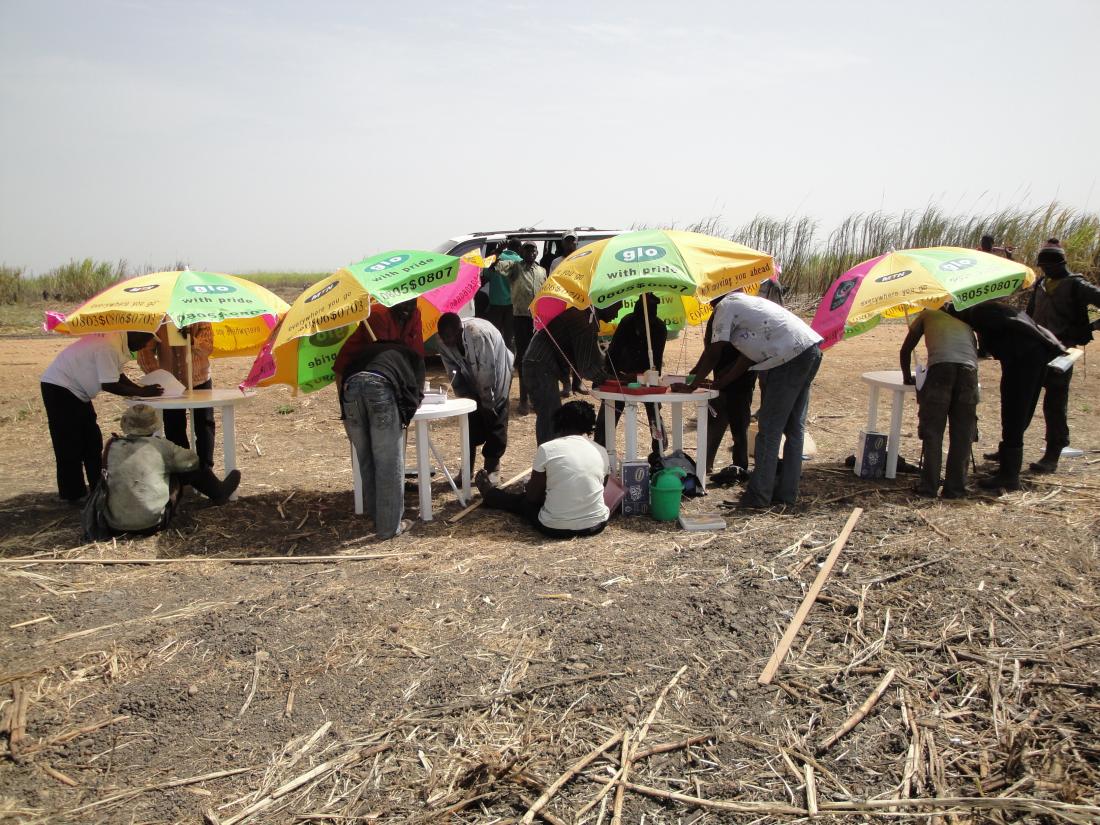
Study participants were men who typically worked as smallholder farmers throughout the year and worked as sugarcane cutters on the plantation during the harvest season. Participants had worked at the plantation for a year and were in good nutritional health, on average. When participants were tested for malaria, 64.1 percent were malaria-negative and 35.9 percent were malaria-positive.
Workers could choose between two tasks each day: cutting sugarcane or “scrabbling,” which involved gathering the cut cane and tying it into bundles. Cutting paid 2.04 naira (about US$0.01 at the time of evaluation) per piece of cut sugarcane. Workers were free to cut as much cane as they could each workday, earning 1,008 naira (about US$7 at the time of evaluation) per day on average. Workers were assigned to a work group of about 100 people but worked independently along rows of sugarcane, which were assigned by their supervisor. Scrabbling was less physically demanding than cutting but paid a flat rate of 500 naira per day (about US $3.50 at the time of evaluation). On average, participants worked five days a week on the plantation, and spent about 0.6 of those days scrabbling.
Details of the intervention
Researchers evaluated the impact of malaria testing and treatment on sugarcane cutter’s earnings, days worked, productivity, and task selection (cutting or “scrabbling”) in Adamawa State, Nigeria. The study used a phased‑in randomized design over six weeks, meaning that each week, researchers randomly offered a subset of participants within each plantation work group the following intervention:
- Malaria testing and treatment group (816 workers, or approximately 136 new workers per week, on average): Participants were offered malaria blood tests through a mobile health clinic and received their test results confidentially from a health worker. Participants who tested positive for malaria also received a dose of artemisinin-based combination therapy (ACT), a first-line malaria treatment, along with clear instructions on use. They were also offered two follow-up visits by health workers and a small incentive (50 naira, or US$0.34 in 2009) for returning used ACT boxes to increase medication compliance.
- Comparison group (workers who had not yet been offered malaria testing and treatment): Participants were not offered a malaria test or treatment.
This phase-in design allowed researchers to track participants’ health over time and eventually allowed every worker to access the malaria testing and treatment. Researchers used administrative data from the plantation to track participant earnings, days worked, productivity, and task choice (cutting or scrabbling). Productivity was calculated using how much participants earned daily conditional on working.
To better understand why productivity could change, researchers repeated the intervention at the same plantation in the 2012–2013 harvest season with a new group of 680 workers. A random subsample of 83 of these workers were given a wearable movement tracker (Fitbit) to wear before, during, and after malaria testing and treatment. Physical activity data from the Fitbits allowed researchers to measure how hard workers were working throughout the day.
Results and policy lessons
Sugarcane-cutters who were offered malaria testing and treatment earned more, worked more days, and were more productive two- and three-weeks later. Participants who tested positive for malaria earned more after being treated because they could work more days, while participants who tested negative earned more by being more productive and choosing higher-paying tasks. A key policy lesson is that health information benefited sick and healthy workers, particularly in malaria endemic areas where workers may adjust their effort in physically demanding jobs to prevent illness. Investing in more accessible health testing may be an undervalued policy option because of these population wide benefits.
Impact on earnings, days worked, and productivity: Participants who were offered malaria testing and treatment earned 10.8 percent more in the following two weeks and 13.4 percent more in the following three weeks. Participants earned more because they were able to work more days (5 percent more) and they were more productive (6 and 9 percent more two- and three-weeks later, respectively). Fitbit data from the 2012–13 replication study confirmed that these productivity gains were driven by workers putting in more physical effort during their fixed working hours, not from working longer days.
Task selection: Participants who were offered malaria testing and treatment spent less time scrabbling, the lower‑paying, less intensive bundling task, and more time on the higher‑earning, more physically-demanding cutting task.
Impact on cane-cutters who tested positive for malaria (35.9 percent of participants): Participants who tested positive for malaria earned 9.1 and 11.2 percent higher weekly wages two and three weeks later, respectively. These participants earned more because they were able to work more days—cane-cutters who tested positive worked more days per week after treatment. All participants who tested positive for malaria accepted treatment.
Impact on cane-cutters who tested negative for malaria (64.1 percent of participants): Participants who tested negative for malaria earned 11.7 and 14.2 percent more in the following two and three weeks, respectively, likely driven by higher productivity rather than increased days worked. Participants who tested negative were also less likely to opt for lower-paid, less physically-intensive scrabbling after receiving their healthy diagnosis. Researchers suggest that receiving a negative diagnosis changed worker’s health and earnings expectations, thus increasing their daily productivity and choice of task. The replication study supported this finding: even without the option to switch tasks, workers who tested negative still increased their physical effort during working hours after receiving a healthy diagnosis.
Cost-benefit analysis: Participants who were offered malaria treatment and testing earned 13.4 percent more three weeks later, translating to about US$13.2 per worker at the time of evaluation. The total cost of the program (including medication, health worker wages, and testing supplies) was US$10.02 per worker on average, yielding a benefit-cost ratio of 1.3. This ratio may be even higher with lower prices of ACT medication.
World Health Organization Regional Office for Africa. 2023. Report on Malaria in Nigeria 2022. Geneva: World Health Organization Regional Office for Africa. https://www.afro.who.int/countries/nigeria/publication/report-malaria-nigeria-2022
Adamawa State Government. 2022. Adamawa State 2023–2025 Medium‑Term Sector Strategy (MTSS). Adamawa State Ministry of Education. https://planipolis.iiep.unesco.org/sites/default/files/ressources/Adamawa-State-2023-2025-Education-Sector-MTSS-Quality-Assured-and-Formatted-240922.pdf