Policy Brief: Case Management Programs in North America
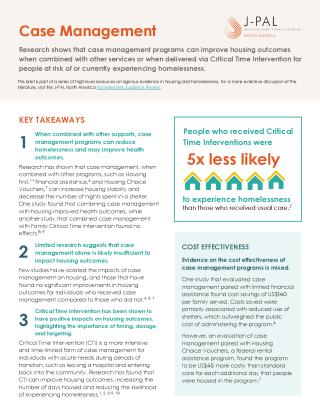
Case Management programs provide holistic support to individuals facing the compounding challenges of experiencing poverty, including housing insecurity, barriers navigating the housing market, unemployment, and more. This brief reviews experimental and quasi-experimental evaluations of case management programs in North America, finding that it can improve housing outcomes for people at risk of or currently experiencing homelessness when combined with other services or delivered via Critical Time Intervention.
People who are at risk of or currently experiencing homelessness often face many compounding challenges at once including housing insecurity, unemployment or underemployment, difficulty affording basic necessities, and more.
In case management programs, case managers offer holistic support to help navigate these barriers by providing resources and plans tailored to an individual's specific needs. Case managers can connect clients to housing programs they are eligible for, help identify housing options, or support in housing or job application processes, among other services. Case management programs across North America vary in their level of intensity and who they serve. Critical Time Intervention, for example, is a more intensive and time-limited form of case management for individuals transitioning from institutional settings to the community.
This brief synthesizes results from rigorous experimental and quasi-experimental evaluations of case management programs in North America, finding that case management can improve housing outcomes for people at risk of or currently experiencing homelessness when combined with other services or when delivered via Critical Time Intervention.