J-PAL J-PAL
The Abdul Latif Jameel Poverty Action Lab
  • About
    • Overview
    • People
    • Strengthening Our Work
    • Code of Conduct
    • Initiatives
    • Events
    • Blog
    • News
    • Press Room
  • Offices
    • Overview
    • Global
    • Africa
    • Europe
    • Latin America and the Caribbean
    • Middle East and North Africa
    • North America
    • South Asia
    • Southeast Asia
  • Sectors
    • Overview
    • Agriculture
    • Crime, Violence, and Conflict
    • Education
    • Environment, Energy, and Climate Change
    • Finance
    • Firms
    • Gender
    • Health
    • Labor Markets
    • Political Economy and Governance
    • Social Protection
  • Evaluations
  • Research Resources
    • About Us
    • Our Work
    • Join ASPIRE
    • Newsroom
  • Policy Insights
  • Evidence to Policy
    • Pathways and Case Studies
    • The Evidence Effect
  • Blog
  • Careers
  • Courses
  • For Affiliates
  • Support J-PAL

Utility menu

  • Blog
  • Careers
  • Courses
  • For Affiliates
  • Support J-PAL

Quick links

  • Evaluations
  • Research Resources
  • Policy Insights
  • Evidence to Policy
    • Pathways and Case Studies
    • The Evidence Effect
  • About

    The Abdul Latif Jameel Poverty Action Lab (J-PAL) is a global research center working to reduce poverty by ensuring that policy is informed by scientific evidence. Anchored by a network of more than 1,100 researchers at universities around the world, J-PAL conducts randomized impact evaluations to answer critical questions in the fight against poverty.

    • Overview

      The Abdul Latif Jameel Poverty Action Lab (J-PAL) is a global research center working to reduce poverty by ensuring that policy is informed by scientific evidence. Anchored by a network of more than 1,100 researchers at universities around the world, J-PAL conducts randomized impact evaluations to answer critical questions in the fight against poverty.

      • Affiliated Professors

        Our affiliated professors are based at over 130 universities and conduct randomized evaluations around the world to design, evaluate, and improve programs and policies aimed at reducing poverty. They set their own research agendas, raise funds to support their evaluations, and work with J-PAL staff on research, policy outreach, and training.

      • Invited Researchers
      • J-PAL Scholars
      • Board
        Our Board of Directors, which is composed of J-PAL affiliated professors and senior management, provides overall strategic guidance to J-PAL, our sector programs, and regional offices.
      • Staff
    • Strengthening Our Work

      Our research, policy, and training work is fundamentally better when it is informed by a broad range of perspectives.

    • Code of Conduct
    • Initiatives
      J-PAL initiatives concentrate funding and other resources around priority topics for which rigorous policy-relevant research is urgently needed.
    • Events
      We host events around the world and online to share results and policy lessons from randomized evaluations, to build new partnerships between researchers and practitioners, and to train organizations on how to design and conduct randomized evaluations, and use evidence from impact evaluations.
    • Blog
      News, ideas, and analysis from J-PAL staff and affiliated professors.
    • News
      Browse news articles about J-PAL and our affiliated professors, read our press releases and monthly global and research newsletters, and connect with us for media inquiries.
    • Press Room
      Based at leading universities around the world, our experts are economists who use randomized evaluations to answer critical questions in the fight against poverty. Connect with us for all media inquiries and we'll help you find the right person to shed insight on your story.
  • Offices
    J-PAL is based at MIT in Cambridge, MA and has seven regional offices at leading universities in Africa, Europe, Latin America and the Caribbean, Middle East and North Africa, North America, South Asia, and Southeast Asia.
    • Overview
      J-PAL is based at MIT in Cambridge, MA and has seven regional offices at leading universities in Africa, Europe, Latin America and the Caribbean, Middle East and North Africa, North America, South Asia, and Southeast Asia.
    • Global
      Our global office is based at the Department of Economics at the Massachusetts Institute of Technology. It serves as the head office for our network of seven independent regional offices.
    • Africa
    • Europe
    • Latin America and the Caribbean
    • Middle East and North Africa
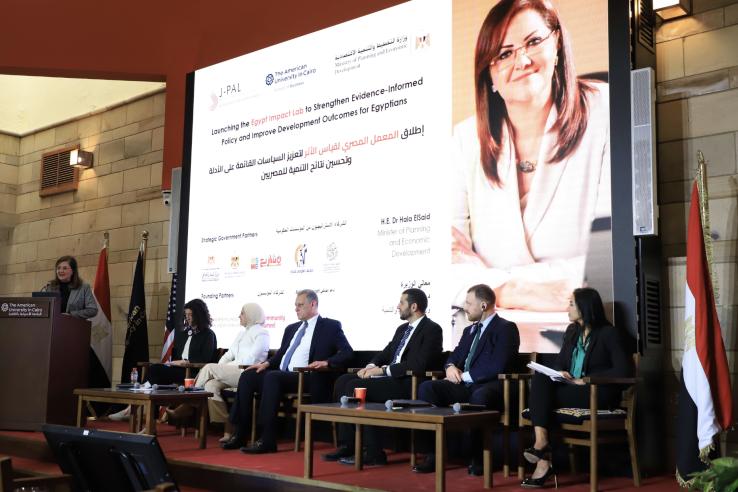
      J-PAL MENA is based at the American University in Cairo, Egypt.
    • North America
    • South Asia
    • Southeast Asia
  • Sectors
    Led by affiliated professors, J-PAL sectors guide our research and policy work by conducting literature reviews; by managing research initiatives that promote the rigorous evaluation of innovative interventions by affiliates; and by summarizing findings and lessons from randomized evaluations and producing cost-effectiveness analyses to help inform relevant policy debates.
    • Overview
      Led by affiliated professors, J-PAL sectors guide our research and policy work by conducting literature reviews; by managing research initiatives that promote the rigorous evaluation of innovative interventions by affiliates; and by summarizing findings and lessons from randomized evaluations and producing cost-effectiveness analyses to help inform relevant policy debates.
    • Agriculture
      How can we encourage small farmers to adopt proven agricultural practices and improve their yields and profitability?
    • Crime, Violence, and Conflict
      What are the causes and consequences of crime, violence, and conflict and how can policy responses improve outcomes for those affected?
    • Education
      How can students receive high-quality schooling that will help them, their families, and their communities truly realize the promise of education?
    • Environment, Energy, and Climate Change
      How can we increase access to energy, reduce pollution, and mitigate and build resilience to climate change?
    • Finance
      How can financial products and services be more affordable, appropriate, and accessible to underserved households and businesses?
    • Firms
      How do policies affecting private sector firms impact productivity gaps between higher-income and lower-income countries? How do firms’ own policies impact economic growth and worker welfare?
    • Gender
      How can we reduce gender inequality and ensure that social programs are sensitive to existing gender dynamics?
    • Health
      How can we increase access to and delivery of quality health care services and effectively promote healthy behaviors?
    • Labor Markets
      How can we help people find and keep work, particularly young people entering the workforce?
    • Political Economy and Governance
      What are the causes and consequences of poor governance and how can policy improve public service delivery?
    • Social Protection
      How can we identify effective policies and programs in low- and middle-income countries that provide financial assistance to low-income families, insuring against shocks and breaking poverty traps?
Displaying 3151 - 3165 of 8335
Two doctors speaking with notepad
Blog

The role of health economics in addressing poverty and building better policy

J-PAL staff sat down with Matt Notowidigdo (University of Chicago), Co-Scientific Director of J-PAL North America, and Tal Gross (Boston University) to examine their new book's approach to health economics and the impact of randomized evaluations on their understanding of the health care system...
womensurvey
Event

Ferramentas práticas para integração de gênero no monitoramento e avaliação de programas

Painel de discussão apresentando duas ferramentas práticas para integrar a perspectiva de gênero na avaliação de políticas e programas, a Ferramenta de Avaliação Rápida de Resultados em Igualdade de Gênero e Empoderamento de Mulheres da ONU Mulheres e a versão em português do Guia Prático para Medir...
In Foca Izmir, Turkey a Syrian refugee woman works in the production of sun-dried tomatoes.
Event

Displaced Livelihoods Initiative (DLI): Policymaker and Practitioner Information Session

The Displaced Livelihoods Initiative (DLI) hosted a policymaker and practitioner information session on May 10, 2023 at 9am ET.
Pregnant woman with smartphone
Blog

Leveraging technology to improve child-caregiver interactions at scale

Can technology be used to improve child-caregiver interactions and support child development? Traditional parenting interventions are often costly and tightly controlled, which limits their large-scale implementation. A low-cost intervention called Crianza Positiva, delivering text and audio...
Photo of an officer checking the condition of the solar panel, early warning system, in anticipation of landslides
Blog

Of satellites and surveys: How innovative data collection can speed up climate action

This Earth Day blog post discusses how we speed up the path from research to policy action at J-PAL through the King Climate Action Initiative (K-CAI), which prioritizes funding research and scaling that uses administrative and remote sensing data to generate results in a timely manner.
A woman sits and is weaving a rug
Blog

New Displaced Livelihoods Initiative will help advance sustainable livelihoods for displaced and host communities

Today, we announce the launch of the Displaced Livelihoods Initiative (DLI), jointly managed by Innovations for Poverty Action (IPA) and the Abdul Latif Jameel Poverty Action Lab (J-PAL), with generous support from the IKEA Foundation. DLI is the world’s first research fund dedicated to generating...
Person opening opening mail with letter containing text "Health Insurance Marketplace: You're almost done at Healthcare.gov..."
Policy insight

The effect of nudges on health insurance take-up in the United States

Providing nudges to individuals eligible for health insurance benefits leads to small but notable increases in insurance take-up and plan switching. Low-cost, mass-outreach campaigns are particularly cost-effective compared to more-intensive interventions.
Person opening opening mail with letter containing text "Health Insurance Marketplace: You're almost done at Healthcare.gov..."
Blog

Overcoming administrative burdens: Strategies to increase access to health insurance in the United States

A new J-PAL policy insight highlights evidence from randomized evaluations on the impact of informational “nudges”—strategies designed to inform individuals about various aspects of health insurance and influence behavior without changing legal or economic systems—on health insurance take-up. In...
Sign on store front that business accepts Supplemental Nutrition Assistance Program (SNAP)
Update
J-PAL Updates

April 2023 North America Newsletter

J-PAL North America's April newsletter highlights how evidence can be leveraged at the end of the public health emergency.
Two girls doing schoolwork at desk
Blog

Affiliate Spotlight: Selim Gulesci on entrepreneurship, gender, and the policymaking process

This affiliate spotlight features reflections from Selim Gulesci on his research surrounding gender, labor, and economics, and touches on his new role of Scientific Advisor for J-PAL Africa’s Girls’ Education and Empowerment portfolio.
A person looks at housing listings on a laptop
Blog

Researching racial equity: Racial discrimination, choice constraints, and policy implications

In this interview with J-PAL staff, J-PAL affiliated professor Peter Christensen (University of Illinois, Urbana-Champaign) discusses his ongoing series of evaluations, including a 2021 paper on housing discrimination, and the role randomized evaluations can play in addressing racial inequities.
Municipal workers on vehicle in Rajpath, Delhi engulfed by smog
Resource
Basic page

The India Climate and Health Data Capacity Accelerator

Data.org and J-PAL South Asia launched the India Climate and Health Data Capacity Accelerator in May 2023, with support from Wellcome. The Accelerator aims to create a sustainable and scalable model to strengthen the data capacity of the social sector in India.
Notepads with J-PALs logo
Event

J-PAL: La Economía como herramienta para combatir la pobreza

En 2023 J-PAL cumple veinte años combatiendo la pobreza de la mano de la evidencia científica. Con el fin de dar a conocer la misión de la institución, la oficina de J-PAL para Latinoamérica y el Caribe y el Instituto de Economía de la Universidad Católica llevarán a cabo un encuentro con la...
Tutor and student study together in Gaborone
Blog

20 for 20: The tutor is calling - Targeted instruction by phone boosts learning across six countries

Youth Impact tested a phone-based adaptation of Teaching at the Right Level for mathematics that became ConnectEd, a one-on-one tutoring program that uses phones to connect high-quality instruction with students and parents. With ConnectEd, every week grade 3 to 5 students receive math problems...
Field
Event

When does climate finance have real impact?

During UNGA and Climate Week, join J-PAL's ESG and Corporate Partnerships team and the King Climate Action Initiative to delve into the critical role of evidence-based decision-making in climate finance. We will explore how rigorous data and research can be leveraged to identify, measure, and...

Pagination

  • First page « First
  • Previous page ‹
  • …
  • Page 209
  • Page 210
  • Current page 211
  • Page 212
  • Page 213
  • …
  • Next page ›
  • Last page Last »
J-PAL

J-PAL

400 Main Street

E19-201

Cambridge, MA 02142

USA

Contact

+1 617 324 6566

[email protected]


Press Room

Stay Informed

Receive our newsletters

Subscribe


Privacy Policy

Accessibility

MIT