

February 2026 Global Monthly Newsletter
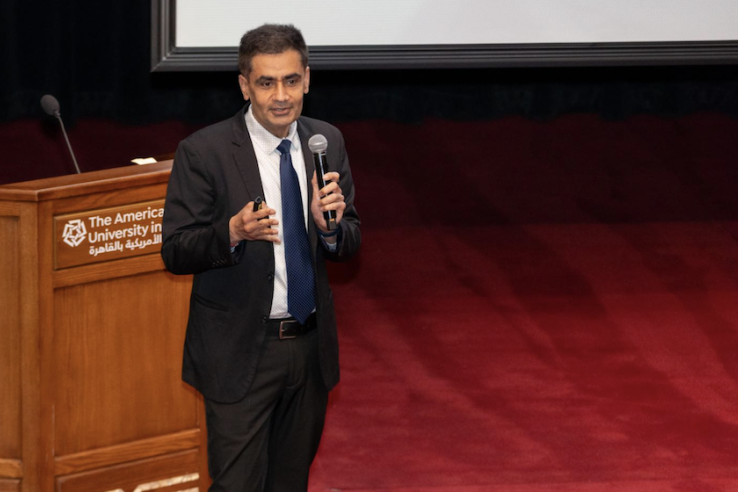
Our annual update and priorities for 2026
In our annual update, "Improving Lives Through Evidence," we reflect on a moment of rapid change for global development marked by tighter budgets, accelerating AI, and mounting climate risks. The digital report shares how we're meeting this moment: Read insights from Iqbal Dhaliwal, J-PAL's Global Executive Director; explore lessons from our latest research and partnerships; and learn about our vision for the coming year.
Join us at the AI Impact Summit
🗓️ February 17
Governments, NGOs, and social enterprises are rapidly adopting AI for their social programs, bringing questions about effectiveness, transparency, and unintended harms into sharp focus.
At the AI Impact Summit in New Delhi, India, we're hosting a full-day seminar to explore the role of responsible AI solutions in climate and agriculture, education, health, taxation and governance, and employment. Speakers include senior government officials leading India's national AI strategy; leaders from global tech companies like Anthropic, Google, and Meta; leaders from civil society; funders of AI for social good programs; and researchers in the J-PAL network conducting randomized evaluations of the impacts of new AI tools.
The seminar is an official event of the AI Impact Summit organized by the Government of India. It is the first-ever international AI summit to take place in the Global South—and the first to explicitly focus on impact. Learn more and register »
Exploring innovations and challenges for smallholder farmers
📍 Rabat, Morocco
The UM6P-J-PAL Applied Lab for Agriculture (UJALA) gathered over 300 researchers, practitioners, and policymakers in Morocco for its inaugural policy conference, focused on how smallholder farmers are navigating climate change and new technologies. Panelists explored the barriers farmers face to adopting new methods, the potential of digital tools when aligned with farmers’ needs, and the role of sustainable farming in soil health. In keynote remarks, J-PAL Director and MIT professor Esther Duflo emphasized the importance of supporting farmers as they adapt to climate change while improving crop productivity. Read more »
Training the next generation of philanthropic leaders across Asia
📍 Hong Kong
🗓️ Applications due February 15
This January, the Institute of Philanthropy launched the Leadership Excellence in Asian Philanthropy (LEAP) Fellowship, a flagship training program designed to empower the next generation of philanthropic leaders in Asia. Developed with faculty from J-PAL, the University of Hong Kong, and the London School of Economics, the LEAP Fellowship will equip participants with the skills, networks, and tools needed to strengthen Asia’s philanthropic sector.
The fellowship is tailored for experienced professionals in philanthropy who are currently or will potentially be in a leadership position. This June, J-PAL will lead a training on impact measurement to build participants’ skills in interpreting rigorous research and transforming evidence into actionable insights for their organizations. Applications are due February 15. Read more »
FEATURED BLOGS
Designing sustainable urban development projects
As cities worldwide grow and face rising climate risks, policymakers must ensure major urban development projects deliver real benefits for their communities. In a new blog, J-PAL Middle East and North Africa (MENA) staff and guest author Nermin Dessouky, Urban Development Programme Officer at UN-Habitat, explore how leveraging data and randomized evaluations in urban projects, like public transportation planning, can help reduce risks for these high-cost investments.
The blog also highlights how a learning partnership between the Hub of Advanced Policy Innovation for the Environment, J-PAL MENA’s Air and Water Lab, and UN-Habitat helped policymakers in Egypt design urban programs for measurable impact. Read more »
Reflections from J-PAL North America's Evidence Matters Convening
The Evidence Matters Convening, hosted by J-PAL North America in partnership with King County, Washington and the Wilson Sheehan Lab for Economic Opportunities, celebrated the work these teams, along with other policy labs, researchers, and state and local governments, are doing to advance evidence-informed policymaking across the United States. A new blog from J-PAL North America Senior Policy Associate Victoria Moura shares key takeaways on supporting the childcare workforce, improving safety net access, strengthening transit mobility, and embedding evidence into local budgeting. Read more »
Supporting job growth in low- and middle-income countries
In a new blog, Devin Chesney, Executive Director of the Aspen Network of Development Entrepreneurs, and Ying Gao, Senior Policy Manager at J-PAL, blend research and practitioner perspectives to explain why entrepreneurship alone isn’t enough to create jobs. Reflecting on Devin’s interview with J-PAL Director and MIT professor Esther Duflo last fall, the authors outline three broad ideas for policymakers and donors:
- Look beyond individual entrepreneurs to the systems that support them,
- Use evidence to improve how organizations help high‑potential firms grow, and
- Align funding with the broader needs of business ecosystems.
Together, these insights point towards stronger, more inclusive entrepreneurship ecosystems. Read more »
FEATURED EVALUATION SUMMARY
The effect of vocational training on gender norms
📍 Nigeria
Policy issue: While job training programs aim to help people find jobs, emerging evidence shows they can also influence people’s behaviors beyond the labor market by building skills and social ties. Can job training also shift gender attitudes by expanding participants’ economic opportunities and exposing them to new people and beliefs at their workplaces?
Evaluation: Researchers conducted a randomized evaluation to test the impact of providing a gender-neutral job training program for marginalized youth on their beliefs about gender norms. The program included outreach, mentoring, support services, and a year-long vocational training program.
Results: Youth who were offered job training adopted more equitable gender views, even though the training did not discuss gender. Their family members and caregivers also became more supportive of women’s roles in work and decision-making. The researchers suggest that job training helped youth from conservative communities enter the labor market and build new social connections, which fostered more equal gender views.
Research by: Emily Crawford (Binomial Optimus Limited), Benjamin Crost (University of Calgary), Oeindrila Dube (University of Chicago), Marcus Holmlund (The World Bank), Eric Mvukiyehe (Duke University)
FEATURED RESEARCHER
Your lived experience is an asset that gives you insight others may not have. Use it, trust your voice and remember that building a research career is a marathon.”
Nathaniel Olutegbe on fostering peaceful relations among farmers and herders in Nigeria
Our latest African Scholar Spotlight features Nathaniel Olutegbe from the University of Ibadan, who explores how locally-rooted solutions, such as community dialogue and adapted edutainment, can foster more peaceful coexistence between farmers and herders. His J-PAL-funded project sheds light on existing community structures and how people perceive their legitimacy, effectiveness, and accessibility. Read more »
WELCOMING OUR NEW AFFILIATED PROFESSORS
In summer 2025, we welcomed 29 talented researchers to the J-PAL network. We feature a few of them here each month.
Alex Bartik
University of Illinois at Urbana-Champaign
Patricio Dalton
Tilburg University
Eva Vivalt
University of Toronto
📺 FEATURED MULTIMEDIA
WATCH: Abhijit Banerjee at the Global Impact Evaluation Forum
At the World Food Programme’s Global Impact Evaluation Forum in Rome, J-PAL team members advocated for evidence-driven policy on panels about cost-effectiveness, locally-led impact evaluations, and the role of evidence in humanitarian response and accountability.
J-PAL Director and MIT professor Abhijit Banerjee delivered a keynote speech on the value of rigorous research during the current climate of humanitarian aid reductions. He emphasized the need to show that evidence matters in humanitarian settings amid a shifting global aid landscape, and called on researchers and practitioners to continue learning from proven solutions. Watch the video »
FEATURED EVENTS
Webinar: Launching a Research Partnership for Equitable Climate Action in Orlando
🗓️ March 3 | 2-3pm EST
Join J-PAL North America, researchers in the J-PAL network, and climate leaders from Orlando, Florida, for a conversation on the promise of rigorous evaluation in informing effective, equitable climate solutions. The webinar will feature a panel discussion with participants from the inaugural J-PAL North America Climate Action Learning Lab and their research partners, highlighting a study evaluating electric vehicle subsidies for low-income households in Orlando. Speakers will also share insights from a forthcoming climate action literature review that summarizes results and policy lessons from randomized evaluations. Register now »
FEATURED TRAININGS
Apply today to J-PAL North America Climate Action Learning Lab
🗓️ Apply by March 27
The Climate Action Learning Lab is recruiting a cohort of leaders from local government agencies, nonprofit organizations, and industries in North America to identify and scale effective and equitable climate mitigation and adaptation strategies. From May to August 2026, the Learning Lab will provide participants with a suite of free customized evaluation trainings, peer learning opportunities, and connections to academic researchers. Learn more »
Strengthen your data and economics skills this spring
🗓️ Enroll by February 17
The Data, Economics, and Design of Policy (DEDP) MicroMasters spring term courses started on January 20, but enrollment is still open until February 17. Those who complete the credential (five courses) can apply to MIT’s residential master’s DEDP program, one of several pathway universities, or J-PAL's Alliance for Data, Evaluation, and Policy Training (ADEPT) partners. If you aren't able to enroll now, summer courses start on May 12. Learn more »
ADEPT partnership spotlight: Leverage your DEDP MicroMasters to apply to the Paris School of Economics
🗓️ Apply by March 12
Through J-PAL’s Alliance for Data, Evaluation, and Policy Training (ADEPT), the admissions committee for the Paris School of Economics’ Master in Public Policy and Development (PPD) will consider applicants’ DEDP MicroMasters course certificates, recognizing the strong foundation it provides in economics, data analysis, and policy design. Apply today to advance your educational journey in economics and make a tangible impact. Learn more »
🗞️ MEDIA HIGHLIGHTS
“MIT Open Learning has opened doors I never imagined possible”
MIT News
‘Build a strong economy, ignore the noise’: Dhaliwal’s message at Davos
NDTV
Job skills won’t last: Nobel laureate Esther Duflo on rethinking college education
Hindustan Times
J-PAL’s Iqbal Dhaliwal on the power of AI and how it can help measure social schemes
CNBC-TV18
UM6P hosts UJALA conference on evidence-based agricultural policy
Morocco World News
📄 NEW RESEARCH PAPERS
On the Allocation and Impacts of Managerial Training
Achyuta Adhvaryu, Emir Murathanoglu, and Anant Nyshadham
Occupational Mobility and Retraining: Experimental Evidence on Firms’ Hiring Preferences
Ghazala Azmat, Luc Behaghel, Yagan Hazard, Roland Rathelot, and Joyce Sultan
From Default to Second Chances: Rehabilitating Delinquent Digital Borrowers
Alfredo Burlando, Michael A. Kuhn, Silvia Prina, and Brock M. Wilson
Impact of Reminder Messages, with and Without Financial Incentives, on Influenza Vaccination: A Randomized Trial in a California Health System
Tom Y. Chang, Mireille Jacobson, Manisha Shah, Rajiv Pramanik, Samir B. Shah