

J-PAL North America and Overdeck Family Foundation fund new study on building children’s language skills out of University of Chicago
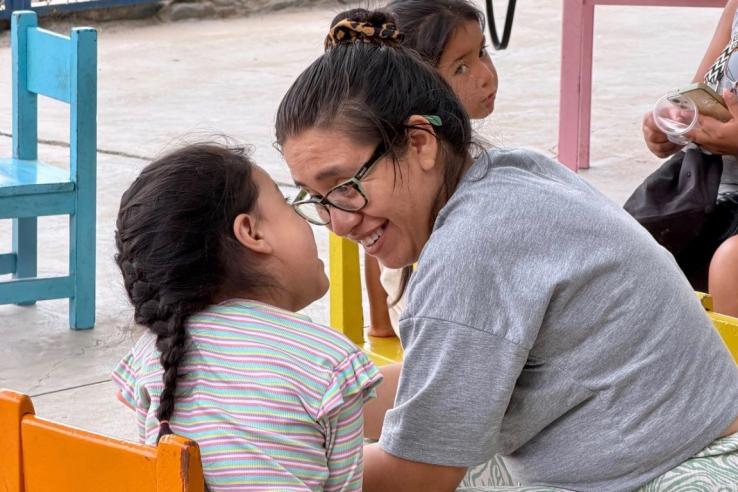
The University of Chicago’s Behavioral Insights and Parenting Lab is evaluating Chat2Learn AI, a low-cost messaging program that provides caregivers with timely, personalized conversation prompts—or “what to say”—to spark rich conversations with their preschool-aged children.
Children from low-income households often have fewer opportunities for frequent, interactive communication with adults than peers from high-income households—experiences that play an important role in early childhood development. This difference can contribute to gaps in language development and other critical school-readiness skills. To address these gaps, the Behavioral Insights and Parenting (BIP) Lab has spent the last four years developing and testing Chat2Learn AI. This app texts caregivers four to five chat prompts each week to start regular conversations with children. These conversational cues reflect the child's developmental stage; paired with colorful illustrations, they feature on-demand follow-up, AI-personalized follow-up prompts to scaffold further conversation.
Caregivers often want to have enriching conversations with their children, so Chat2Learn AI aims to make it easy to start by providing a timely reminder and an engaging topic, reducing the planning and mental effort required of caregivers. Over time, these conversations may help build habits that lead to more frequent, richer interactions and support children’s language development. When these resources are provided to families from low-income households, this app could help reduce the income-based gap in school readiness skills among preschool- and kindergarten-aged children.
The BIP Lab recently launched a full-scale randomized evaluation to test the effectiveness of Chat2Learn AI, with support from J-PAL North America and the Overdeck Family Foundation. “We’re thrilled to support the BIP Lab’s research efforts,” said Emily Hanno, Research and Impact Officer at Overdeck Family Foundation. “This study will deepen the field’s understanding of how emerging technologies can strengthen, not replace, the developmentally rich interactions that drive young children’s learning.”
J-PAL North America has supported this research across multiple stages to test the underlying mechanisms and refine the intervention before moving to a larger randomized evaluation (Learning Curiosity, Chat2Learn-AI). According to Daniela Gomez Trevino, Senior Research & Policy Manager and Education sector lead at J-PAL North America, “The evolution of Chat2Learn AI demonstrates the value of sustained investment in research—from piloting early-stage ideas to evaluating impact at scale. This long-term partnership reflects the commitment to identifying promising approaches and building the rigorous evidence needed to understand whether these approaches can meaningfully improve outcomes for low-income families and their children.”
The new study builds on a series of previous evaluations that explored how simple prompts can encourage richer caregiver-child conversations and support early learning skills. An initial randomized evaluation found that conversation prompts strengthened children’s vocabulary and parental agency for building their children’s skills. To further test the mechanism, a proof-of-concept experiment demonstrated that caregivers who were given open-ended conversation prompts used more varied language, longer sentences and more open-ended questions with their children. Finally, a recent pilot evaluation of Chat2Learn AI found promising signs that the platform may encourage caregivers to ask more open-ended questions and children to talk more, although the results were not strong enough to draw firm conclusions. The findings also suggested that prompts may work better when caregivers receive guidance on how to respond to what their children say and ask follow-up questions that keep the conversation going. These strategies promoted richer, more developmentally supportive interactions.
The new study takes the next step: testing whether these promising changes in caregiver-child conversations ultimately translate into stronger language skills for children. The study will include 1,000 families with preschool- and kindergarten-aged children older than six months. Researchers will examine whether the program strengthens children’s language skills and will also explore its effects on children’s curiosity, parent-child relationships, and parents’ confidence in supporting their children’s learning. The results will help answer a critical question: Can a low-cost, scalable tool that makes it easier for caregivers to have rich, everyday conversations with their children translate into meaningful improvements in children’s language development? If successful, Chat2Learn AI could offer a promising way to expand early learning opportunities for children from lower-income families, narrowing inequality in school readiness.