
K-CAI at COP30: How evidence is powering climate solutions
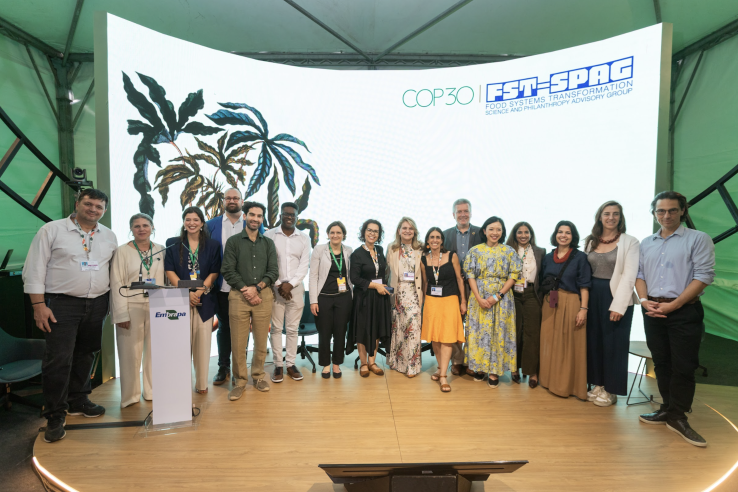
In Belém, Brazil, where the Amazon rivers converge and forests help regulate the earth’s temperature, COP30 last month was a unique summit and call to action. Ten years ago, when the Paris Agreement was signed, the world was on track for almost 4°C of warming by 2100. Today, thanks to global efforts and innovation, that projection has fallen to about 2.7-3.1°C—a full degree lower, but still far above the 1.5-2°C target that scientists say is critical to avoid catastrophic tipping points.
For J-PAL, this moment underscores why evidence matters in the fight against climate change. This is not just an environmental crisis—it is a development crisis. Low-income people in low- and middle-income countries are disproportionately affected by climate shocks, from crop failures to floods and heatwaves, which threaten hard-won gains against poverty.
This is why J-PAL works to generate climate solutions that protect livelihoods and promote equity. From tackling deforestation to building climate-resilient agriculture and ensuring just transitions for vulnerable communities, we are working to turn research into real-world impact. Five years after launching the King Climate Action Initiative, our portfolio has grown to over 100 projects and 14 scale-ups, shaping policies that reduce emissions globally and directly reach 33 million people with cleaner air, better tools for adaptation, and green technology.
At COP30, we shared this journey and looked ahead: exploring funding partnerships for an Amazon Livelihoods Lab to test solutions at the intersection of livelihoods and sustainability, and advancing bold ideas for adaptation finance and equitable carbon pricing that sparked global dialogue.
Event highlights from J-PAL at COP30
Protecting nature and supporting local communities
- Panel on Using Cash Transfers to Protect Nature: J-PAL LAC and the Nature Conservancy organized a panel that convened local government officials, development practitioners, and research institutions to explore the state of evidence on Payments for Ecosystem Services programs. After Maria Paz Monge, Senior Policy and Communications Manager at J-PAL LAC, shared evidence on how to design more scalable and inclusive PES policies, participants discussed key barriers deterring broader and fairer participation, drawing on lessons from around the world. They also emphasized the critical role communities play in co-designing PES programs (i.e., targeting, payments parameters, contract terms, delivery systems) to ensure more effective policy take-up, operational scale, and durable impact. This event was part of a broader effort from J-PAL and TNC to support governments in implementing better PES programs based on evidence and practice.
- Dialogue on Inclusive Climate Solutions: At Goals House, Esther Duflo joined Kleber Karipuna, co-chair of the Global Alliance of Territorial Communities, and David Gelles of The New York Times to spotlight indigenous leadership in advancing inclusive climate solutions. The discussion called for more research in the Amazon to preserve the environment and local livelihoods, a priority area for J-PAL in the coming years.
- Learning From Indigenous Leaders: J-PAL participated in a dialogue with indigenous, quilombola, and extractivist leaders to share climate strategies for small-scale farmers and women in agriculture.
Funding climate adaptation
- Keynote on Advancing Climate Justice with COP30’s Forests Envoy and Vale CEO: In the official COP30 Blue Zone, Esther Duflo presented “A grand bargain for climate mitigation, adaptation and compensation.” The proposal advocates for more funding from wealthy countries for climate adaptation through direct cash transfers to individuals affected by climate shocks, community block grants, and government disaster preparedness funding. The session was introduced by Beto Veríssimo, Brazil’s forests envoy and founder of Imazon, a leading Amazonian think tank, and Gustavo Pimenta, CEO of Vale.
- Dialogue on Mobilizing Business Coalitions for Nature and Climate: Esther Duflo participated in a fireside chat with Johan Rockström, Director of the Potsdam Institute for Climate Impact Research, at CASE, a private sector coalition that includes major Brazilian banks (Itaú, Bradesco) and global companies (Natura, Nestlé, and Vale).
Building resilient food systems
J-PAL Panel on Bridging Research and Scale for Agricultural Solutions: Leonie Rauls, Senior Policy Associate at J-PAL, moderated a panel in the Blue Zone on what it takes to scale scientific innovations for food and agriculture. The conversation, co-sponsored by OCP Nutricrops, brought together thought leaders driving change in global food systems, including Hicham El Azami representing both UJALA—a J-PAL embedded lab—and OCP Nutricrops. Hicham shared how UJALA reimagines the private sector’s role in funding and scaling policy-relevant research on agricultural technologies and practices.
The discussion underscored a powerful message: scaling isn’t just about technology, it’s also about collaboration. Researchers discover evidence-informed solutions, implementers build strong delivery systems, and multilateral development banks create sustainable funding environments. Together, these partnerships can transform agricultural innovation from promising pilots into global impact.
- Panel on Making Markets Work for Small-Scale Farmers Facing Climate Risk: Leonie also presented at the CGIAR and FAO Food & Agriculture Pavilion in the Blue Zone on evidence-based market access interventions to help farmers build resilience. Following the presentation, Leonie joined a panel discussion of member organizations of the International Agri-Food Network and a farmer from the Global Farmer Network to discuss how to leverage the private sector to integrate evidence-based interventions like contracting and crop storage technologies into supply chains. Watch the recording.
- Event on Scaling Evidence-Based Agricultural Innovations: Topics included forecasting technologies to help farmers adapt to climate variability, rainwater harvesting in regions facing desertification, and innovations such as flood-tolerant seeds, all technologies that have been rigorously evaluated through J-PAL’s flagship ATAI and K-CAI initiatives.
- Panel on Empowering Smallscale Women Farmers: In a panel discussion hosted by BRAC on supporting women farmers to adapt to climate change, Andre Zollinger, Senior Policy Manager at J-PAL, emphasized the need to base programs on existing evidence and the urgency of new research to clarify the impacts of agricultural policies on women farmers specifically.
Looking ahead
The stakes could not be clearer: every fraction of a degree avoided means fewer lives lost, less economic damage, and more resilient communities. The good news is that we already know what works to take us in the right direction to protect natural carbon sinks like forests, as well as a number of measures to help vulnerable communities adapt to a changing climate.
At COP30, we showed how rigorous research can accelerate this progress: from sharing insights on climate-adaptive agriculture and building a funding coalition in support of an Amazon Livelihoods Lab, to advancing bold ideas that support farmers, landowners, and markets.
The next decade is decisive. Investing in solutions we know work could bend the curve dramatically. We invite governments, funders, and innovators to join us in scaling evidence-driven climate action—because the cost of delay is measured in degrees, and every degree matters.
Learn more about our environment, energy, and climate change work.