Image


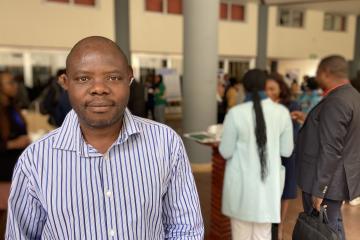
This post is part of our ongoing series showcasing the work and perspectives of economists from the African continent who are leading randomized evaluations. Through our African Scholars Program, we hope to help create more opportunities for African researchers to advance the research agenda on the continent through randomized evaluations. In this spotlight, we speak with Dr. Jonas Fassinou of Ecole Nationale d’Economie Appliquée et de Management, University of Abomey-Calavi (ENEAM-UAC).
What drew you into the field of development economics and, in particular, working with impact evaluations?
I am a Beninese economist, and my interest in development economics came from observing, from a young age, how public decisions shape the daily lives of households. After studying economics at the University of Abomey-Calavi (UAC), I worked as an administrator at the General Directorate of Economy in Benin's Ministry of Economy and Finance, where I contributed to economic forecasting and policy briefs. That experience made the gap between economic analysis and real-world decision-making tangible for me. We could produce the numbers and recommendations, but we often did not know whether the policies we recommended actually worked.
My interest in impact evaluation developed during my PhD at Université Thomas Sankara (UTS) in Burkina Faso, where my thesis examined the determinants of tax compliance and the performance of property tax mobilization in Benin. I kept coming back to the same question: how can we know with some degree of confidence whether the reforms we recommend actually change behavior? Further training helped me develop the tools to answer that question, including the MicroMaster in Development Economics at Université Laval, where I studied impact evaluation and gender analysis, the J-PAL Summer School on development methodologies, and a retooling workshop hosted by the American Institutes for Research and the African Economic Research Consortium (AERC). Through these experiences, I came to appreciate that randomized evaluations produce credible and actionable evidence that African policymakers can use to make informed decisions.
What are your broad research interests?
My research interests lie in public economics, with a focus on domestic resource mobilization and public policy in African contexts. Much of my work examines taxation, tax compliance, and the relative effectiveness of strategies to encourage compliance. I am also interested in how digital finance, including mobile money and digital identification, can help modernize tax administration. More recently, I have begun to explore questions around education and human capital, particularly parental involvement, foundational learning, and how schools and families jointly shape children’s educational outcomes. Gender is also an important lens across my research, from women’s economic empowerment and decision-making power to the gendered effects of education and microfinance interventions.
What are you using J-PAL initiative funds to do? What research questions are you trying to answer?
Benin’s New Program of Study reform, introduced in 1999, has made important progress in improving education, but mathematics performance remains a persistent challenge. Against this backdrop, I am currently working on a project funded through J-PAL’s Learning for All Initiative (LAI). The project, Social Origins and Mathematical Performance in Benin: Second Year of Primary Schooling Case Study, examines whether different levels of parental involvement can improve the mathematics performance of second-grade pupils. We are also interested in whether these effects differ by gender.
I also worked on a project for J-PAL’s Jobs and Opportunity Initiative (JOI) that evaluated the impact of women adopting improved cookstoves on their labour market participation and decision-making power within the household, as well as a project funded by J-PAL’s Digital Identification and Finance Initiative (DigiFI) that evaluated whether SMS reminders and mobile money payments and mobile money payments, can improve micro and small enterprises’ (MSEs) tax compliance and adoption of digital tax payments.
What do you see as the big unanswered research questions that RCTs may be able to help answer? Does this relate to any projects you are excited to work on in the future?
Several questions in my context are waiting for rigorous answers. First, how can African states sustainably mobilize domestic fiscal resources from largely informal economies? We need much more evidence on digital payment channels, communication strategies, and behavioral levers beyond the classic deterrence toolkit in improving tax compliance over the long term. Second, how do we improve foundational learning in francophone West Africa? The evidence base in the region remains limited, particularly on questions around parental involvement, tutoring, and the use of technology in education. Gender dynamics cuts across these questions: which interventions reinforce existing inequalities, and which can help reduce them, whether through time-saving technologies, access to finance, or education?
I am excited about three directions for future research. The first is scaling up our parental involvement intervention with the Ministry of Education. If the pilot produces promising results, we will be able to test what happens when the government implements this intervention on a national scale. The second is the digitalization of property taxation. My work in this area received the Best Paper Award from the African Tax Research Network Conference in 2021[1], where we now have an RCT on mobile money underway. The third is in using evidence in policymaking. I am involved in a mixed-methods study of Benin's first policy lab, Direction de la Recherche et des Études Stratégiques (DRES), which is embedded in the Ministry of Economy and Finance and examines how research actually enters and influences public decision-making.

J-PAL invests in the researcher as much as in the project.
— Dr Jonas Fassinou, Lecturer, Ecole Nationale d’Economie Appliquée et de Management, University of Abomey-Calavi (ENEAM-UAC)
How can organizations like J-PAL continue to build on the support they provide to local researchers in running randomized evaluations?
J-PAL has supported me at every stage of my career, from the JOI cookstoves project to the DigiFI project, and now the LAI pilot. To build on this support, I see potential opportunities in four key areas. First, continue investing in African researchers themselves. The African Scholars Program has created a genuine community and peer exchange amongst African researchers, which is as valuable as the formal mentorship the program provides. Second, organizations like J-PAL should generously support pilot phases, as this is often where research designs fail, because field logistics and implementation assumptions do not hold in practice, particularly in an African context. Third, J-PAL can help researchers build institutional partnerships with governments, which is important because evidence use matters as much as evidence generation.
Finally, organizations like J-PAL should invest in durable local capacity through training, data infrastructure, and policy labs.
What advice would you give to scholars who are considering applying to J-PAL for funding?
What surprised you the most about how J-PAL’s funding process works?
The level of technical depth and the collaborative spirit behind it. I expected a classic grant review. Instead, at every stage, J-PAL’s reviewers pushed me to sharpen the identification strategy, measurement, and statistical power of my projects, almost as if they were co-authors helping to improve the design. Additionally, J-PAL invests in the researcher as much as in the project. Mentorship, feedback, and network building are part of the support offered, and that can shape an early-career scholar’s trajectory far beyond a single grant.
Do you have advice for other young aspiring African scholars considering a career in economic research?
Be patient and persistent. A research career is a marathon, not a sprint. Rejections are part of the process, and each one can be an opportunity to strengthen your research design. Invest early in rigorous training in econometrics, impact evaluation methods, and academic writing, because that knowledge compounds over time. Build your networks through organizations such as Partnership for Economic Policy (PEP), AERC, African Tax Administration Forum (ATRN), International Centre for Tax and Development (ICTD), and J-PAL, and present your work wherever economists gather. Visibility creates opportunities. Stay close to the field: some of the most important research questions come from observing how policies play out in people’s daily lives, and the best data collectors are those who understand the field. Finally, do not underestimate the value of your own context. African data, African institutions, and African questions are not a limitation—they are an opportunity to contribute to and shape the global research agenda.
Jonas Fassinou, and Damas Hounsounon, “Incentives versus deterrent measures and tax compliance of landowners in Benin: a randomized controlled trial approach,” International Tax and Public Finance. (2026), https://rdcu.be/fmiLe