

Help desks to improve women's access to justice
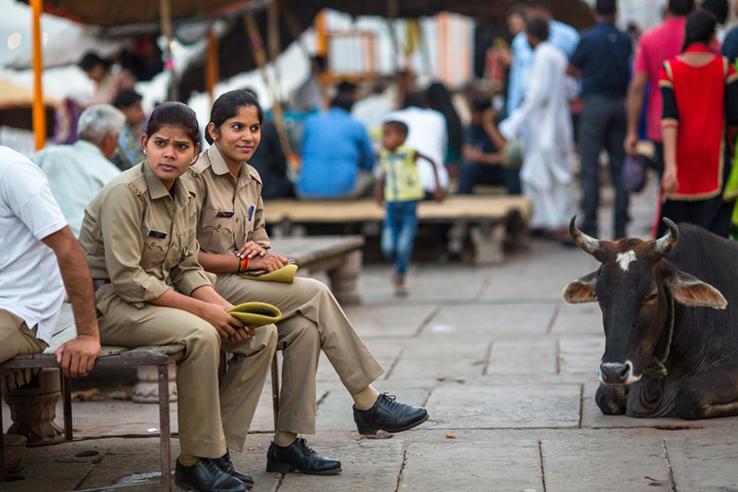
Like many countries, India is responding to rising levels of gender-based violence. Crimes against women are often not reported, limiting access to justice. A randomized evaluation in Madhya Pradesh found that police stations with dedicated spaces for women seeking assistance, known as women’s help desks, were more likely to register cases of crimes against women and domestic violence, particularly when help desks were run by women officers. Based on these findings, the Madhya Pradesh Police Department scaled up the help desks to 950 police stations across the state.
The Problem
Police are often not trained or equipped to handle reports of gender-based violence, leading to under-registration of GBV cases and preventing women from accessing justice.
Many countries face both rising levels of gender-based violence (GBV) and weak law enforcement, which often leads to underreporting of violence against women. These challenges are particularly acute in India, where an estimated four in ten women experience domestic violence in their lifetimes.1 A 2016 study of the four largest cities in Madhya Pradesh state found that only one percent of women experiencing violence reported it to the police.2
Women may be reluctant to report crimes to the police due to stigma surrounding GBV, low trust in the police, a perception that police are unresponsive to women’s concerns, and lack of follow-up. At the same time, police are often not trained or equipped to handle GBV reports and enforce related laws, leading to under-registration of the cases that are reported. This combination of under-reporting and under-registration prevents GBV survivors from having their cases heard in court and getting access to government services, and perpetuates violence by leaving offenders free to re-offend.
Central and state governments in India have launched a variety of initiatives to improve police responsiveness to women, including patrolling hot spots for crimes against women and creating reporting hotlines and women-only police stations. Measures that segregate women’s issues, however, don’t change practices in regular police stations, where women make up just seven percent of the police force and are not always well-integrated.3 The Madhya Pradesh Police (MPP) sought to address this challenge by mainstreaming assistance for GBV survivors at the station level and making police services more accessible.
The Research
The introduction of women’s help desks, dedicated spaces within police stations for women seeking assistance, increased registration of cases of crimes against women, especially when they were staffed by women police officers.
From 2018 to 2020, J-PAL affiliated professor Sandip Sukhtankar (University of Virginia), together with Gabrielle Kruks-Wisner and Akshay Mangla, partnered with the Madhya Pradesh Police Research and Training Department to develop the women’s help desk model and evaluate the impact of introducing women’s help desks in police stations. The study was funded by J-PAL’s Crime and Violence Initiative.
The intervention was developed collaboratively by researchers and police personnel and consisted of four key components:
- Private spaces in stations for women seeking assistance;
- Standard operating procedures and training for officers on case registration and gender sensitization;
- Outreach to local women’s networks via the police, local community groups, and an NGO with expertise supporting survivors of GBV; and
- Assignment of women officers to staff the help desks.
The police selected 180 police stations serving 23 million people to take part in the study. Researchers found that officers in stations with help desks were more likely to register cases of crimes against women and domestic violence, particularly when desks were run by women officers. While police attitudes towards GBV did not change on average during the short period in which the study took place, women officers became more likely to believe claims of GBV.
Women were no more likely to visit police stations with help desks than those without, potentially due to low awareness of them. Rather, when women did come to police stations with help desks, their GBV claims were more likely to be listened to and registered. In stations where help desks were well-implemented and officers well-trained, women visitors also reported greater comfort, satisfaction, and respect.
These findings suggest that, to improve responsiveness to GBV, the police should not just hire more women—many Indian states now require that women make up 30 percent of new recruits—but assign them to front-facing roles and empower them with training and support.
For more on the research, please read the evaluation summary.
From Research to Action
Based on these findings, the Madhya Pradesh Police Department scaled up help desks to 950 police stations across the state.
The research and scale-up were grounded in a strong relationship between the Madhya Pradesh Police Department (MPP) and the research team.
Senior officials in the MPP wanted to do better by survivors of GBV—and to ground their approach in evidence. Towards those goals, they established a Research and Training Department and approached J-PAL to discuss a partnership. In 2017, the MPP signed a Memorandum of Understanding with the researchers to make policing more evidence-based and accessible to all. The MPP already had women’s help desks in one station per district; police personnel collaborated closely with researchers and J-PAL South Asia, in addition to legal consultants and civil society, to develop the expanded help desks model evaluated in the study.
“Crime against women is a major challenge for the Indian Police. Sincere systematic as well as innovative responses have been made over the years to encourage women to reach out to the police in times of need. The rigorous research has come up with excellent policy inputs which would improve access of women to the police and mainstream reforms at the Police Station level."
Rishi Shukla, former Director, Central Bureau of Investigation; former Director-General of Police, Madhya Pradesh Police Department
Based on these findings, the MPP scaled up women’s help desks to 950 stations across the state. With a population of 86 million, Madhya Pradesh is one of the largest states in India. When the study began, sixteen percent of the population reported visiting a police station in the past year, suggesting that nearly four million women may encounter the help desks annually at scale.
This scale-up was supported by an effort led by the Ministry of Home Affairs (MoHA), India’s main planning agency, to enhance police infrastructure for women’s safety. In 2020, MoHA released detailed guidelines for establishing and running women’s help desks after soliciting inputs on the help desks program from the MPP. On International Women’s Day in 2021, MoHA officially announced a nationwide help desks initiative, with dedicated funding for all states, and the scale-up in Madhya Pradesh was launched. Ongoing costs are borne by the state, positioning the scale-up for sustainability.
The four core components of the help desk model—private spaces, standard operating procedures, community outreach, and staffing by women officers—have stayed the same as the program has scaled. Based on a research finding that only 10 percent of women were aware of the help desks, the program introduced new strategies for community outreach, such as visits and events at girls’ high schools and colleges. Oversight has moved from the more experimental Research and Training department to the Crimes Against Women (CAW) department, a signal of greater institutionalization within the police.
With funding from J-PAL’s Innovations in Government Initiative, the research team helped develop online training modules and monitored implementation of help desks at scale to ensure they remained true to the evidence-based model. Researchers are also studying ways to retain newly hired women police recruits.
J-PAL South Asia hosted an event in 2023 with senior police and government officials from multiple states to share research findings and discuss how police can better serve women. In light of this guidance, other Indian states have expressed interest in implementing their own versions of the program, and the research team is planning to evaluate a related intervention in Punjab.
“[This program is] one of its kind, and one of the largest evidence-based policy [projects] on the police and women's security at this scale, at least in India… Other states like Punjab and Chhattisgarh are already trying to follow this lead.”
Vineet Kapoor, Deputy Inspector General of Police (former State Coordinator for Police Research and Training Department), Madhya Pradesh Police Department
Through their ongoing partnership, the Madhya Pradesh Police Department, the research team, and J-PAL South Asia are developing an implementation guide to help state police departments adapt the women’s help desk model to their contexts and implement them successfully at scale.
References
Sukhtankar, Sandip, Gabrielle Kruks-Wisner, and Akshay Mangla. 2022. "Policing in patriarchy: An experimental evaluation of reforms to improve police responsiveness to women in India." Science 377, no. 6602: 191-198. doi: 10.1126/science.abm7387
Abdul Latif Jameel Poverty Action Lab (J-PAL). 2025. " Help Desks to Improve Women’s Access to Justice." J-PAL Evidence to Policy Case Study. Last modified December 2025.
Kalokhe, A., et al. (2017). Domestic Violence against Women in India: A Systematic Review of a Decade of Quantitative Studies. Global Public Health 12, no. 4: 498-513.
Neville, S, et al. (2015). Evaluation of the Madhya Pradesh Safe Cities Initiative. Baseline Report. London: DFID.
Common Cause et al. (2019). Status of Policing in India 2019: Police adequacy and working conditions. New Delhi: Common Cause & Lokniti.