

The impact of payments for ecosystem services on crop burning in India
- Farmers
- Pollution
- Technology adoption
- Climate change mitigation
- Cash transfers
- Information
- Natural resource management
- Conditional cash transfers
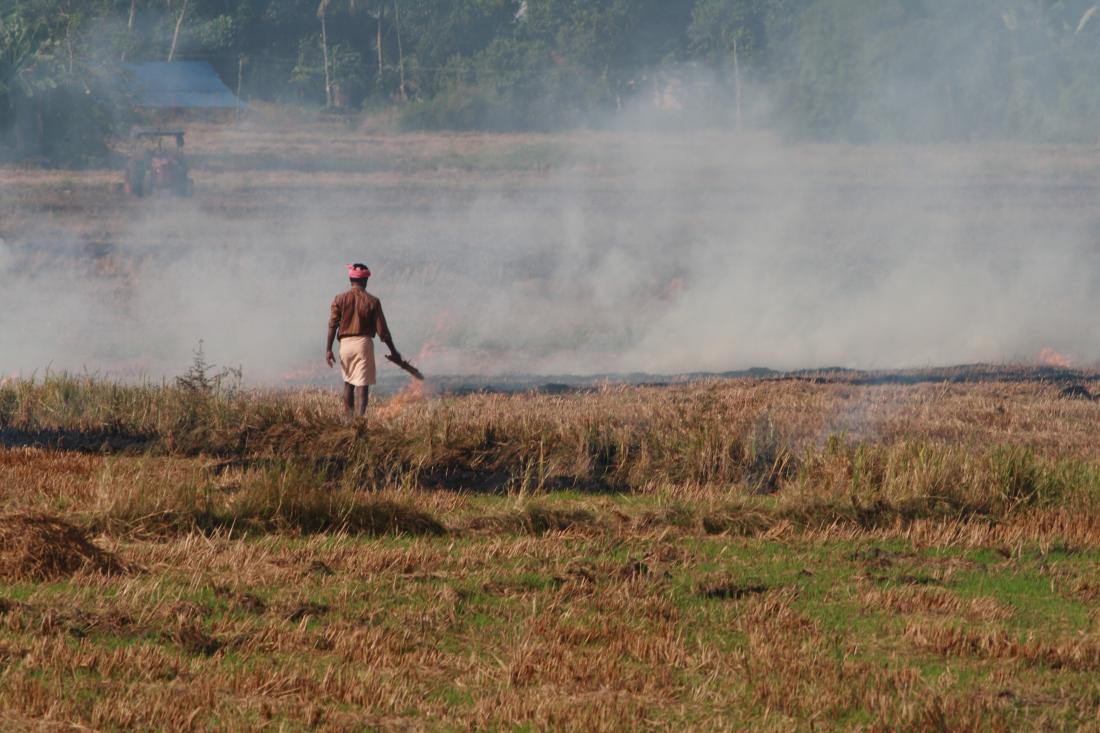
Farmers often burn crop residue to clear fields inexpensively after harvest, creating massive air quality problems across northern India. Researchers conducted a randomized evaluation to test the impact of offering financial rewards to farmers to stop burning rice stalk stubble on their eventual crop residue burning decisions in Punjab, India. They found that pre-harvest payments to farmers helped them to take costly actions to reduce burning by 10 percentage points, compared to when farmers only received payments after completing harvest and field-clearing.
Policy issue
Governments around the world face the tough challenge of designing policies to prevent environmental damage. In low- and middle-income countries, fines to discourage environmental damage may be difficult to enforce without sufficient government resources. Additionally, low-income households may be meaningfully harmed by fines. For example, air quality is a leading cause of preventable poor health and death globally. Burning crop residue to clear fields inexpensively after harvest is a large contributor to poor air quality.
Payments for ecosystem services (PES) is an approach that pays people to avoid environmentally damaging actions rather than imposing a traditional fine. Most PES programs hold payment until after a period of time, in order to verify conditions have been met before making payments. However, this often requires participants to miss out on income or pay for a costly alternative before receiving payment. If PES participants receive partial up-front payment, are they better able to afford and/or more willing to change their habits? How does this compare to a standard PES program?
Context of the evaluation
In northern India, life expectancy is reduced by an estimated six to nine years by air pollution, and burning rice stalk residue accounts for 30-40 percent of air pollution in winter in New Delhi, the most severe season for air pollution. In the northern Indian state of Punjab, approximately 80 percent of land is under agricultural cultivation. Rice and wheat are the two most common crops, often grown on the same fields in different seasons, requiring quick field clearing between crop cycles. Growing and mechanically harvesting rice to clear the way for planting wheat leaves about 2.5 tons of residue per acre, which is commonly cleared by burning.
India’s central government has attempted different policy approaches to reduce stubble burning, including offering subsidies to rent alternative equipment that removes stubble without burning it, known as crop residue management (CRM) equipment. Since 2015, a court ruling in Punjab prohibited farmers from burning stubble, applying fines of approximately INR2,500 to 15,000 (US$31-186) per acre. However, enforcement has been weak. Given the low likelihood of fine enforcement, high costs for renting CRM equipment, and time pressure to prepare fields before planting wheat, many farmers continue to use residue burning.
Households in the study had between 2-12 acres of paddy and used equipment that indicated they had burned crop residue the previous year. More than half of their income came from agriculture; in the comparison group, households made on average INR114,000 in profits per year (US$1,415). Most households stated it would be hard to get a loan of INR5,000 (US$62) for large investments like CRM equipment, and fewer than half of study households had that amount in savings. Roughly half of all households had ever signed a contract. Of all households in the study, 13 percent stated they entirely trusted the government, while 7 percent trusted NGOs.
Details of the intervention
Researchers conducted a randomized evaluation to test the impact of different versions of PES programs in Punjab, India that offered farmers funds before and after harvest for reducing stubble burning.
Researchers identified 1668 farmers with an area of paddy cultivation between 2 and 12 acres across 171 villages in Bathinda and Faridkot, two districts with high rates of burning in 2019. Villages were randomly assigned to one of the following groups:
- PES paid after clearing (30 villages): Eligible farmers were offered a PES agreement that paid them INR₹800 (US$9.93) per acre for up to ten acres (to a maximum of INR₹8,000 (US$99.28) on the condition that they not burn their paddy fields. The government of Punjab helped determine this payment level, envisioning what would be feasible if the program were applied state-wide and run by the government.
- Higher PES, paid after clearing (28 villages): Farmers were offered a PES agreement that paid them INR₹1,600 (US$19.86) per acre for up to ten acres (to a maximum of INR₹16,000 (US$198.57)) on the condition that they not burn their paddy fields.
- Up-Front PES with 25 percent advance (31 villages): Farmers were offered the lower amount (INR₹800 per acre), and if they accepted it, received 25 percent of the amount (INR₹200 (US$2.48) per acre for up to ten acres) within 2-3 days of signing, unconditional on whether or not they burned residue later. The remainder was paid after checking that farmers did not burn crop residue.
- Up-Front PES with 50 percent advance (31 villages): Farmers were offered the lower amount (INR₹800, and if they accepted it, received 50 percent of the amount (INR₹400 (US$4.96) per acre for up to ten acres) within 2-3 days of signing unconditional on whether or not they burned residue later. Farmers received the remaining payment after researchers checked they did not burn crop residue.
- Comparison (51 villages): Farmers engaged in business as usual, with no PES offer.
For all payments besides up-front advances in two of the intervention arms, farmers agreed to contact the project team once they had managed stubble so that the team could visit the farm and check for signs of stubble burning. If there were no signs of burning on any plots, they would be eligible for payment.
Before offering PES contracts near the start of rice harvest, starting in October 2019, researchers visited households to collect basic data including defining the boundaries of farmers’ land. Researchers mapped the land plots to satellite images, and trained a machine learning model to identify signs of crop residue burning. During the program, researchers visited plots in-person to verify non-burning when farmers called. They also collected data on CRM usage and agriculture outcomes after the program, in late summer 2020.
Results and policy lessons
Farmers who were offered PES contracts with up-front payment were half as likely to burn stubble on their fields as those offered standard contracts.
Take-up of PES contracts: Approximately 72 percent of farmers offered any contract signed up for PES to avoid burning stubble in their fields, regardless of whether they were offered partial payment up-front.
Contract compliance: Researchers consider farmers to have complied with the program if they requested monitoring of their plots, and all plots were assessed as harvested and unburned. In the groups offered up-front PES, farmers were 10 percentage points more likely to comply with the contract than farmers offered standard PES, where on average 8.5 percent of farmers complied.
Remote sensing confirmation: Using remotely sensed data that analyzed burn patterns across all farms in the study, researchers found that farmers offered standard PES were just as likely as the comparison group to burn their stubble. This means that the standard PES contract did not cause additional farmers to stop burning.
However, farmers offered up-front PES were 7.7 percentage points less likely to burn residue than the comparison group, where 90.1 percent of farmers burned residue. The modest impact on reduced burning suggests that the payments were not high enough to compensate for the effort and costs of finding alternatives to burning.
Trust and access to cash: Farmers offered up-front PES may not have burned residue because they were more confident that they would receive the full payments at the end of the contract than those offered standard PES, or because they could afford different options. In a subset of farmers in the PES groups, 92.2 percent of farmers in the up-front PES group trusted they would be paid if they complied relative to 85.4 percent of farmers offered standard PES. However, there was no difference between the groups in reporting how important their access to cash was in deciding whether to invest in crop management equipment.
Cost-benefit comparison: Researchers calculate that every dollar spent on up-front PES generated 125 to 190 times the cost in health benefits from reduced stubble burning, costing roughly $3,600 to $5,400 per life saved.
This study demonstrates that PES can be effective at reducing harm to the ecosystem. Future research that varies the amounts of payments or includes dynamic incentives over seasons could help design cost-effective and more scalable versions. For example, if the program were implemented at a large scale over time, farmers may be more likely to trust it over multiple seasons, which could further reduce costs.