

Improving Literacy Through Cognitive Science: Evidence from the United Arab Emirates
- Children
- Parents
- Primary schools
- Students
- Teachers
- Student learning
- Cognitive development
- Training
- Pedagogical innovation
- Tailored instruction
- School-based inputs
Arabic-speaking countries perform poorly on international reading assessments. Evidence from cognitive science suggests that several features of Arabic make the language particularly difficult for beginning readers. In partnership with the Al Qasimi Foundation for Policy Research (AQF), researchers conducted a randomized evaluation in the United Arab Emirates (UAE) to test the impact of the Iqra curriculum, a cognitive science-based literacy program, on young students’ Arabic reading skills. The program improved students’ Arabic literacy, including letter identification, word reading, and reading fluency.
Policy issue
Children in Arabic-speaking countries often struggle to learn to read. In the United Arab Emirates (UAE), many children speak one Arabic dialect at home, but learn to read in Modern Standard Arabic at school. Written Arabic also creates challenges for beginners. The same letter can look different depending on where it appears in a word. Policymakers therefore need better evidence on how to teach Arabic reading in the early grades. This study asks whether Iqra, a structured literacy curriculum based on cognitive science, can improve Arabic reading when introduced in primary classrooms in the UAE.
Context of the evaluation
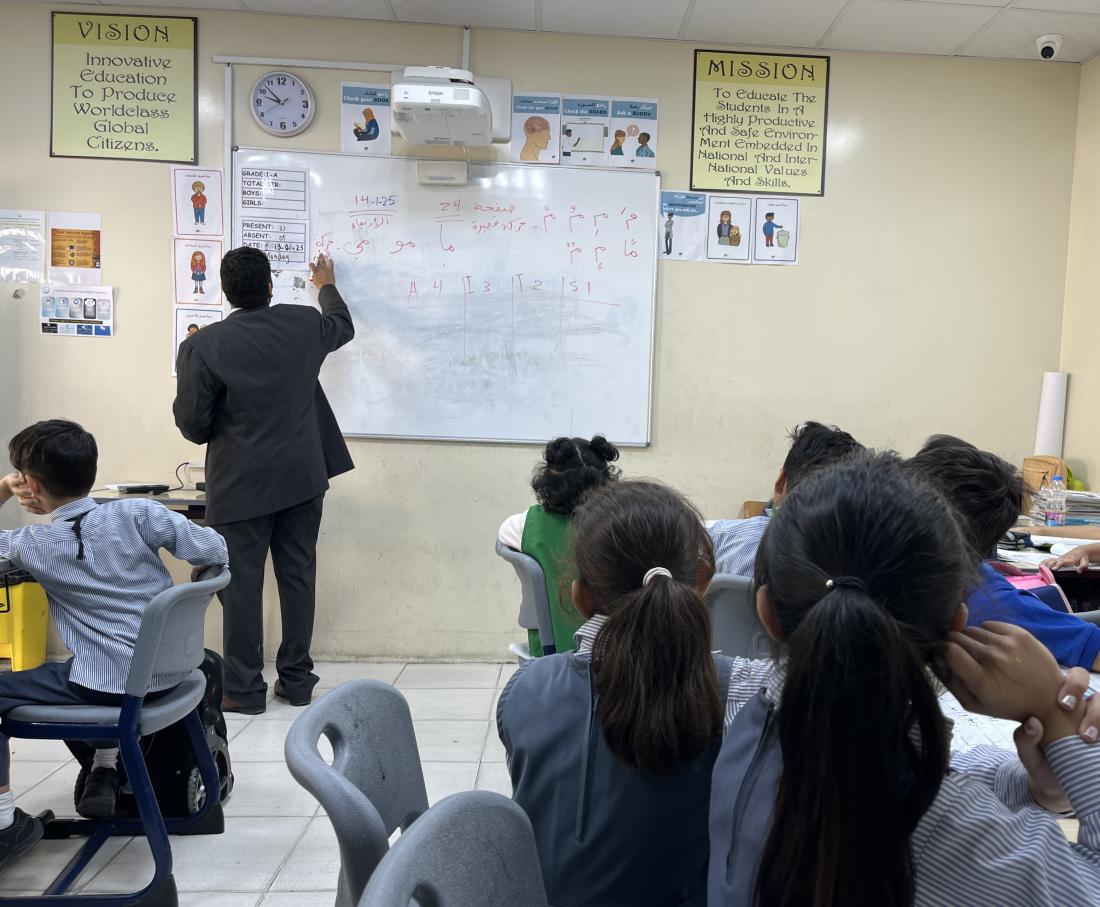
The Iqra curriculum consists of forty lessons, meant to be taught in 45 minute segments over the course of the school year. The lessons typically replace Arabic lessons taught using the standard curriculum, with total instruction time held constant. The curriculum introduces letters one at a time, going from simpler to more complex letters, and uses large font sizes and spacing to support students’ automatic letter and word recognition. The curriculum also uses reading techniques like reading out loud as a class and reading in pairs.
The evaluation of Iqra took place in 26 schools across Ras Al Khaimah (RAK), an emirate in the United Arab Emirates. Of these schools, seven were public and nineteen were private, with a mix on Emirati and international schools.
About two-thirds of the students were native Arabic speakers. The remaining students spoke other languages at home, typically Urdu or other South Asian languages. The students in the study were between 5-8 years old, with the majority of students in grade 1 and the rest in the second year of kindergarten.
Details of the intervention
In partnership with the Al Sheikh Saud bin Saqr Al Qasimi Foundation for Policy Research (AQF), researchers conducted a randomized evaluation to test the impact of the Iqra curriculum on children’s literacy skills. Researchers randomly assigned 83 classrooms in 26 schools to one of two groups:
1. Iqra group (41 classrooms): Students received the Iqra curriculum in parallel to the usual Arabic curriculum designed by the Ministry of Education. Iqra was delivered for two class periods every week, for a total of one hour and twenty minutes. In most schools, Iqra was integrated into the regular Arabic class time, and replaced two of the lessons following the standard curriculum. In 5 of 26 schools, Iqra was taught during extracurricular time.
2. Comparison group (42 classrooms): Students followed the standard Arabic curriculum, which involves about 4.5 to 5.25 hours of weekly instruction time.
Researchers assessed students on their literacy in Arabic before and after the school year, once in September-October of 2024 and once in May of 2025. Outside observers visited classrooms to assess teacher implementation of the curriculum. Once teachers were over halfway through the school year, they completed a survey about their instructional practices.
Results and policy lessons
Literacy outcomes: Iqra improved Arabic reading. Students assigned to the program scored 0.19 standard deviations higher in word reading and 0.09 standard deviations higher in overall Arabic literacy. These gains were concentrated in the skills most relevant for beginning readers and most directly targeted by the curriculum, including word reading, letter identification, decoding, and reading fluency. Effects were weaker for more advanced skills, such as reading comprehension. The overall literacy effect is equivalent to about one quarter of a year of progress by local standards, or 0.17 learning-adjusted years of schooling using an international benchmark.
Other student outcomes: Iqra did not appear to affect learning beyond Arabic reading. The program neither improved nor harmed numeracy. It also had no detectable effects on executive function, including students’ attentional capacity and their ability to sustain attention during effortful tasks.
Teacher practices: Implementation data show that Iqra changed classroom practice. Treatment and control classrooms were exposed to distinct pedagogical approaches. Iqra classrooms placed greater emphasis on repeated decoding practice and visual scaffolds, including reading aloud with students, presenting words/sentences around a target letter, and focusing on one new letter or vowel per class.
Use of Results:
The Iqra program is now being scaled up to all private schools in Ras Al Khaimah.