

Technology Adoption and Diffusion through Social Networks Among Coffee Farmers in Rwanda
- Farmers
- Rural population
- Technology adoption
- Training



New agricultural technology has the potential to improve crop yields in low-income economies, but only if farmers put it to use. In Rwanda, researchers worked with TechnoServe to evaluate the impact of an agronomy training program on trained farmers’ knowledge and use of best practices in coffee-growing, along with spillovers on untrained farmers. The agricultural trainings expanded trained farmers’ social networks, improved their knowledge of best practices, and improved their self-reported technology adoption relative to untrained farmers in the same villages. Neither knowledge nor adoption spread to untrained farmers. In fact, untrained farmers experienced lower yields in villages with a higher share of trained farmers. The researchers suggest that in contexts where local input markets are constrained, the usual model for agricultural extension programs of training only some farmers may be ineffective.
Policy issue
New agricultural technology has the potential to improve crop yields in low-income economies, but only if farmers put it to use. To enable the diffusion of new technologies, governments, NGOs, and firms invest heavily into agricultural training programs. It is common for such programs to operate by training a small group of farmers within a local community, under the assumption that knowledge of the new technologies will spread organically. However, there is mixed evidence on the extent to which this diffusion actually happens. It is also unclear if the group training itself can alter participants’ social networks in ways that aid or hamper the spread of knowledge. If knowledge does not spread far beyond the trained farmers, the training program may place untrained farmers at a disadvantage. To what extent does knowledge spread from agricultural training programs? Do these programs place some farmers at a disadvantage? Do these programs alter social networks?
Context of the evaluation
Coffee is a major export crop for Rwanda and contributes about US$62 million in export earnings each year. The coffee industry in Rwanda is dominated by about 500,000 smallholder coffee producers. The conditions for growing coffee in Rwanda are ideal, but adoption of the latest agricultural technology remains low.
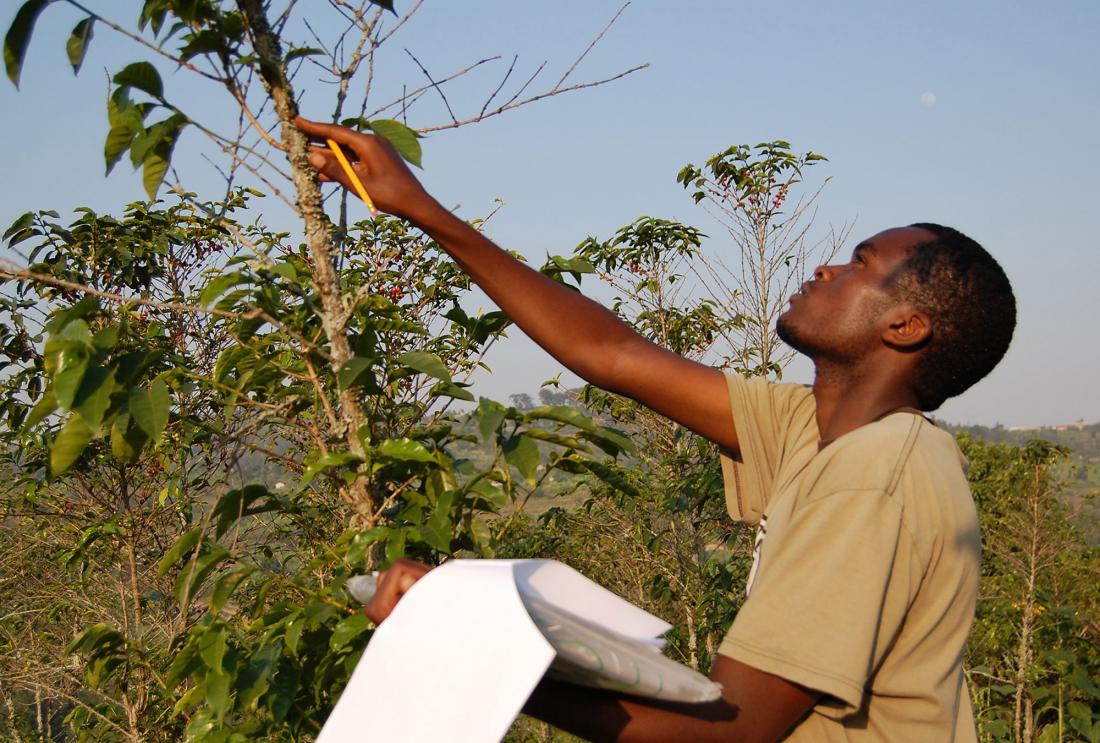
TechnoServe, an agri-business NGO, conducted agricultural technology trainings in several coffee growing regions in Rwanda and other East African countries between 2010 and 2015. Researchers conducted a randomized evaluation of one of TechnoServe’s agronomy training programs in Kamonyi, Rwanda. Smallholder coffee farmers in this district harvested, on average, 188 kilograms of coffee at a time. Eighteen percent of farmers applied NPK fertilizer to their coffee trees.
Details of the intervention
Researchers conducted a randomized evaluation to test the impact of the agronomy training program on farmers’ coffee-growing practices, crop yields, knowledge-sharing, social network structure, revenues, and spillovers onto coffee farmers who did not receive the agronomy training. There were 1,594 coffee farmers from 27 villages who signed up for TechnoServe’s training program. Researchers randomly assigned the 27 villages to one of four groups:
- Low-density training villages (8 villages, 380 farmers): In about one third of the villages, 25 percent of the farmers who signed up were offered the trainings.
- Medium-density training villages (10 villages, 610 farmers): In around one third of the villages, 50 percent of the farmers who signed up were offered the trainings.
- High-density training villages (9 villages, 604 farmers): In approximately one third of the villages, 75 percent of the farmers who signed up were offered the trainings.
- Comparison (739 farmers): The farmers who were not offered trainings compose the comparison group.
Researchers surveyed 1,327 coffee farmers who did not sign up for the training. This design allowed researchers to measure diffusion of information about agricultural practices and changes in social networks within villages.
The training lasted for over a year and a half and covered several best practices in coffee growing: tree pruning, fertilizer use, pest and weed management, mulching, soil and water conservation, optimal shade, and record keeping. Training sessions took place once a month for eleven months in the first year of the program and TechnoServe conducted an additional six review training sessions over the course of the second year. There were 38 groups of around thirty farmers each attending the trainings, which took place on the plot of a designated "focal farmer." The focal farmers were chosen based on the accessibility of their plots and because of their perceived respectability in the community and interest in learning.
Researchers conducted ten rounds of surveys between December 2009 and October 2012, collecting data on farmers’ social networks, knowledge and adoption of agricultural best practices, agricultural inputs, and yields.
Results and policy lessons
The agricultural trainings expanded trained farmers’ social networks, improved their knowledge of best practices, and improved their self-reported technology adoption. Neither knowledge nor adoption spread to untrained farmers, and in fact they saw lower yields, while trained farmers’ yields did not change.
Social networks: Coffee farmers gained more friends among farmers in their village who also signed up for the trainings. Trained farmers made more friends among other trained farmers, while untrained farmers made the same number of friends among trained and untrained farmers. At the same time, all farmers had fewer friends from outside their village. Overall, this suggests that untrained farmers did not acquire new social ties with trained farmers as a consequence of the training, while trained farmers’ social networks shifted towards other trained farmers.
Knowledge and adoption of coffee-growing best practices: Nearly three years after the trainings began, farmers who participated were more knowledgeable about best practices than comparison farmers, and they were more likely to implement the new practices. Trained farmers’ knowledge levels increased by 1.24 standard deviations (SDs) compared to untrained farmers. Trained farmers were also 0.32 SDs more likely than untrained farmers to state they were adopting best practices taught in the trainings. In addition, audits indicate trained farmers were 0.04 SDs more likely to take up these practices, and were 0.031 SDs more likely to have healthy coffee trees.
Moreover, trained farmers did not share their knowledge with untrained farmers. Untrained farmers did not become more knowledgeable of or more likely to adopt best practices when they had more friends who were trained farmers. In fact, having more friends receive training may have caused some untrained farmers to adopt fewer best practices, based on audits of their trees.
Coffee harvest: Researchers found that the training program did not increase farmers’ yields or net revenues. However, by examining outcomes by the density of trained farmers in each village, researchers found evidence that untrained farmers experienced lower yields, input use, and revenues when there were more trained farmers in their village. The researchers hypothesize that this was caused by a reallocation of a limited supply of agricultural inputs, such as fertilizer, compost, and hired labor, in the district.1 Trained farmers may have gone further out of their way to acquire these inputs, raising prices and leaving less available for untrained farmers.
These results suggest that while the trainings helped farmers learn about coffee-growing technologies, such knowledge did not spread to untrained farmers. Moreover, untrained coffee farmers had lower yields and used fewer inputs, possibly because trained farmers acquired more of a limited supply of agricultural inputs. In contexts where local input markets are constrained, the usual model for agricultural extension programs of training only some farmers may be ineffective.