MENA - Community of Practice Series
Overview
The MENA-Community of Practice (M-CoP) aspires to establish a culture of evidence-based policy in MENA's education sector.
This goal involves:
- Embedding evidence in policy processes
- Catalyzing continuous learning and improvement
- Empowering stakeholders
Description
By bringing together key public, private, and civil society stakeholders (such as government officials, NGOs, researchers, and school administrators), the series of online convenings fosters ongoing dialogue about what works to increase access to and the quality of education opportunities for young people in the region.
This collaborative platform aims to unite all actors in a dynamic exchange of insights and strategies to comprehend and tackle the root causes of educational challenges in the MENA region.
M-CoP 1: Myth Busting: What Does Not Work In Education
The first webinar, hosted by J-PAL MENA, titled "What Does Not Work for Education: Insights from Randomized Evaluations," delved into real-world findings from Randomized Controlled Trials (RCTs) to explore why certain education interventions have fallen short—and the lessons we can draw from them. Following this, we discussed the pressing challenges facing development practitioners amid emerging uncertainties. Through an open dialogue and local case studies, participants shared how they plan to prioritize their activities, drawing on evidence of what works. By bridging rigorous research with practical insights, M-CoP aims to refine strategies, avoid common pitfalls, and promote more effective, evidence-based approaches to education in the region.
Covered Topics:
Myth Busting: Evidence Sharing by J-PAL MENA
- Highlighting Lessons from RCTs – This session examined key insights from RCTs that reveal why certain education interventions did not achieve their intended outcomes.
- Bridging Research and Practice – Speakers discussed how stakeholders can use rigorous evidence to refine policies and programs, ensuring better educational outcomes.
The Road Ahead: Opportunities and Challenges
- This discussion focused on the pressing challenges facing development practitioners amid emerging uncertainties.
Speakers
- Nayera Adly Husseiny, Senior Policy, Communication, and Training Manager, J-PAL MENA and Egypt Impact Lab Lead
- Arwa Adel, Senior Policy, Training and Events Associate
- Farida Maged, Policy and Communications Associate
M-CoP 2: Evidence-Based Approaches To Foundational Literacy And Numeracy Programs
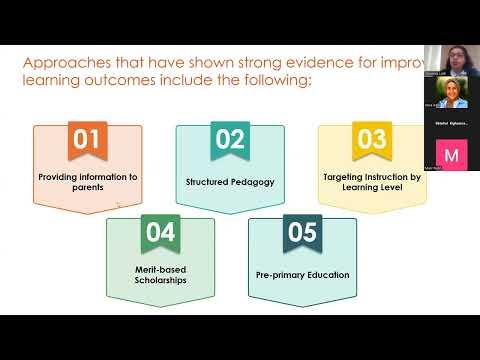
This webinar delves into real-world lessons from interventions conducted on foundational literacy programs; thereby highlighting learnings on cost-effectiveness, evidence strength, and barriers to foundational literacy and numeracy programs conducted globally.
Through fostering an open dialogue, this webinar aims to shed light on the use of evidence for measuring program effectiveness and inform future scale-up or adaptations.
Covered Topics:
What works to improve Foundational Literacy and Numeracy Programs?
- This session explored interventions that have shown strong evidence and high cost-effectiveness for foundational literacy and numeracy programs by J-PAL.
Regional Initiatives: National Programme for Developing Arabic Language Skills in Egypt
- This session discussed lessons from the implementation and evaluation of the National Programme for Developing Arabic Language Skills in Egypt.
Regional Initiatives: IQRA Program Evaluation - UAE
- Spotlight on regional interventions in the UAE that improve education outcomes for children’s basic skills in foundational literacy.
Speakers
- Ebtehal El-Ghamrawy, Education Specialist, UNICEF Egypt
- Arwa Adel, Senior Policy, Training and Events Associate, J-PAL MENA
- Yassmine Lotfi, Policy Associate, J-PAL MENA
- Mennatallah Badr, Research Associate, J-PAL MENA
- Marc Nabil, Research Associate, J-PAL MENA