


UJALA Researcher-Led Evaluations Request for Proposal (RFP)

Farmers planting rice near Yogyakarta, Indonesia
Alexander Mazurkevich, Shutterstock

UM6P-J-PAL Applied Lab for Agriculture (UJALA) is calling for proposals to evaluate agricultural technologies and practices aimed at improving the productivity, profitability, food security, and environmental sustainability of small-scale farmers globally. 

Overview

Researcher-Led Evaluations are initiated and designed by research teams who identify both the intervention and the implementing partner responsible for delivering it. Under this modality, the implementing partner is independent of OCP Nutricrops, though proposed projects must align with UJALA’s research agenda and geographic focus.

This stream enables UJALA to support rigorous evaluations of innovative interventions and delivery models that may not be embedded within existing OCP Nutricrops programs, while remaining aligned with its broader strategic priorities, and generating evidence to inform future strategic and operational decisions within OCP Nutricrops.

Focus Themes 

UJALA will focus on improving farmers’ productivity, profitability, food security, and environmental sustainability through studies that aim to answer an open question relevant to the five priority themes (details below):

  1. Subsidy schemes to improve food security 
    Input subsidies are widely used, but evidence on their long-term impacts is mixed, and outcomes often depend on program design. Key questions focus on targeting, delivery mechanisms (cash vs. in-kind), cost-effectiveness, and how subsidies can generate sustained improvements in farmer welfare
  2. Reducing the reliance of low-income households on imported food 
    Many low- and middle-income countries remain vulnerable to dependence on food imports. UJALA explores strategies to strengthen domestic production, improve value chain integration, and build resilience to external shocks, including through productivity growth, digital tools, and resilient production systems.
  3. Overcoming farmers’ constraints to technology adoption 
    Small-scale farmers often face barriers (e.g., limited information, liquidity constraints, risk exposure, and market access). UJALA assesses which constraints matter most and how to address them through effective partnerships and delivery models. Particular attention is given to climate-resilient practices, soil health, efficient input use, and farmer responses to soil testing and agronomic advice to support sustained adoption at scale.
  4. Improving access to input and output markets 
    Productivity gains alone do not improve farmer welfare without functioning and accessible markets. UJALA supports research on strengthening input and output markets, reducing transaction costs, and improving value chain integration. This includes aggregation mechanisms, buyer access, price information, commercialization pathways, and how market integration affects incentives to adopt improved practices and supports sustainable scaling.
  5. Fertilizer customization and small-scale farmer outcomes 
    Site-specific, nutrient-balanced fertilization can outperform conventional practices, but adoption remains limited, and evidence on scalable implementation is still emerging. UJALA supports rigorous studies on customized and conventional approaches, assessing impacts on yield, profitability, and climate resilience, and identifying effective delivery, training, and scaling strategies to promote sustainable adoption.

Your proposal must address one or more priorities in UJALA’s research agenda, which discusses entry points for policy-relevant randomized evaluations.

Geographic Focus

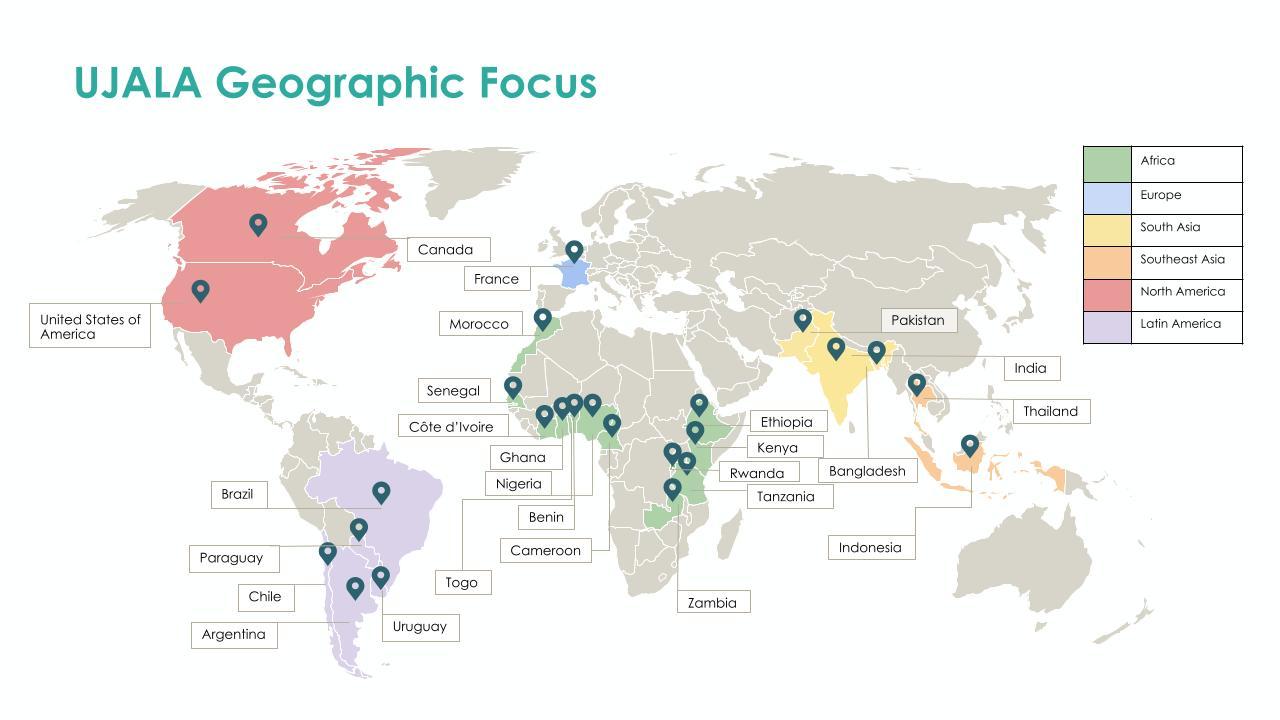
UJALA supports research in countries where OCP Nutricrops has ongoing, past, or planned farmer-centered initiatives, ensuring close alignment between research activities and strategic priorities.

Image
UJALA geographic focus

Eligibility Criteria

UJALA’s request for proposals (RFP) is open to research teams led by J-PAL Affiliated Professors or J-PAL Invited Researchers, who must serve as Principal Investigator (PI) or eligible co-Principal Investigator (co-PI) on the project. UJALA African Scholars are also eligible to apply for Pilot Studies under the initiative. All proposals may include collaborators outside of this network.

Funding Pathways

UJALA offers multiple funding pathways to accompany projects across stages of development: from early experimentation to rigorous evaluation, long-term learning, and adaptation at scale. Researchers may apply to one of the following:

  1. Pilot Studies: Support early-stage projects that test feasibility, take-up, and implementation to inform the design of a future full-scale randomized evaluation (up to US$75,000 pre-tax).
  2. Full Randomized Controlled Trials (RCTs): Support fully developed randomized studies with secured partners, and defined randomization methods (up to US$300,000 pre-tax for research, plus up to US$75,000 pre-tax for implementation costs if required).
  3. Completion Endline Studies: Support completion of final outcome measurement when prior funding did not cover endline data (up to US$100,000 pre-tax).
  4. Long-Term Follow-Up Studies: Support additional rounds of data collection to examine the persistence of adoption and longer-term impacts several years after implementation (up to US$200,000 pre-tax).
  5. Scale-Up or Replication Studies: Support testing proven interventions in new contexts or adapting them to align with UJALA’s research priorities and OCP Nutricrops’ strategic objectives (up to US$75,000 pre-tax).

Learn more about each of these funding pathways. 

Application Timeline and Submission Instruction 

UJALA is currently accepting proposals for its Spring RFP. Below are the key dates:

  • RFP opens: March 30, 2026
    All questions must be submitted to [email protected]
  • Letter of Intent (LOI) (Required): April 20, 2026 
    • The required UJALA letter of intent (LOI) is used to determine research team eligibility, agenda fit, project readiness and feasibility, and ensure we are set up to manage the review volume. 
    • Submission of an LOI is mandatory to advance to the RFP stage. All applicants will be notified of the next steps, and selected applicants will be invited to submit a full proposal. See the How to Apply section for details.
  • Full Proposal Deadline (By Invitation Only): June 5, 2026
    • Only applicants whose LOIs are selected will be invited to submit a full proposal. Invited applicants will receive detailed submission guidelines and the full proposal package.
    • Off-cycle proposals will face the same scrutiny and review process as proposals submitted during the RFP round. Contact the UJALA team for more details at [email protected].
  • Funding Decisions Announced: August 31, 2026

How to Apply?

Researchers must first submit a Letter of Interest (LOI) outlining their proposed idea. After submission, UJALA will review the LOI and notify applicants of the outcome. Selected applicants will be invited to submit a full proposal as part of the RFP process.

Please click on the “Apply Here” button below to access the online application form, where you can access the LOI template and follow the instructions to complete and submit your application.

Apply Here 

Contact Us

Looking for more information or have any questions? ​​Check our FAQ document for details on eligibility, application process, funding, and review process.

Still didn’t find what you’re looking for? Reach out to the UJALA team at [email protected] at any point before, during, or after your application. The team will be happy to assist you and get back to you as soon as possible. Please note that time differences may apply as UJALA working hours follow the Rabat time zone.

Page Content