


Using Evidence
Leverage findings from current literature to drive decision-making.
Public and nonprofit leaders strive to support the members of their communities at risk of and currently experiencing homelessness. Evidence from rigorous research can inform decisionmakers about how to have the biggest impacts.
While there are countless research questions yet to be answered, the current body of literature can provide meaningful guidance on the best ways to prevent and reduce homelessness.
If you are a nonprofit or public sector leader interested in leveraging existing evidence to inform decisionmaking, we hope the resources below can offer a helpful starting place.
Applying Research Insights to Your Context
There is an abundance of information on addressing homelessness, but not all of the insights will be appropriate or applicable to use in every situation. The following video provides suggestions for getting started with using rigorous evidence to inform decision-making.

Existing Literature
The following briefs offer high-level takeaways from existing experimental and quasi-experimental evidence on common homelessness prevention and reduction programs. Current topics include:
- Case Management
- Emergency Financial Assistance (also known as Emergency Rental Assistance)
- Housing First
- Legal Assistance
- Vouchers
For a more comprehensive review of existing literature, please visit our 2019 Evidence Review, Reducing and Preventing Homelessness: Lessons from Randomized Evaluations.
For additional evidence-based housing programs, we recommend reviewing Results for America's Economic Mobility Catalog.
Case Management
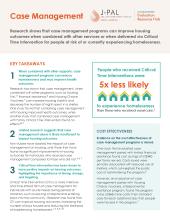
Case Management programs provide holistic support to individuals facing the compounding challenges of experiencing poverty, including housing insecurity, barriers navigating the housing market, unemployment, and more.
Rigorous experimental and quasi-experimental evaluations of case management programs in North America show that:
- When combined with other supports, case management programs can reduce homelessness and may improve health outcomes.
- Limited research suggests that case management alone is likely insufficient to impact housing outcomes.
- Critical Time Intervention has been shown to have positive impacts on housing outcomes, highlighting the importance of timing, dosage, and targeting.
However, evidence on the cost effectiveness of case management programs is mixed.
More on Case Management
Emergency Financial Assistance
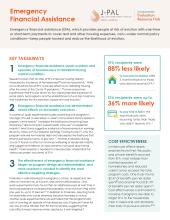
One-time and short-term emergency financial assistance (EFA) programs have emerged as a key strategy for preventing evictions and supporting both renters and landlords. Sometimes referred to as emergency rental assistance, these programs cover arrears, future rent, utility bills, or other housing costs.
Rigorous experimental and quasi-experimental evaluations of EFA programs in North America show that:
- Emergency financial assistance averts evictions and episodes of homelessness in standard housing market conditions,
- Emergency financial assistance has demonstrated mixed effects on secondary outcomes, and
- The effectiveness of emergency financial assistance hinges on program design and administration, and more research is needed to identify the most effective targeting strategies.
Additionally, limited cost effectiveness analyses found that the public and private benefits accrued from EFA, most notably from averted episodes of homelessness and reduced violent crime, exceed the total program costs.
Housing First
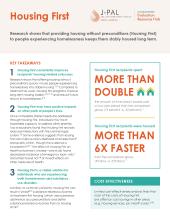
Housing First is an approach to homelessness reduction that provides individuals with long-term subsidized housing without preconditions—such as employment or sobriety—and then offers additional supportive services to residents.
Rigorous experimental and quasi-experimental evaluations of Housing First programs in North America show that:
- Housing First consistently improves recipients’ housing-related outcomes,
- Housing First may have positive impacts on other parts of people's lives, and
- Housing First is a viable solution for individuals who are experiencing both homelessness and substance use disorders.
Furthermore, limited cost-effectiveness analysis finds that most of the costs of Housing First are offset by cost savings in other areas (e.g., housing services, jail, health care).
More on Legal Assistance
Legal Services in Housing Court
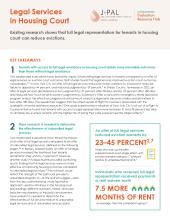
Two legal services for tenants facing eviction include full legal representation and unbundled legal services. Full legal representation provides comprehensive, individualized support throughout the duration of the case. Unbundled legal services involve a licensed attorney providing a reduced set of legal services, while the tenant represents themselves during all other stages of the case.
Rigorous experimental and quasi-experimental evaluations of legal assistance programs in North America show that:
- Tenants with access to full legal assistance in housing court obtain more favorable outcomes than those without legal assistance.
- More research is needed to determine the effectiveness of unbundled legal services.
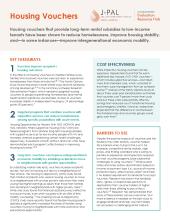
Vouchers
In the 1970s and ’80s, the focus of affordable housing policy in the United States shifted from providing public housing to increasing access to the private rental market. Housing vouchers became a common strategy for helping low-income individuals and families afford units in the private rental market by subsidizing market-rate rents.
Rigorous experimental and quasi-experimental evaluations of Housing Vouchers in North America show that:
- Vouchers improve recipient’s housing outcomes.
- Targeted programs that combine vouchers with supportive services can reduce homelessness among specific populations with acute needs.
- Long term, vouchers can improve intergenerational economic mobility by enabling recipients to move to neighborhoods with greater opportunities.
Researchers found that for each additional day housed, Housing and Urban Development-Veterans Affairs Supportive Housing (HUD-VASH) vouchers—which include supportive services—cost US$45 more than standard care.
Emerging and Future Literature
There are myriad additional methods of addressing homelessness that have yet to be evaluated with experimental methods, have a limited experimental evidence base, or are currently part of an ongoing evaluation. If you are interested in better understanding the impacts of one of these programs or policy areas, please visit the resources in the "Generate Evidence" section of the Resource Hub!
Sample areas for additional research:
Affordable housing
Brief legal advice
Direct rental assistance
Eviction record expungement
Manufactured homes
Temporary and transitional housing
Unconditional cash transfers