

Encouraging Mothers to Practice Speaking with Their Babies in Ghana




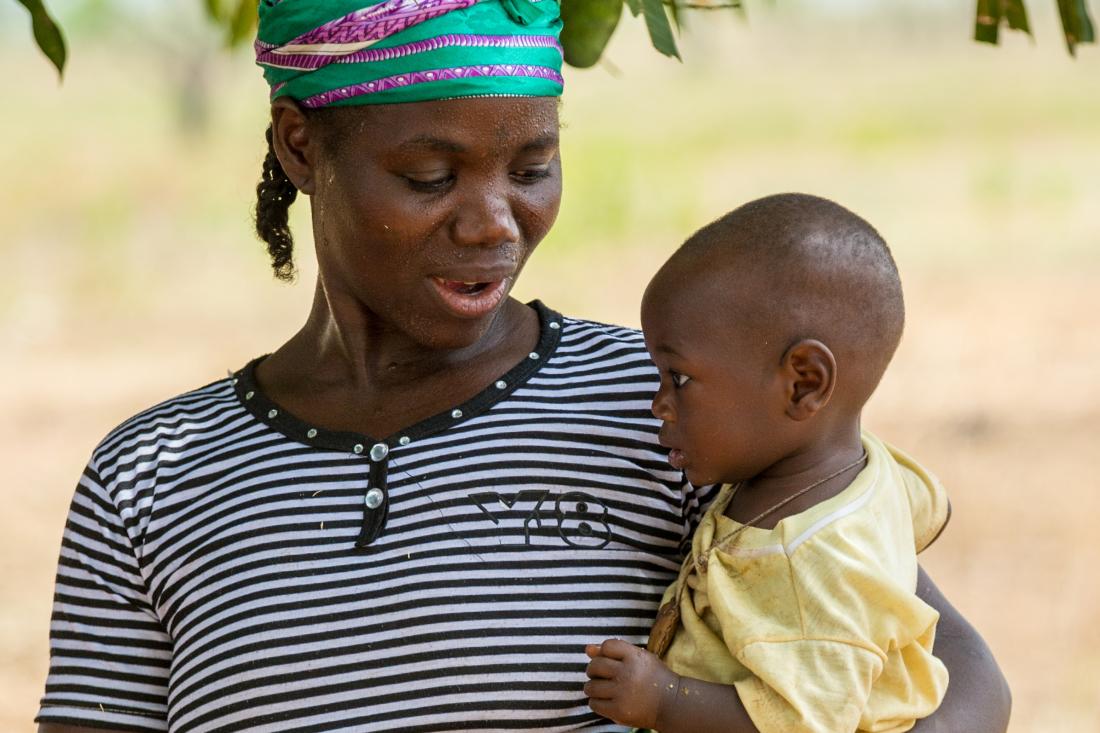
Many parents may not realize that speaking to their babies using full sentences from birth can support early brain development. In Northern Ghana, researchers tested whether providing information could encourage mothers to talk more with their infants, thereby improving child development. Six to eight months after the intervention, mothers who received the information reported they were more likely to talk to their infants and that their children showed stronger language and communication skills. Stronger short-term effects on objectively-measured parent–child conversation suggest that helping parents sustain new habits may yield larger long-term benefits.
Policy issue
It is common for parents everywhere to use a softer, slower, or higher-pitched voice with their babies.1 While this often involves cooing and repeating the child’s noises, experts find that using richer speech, like full sentences, improves infant language processing and vocabulary growth. Experts also recommend talking to babies from birth,2 as research has shown that directing rich speech at babies as young as five months improves their language development.3 However, parents often delay talking to their babies. They may assume their babies are too young to benefit from conversation, since infants show little response to language early on, and brain and language benefits show up later. Even when parents understand the benefits, creating a habit of talking to infants can be challenging.
Intensive home-visiting and group programs can encourage parents to talk to their babies, but these approaches are expensive and difficult to scale; sharing information is much cheaper. Can showing expecting or new mothers in Ghana a short informational video and giving them a habit-building calendar change their beliefs about talking to their babies, how often they talk to them, and how their children grow and learn?
Context of the evaluation
This evaluation took place in Tamale, the urban hub of Ghana’s relatively lower-income Northern Region. A household in the Northern Region earns on average US$38 a month, compared to US$156 across Ghana. People living there also have limited access to health providers: in 2020, the Northern Region was home to 10.2 percent of Ghana’s population, yet only 2 percent of the country’s doctors and nurses worked there.4
This study targeted new or soon-to-be mothers through health centers with the help of IPA Ghana. Most participants had limited awareness of how speaking to their children in full sentences could support their development. While the average participant said they should start talking to their child at eleven months old, they felt full sentences weren’t needed until their child turned two years old. About 11 percent of participants believed parents should start talking to their baby at birth, a rate comparable to those reported in studies in other lower-middle income countries like Morocco and Nepal.
Details of the intervention
Researchers partnered with IPA Ghana to conduct a randomized evaluation to test the impact of showing a short video and giving a calendar to expectant and new mothers in Ghana on their beliefs about talking to their babies, how often they talk to them, and how children grow and learn. They randomly assigned 1,408 expecting or new mothers to one of two groups:
- Informational video and calendar group (705 women): While at a health clinic for an appointment, surveyors offered to show women a three-minute video about the importance of talking to their infant on a tablet. The video highlights how conversation supports infant learning and development, when parents should start talking with their babies, and offers practical tips for how parents can find time to regularly talk with their babies. They also received a calendar featuring key takeaways from the video and colorable stars to track each week they talked with their baby, as an aid for building the new habit. The video and calendar program cost about US$3 per child and could be made cheaper if clinic staff showed the video and distributed the calendar instead of surveyors.
- Comparison group (703 women): While at a health clinic for an appointment, surveyors offered women a Stanford University calendar. The women were not prompted to watch a video.
Even if parents learn that talking to babies matters, this knowledge may not translate into sustained daily practice due to potential difficulties making talking a lasting habit. To test this hypothesis, researchers randomly assigned a subset of mothers in the comparison group to watch the video after completing a full day of interactions recorded via baby-wearable devices. Their interactions were recorded again the next day to assess the immediate effects of receiving information from the video.
Between March and April 2021, mothers in the intervention group watched the video and received a calendar, and six to eight months later researchers asked all mothers about their beliefs about talking with their baby, whether they were doing so, and their baby’s language and use of gestures. Surveyors also conducted a short development assessment with babies. About two weeks after this survey, they measured mother-child interactions through baby wearable recorders.
Results and policy lessons
Ghanaian mothers who were offered the video and calendar believed more strongly in the importance of talking to their babies, reported talking with their babies more often, and raised babies with improved communication skills (as reported by mothers) and babbling more (as observed by surveyors) six to eight months later compared to mothers not offered the video. Results suggest that the video helped mothers understand the importance of talking to their babies, which encouraged them to talk more and translated into reportedly improved language development.5 However, when researchers used wearable recorders on a small subsample to see how often mothers spoke to their babies and how often babies vocalized when surveyors were not around, they could not detect a difference between the groups. Effects on how often mothers spoke to their babies were considerably larger among mothers shown the video the day before the recording, suggesting that sustaining the new behavior, rather than initiating it, may be the key challenge.
Mother’s beliefs about talking to babies: Mothers in the video and calendar group were more likely to believe that talking to their baby was important. Mothers in this group were 10.4 percentage points (31.5 percent) more likely than mothers in the comparison group to believe that parents should start conversing with their babies from birth.
How much mothers talk to their babies: According to the self-reported data, mothers in the video and calendar group talked to their babies more. Mothers in the video and calendar group were 6.5 percentage points (14.8 percent) more likely to report that an adult in the household read or perused a book with their baby relative to mothers in the comparison group. These findings suggest that mothers can learn to talk more with their babies through simple tools like a short video. Once mothers know why talking matters, they know how to do it. Facing budget limitations, researchers did not have a large enough sample with the wearable recorders to detect any difference in mother-child interactions between the two evaluation groups.
Baby’s language development: Mothers in the video and calendar group reported that their babies could communicate better through gestures and had more advanced language skills, relative to mothers in the other group. Their baby’s reported ability to both speak and comprehend words improved. During the final survey, babies of intervention group mothers were more likely to babble in front of the surveyor. However, when being recorded without the surveyor present, babies of mothers in the intervention group did not make more sounds than babies of mothers in the comparison group, potentially due to the smaller sample of babies with wearable recorders.
Overall, showing mothers a low-cost informational video and giving them a calendar highlighting the importance of talking to their child encouraged more mothers to report engaging with their babies and gave them more confidence in their babies' language skills. Objective recordings were inconclusive on the impact of the intervention on how much mothers talked to their babies or on their babies’ language development. However, the larger effects on objectively measured parent–child conversation immediately after the intervention suggest scope for larger long-term effects had mothers continued talking to their babies. The intervention’s potential for low-cost implementation through health clinics makes it a promising strategy for early childhood development in low-income contexts, particularly if complemented by efforts to support building habits.
Dupas, Pascaline, Camille Falezan, Seema Jayachandran, and Mark Walsh. 2025. “Informing Mothers about the Benefits of Conversing with Infants: Experimental Evidence from Ghana.” American Economic Journal: Economic Policy 17 no. 2: 388–417.
Sullivan, Clare. 2022. “The Science Is In: Everyone Recognizes and Uses Baby Talk with Infants.” NPR, July 23, 2022. https://www.npr.org/2022/07/23/1113206642/baby-talk-parenting-language-research. Accessed October 1, 2025.
Centers for Disease Control and Prevention. 2025. “Positive Parenting Tips: Infants (0–1 years). August 5, 2025.” https://www.cdc.gov/child-development/positive-parenting-tips/infants.html
Piazza, Elizabeth A., Zoe Liberman, and Adriana Weisleder. 2024. “Everyday Social Interactions Predict Language Development in Infants.” Current Biology 34 (13): 2956–2962. https://doi.org/10.1016/j.cub.2024.05.045.
Ameyaw, Edward Kwabena, Roberta Mensima Amoah, Carolyne Njue, Nguyen Toan Tran, and Angela Dawson. 2020. “An Assessment of Hospital Maternal Health Services in Northern Ghana: A Cross‑Sectional Survey.” BMC Health Services Research 20 (1088). Published November 26, 2020. https://doi.org/10.1186/s12913-020-05937-5
Regarding the calendar’s role, most mothers who were offered the calendar with key points from the video hung it up and used it, while a smaller group reported coloring in stars to mark the weeks they talked to their babies.