

J-PAL North America Climate Action Learning Lab

Photo credit: Shutterstock.com
The Climate Action Learning Lab supports US state and local governments, nonprofits, and industry leaders in identifying and scaling effective decarbonization and adaptation strategies to address the dual challenges of poverty and climate change.
US public and private sector leaders are currently enacting a broad range of policies and programs to support the transition to a low-carbon economy and adaptation to climate-related hazards. But how do we know which approaches are most effective, and for whom? By embedding randomized evaluation into promising solutions, climate leaders and researchers can determine how to maximize changes in behavior in order to advance adaptation and decarbonization in the most cost-effective ways to benefit all communities.
The J-PAL North America Evidence for Climate Action Project is convening an influential network of researchers and public and private sector leaders to generate rigorous evidence to test the effectiveness of promising climate programs and policies in the United States. As part of this project, we are conducting a Climate Action Learning Lab to provide free, customized training, strategy sessions, peer learning engagements, and opportunities for climate leaders to build partnerships with academic researchers who have expertise in rigorous evaluation and climate evidence. Learning Lab participants will:
- Build skills and knowledge in evidence generation and use
- Review and apply research insights to their own contexts and programs
- Identify priority research questions to guide evidence-building and decision making practices
Select Learning Lab participants will also have the chance to work with researchers in the J-PAL network to design a randomized evaluation to test the effectiveness of a prioritized decarbonization or adaptation policy or program.
What past participants are saying
“The Climate Action Learning Lab has helped us identify research questions for some of the City of Orlando’s deep decarbonization goals. J-PAL staff, along with researchers in the J-PAL network, worked hard to bridge the gap between behavior change theory and the applied, tangible benefits that we achieve through rigorous evaluation of our programs.”
Brittany Sellers - City of Orlando, Florida

Learning Lab Objectives
Participants can expect to:
- Gain a clear understanding of why and when randomized evaluations can be used to determine program impact and maximize changes in behavior, and how they are designed in real-world settings, drawing on examples in the climate space
- Review the existing evidence base on climate mitigation and adaptation policies and programs and learn how to assess whether evaluation findings generalize to local contexts through a systematic framework
- Learn how to scope programs for rigorous evaluation opportunities and systematically generate a set of priority research questions to guide evidence-building and decision making practices
- Learn how to apply the Theory of Change framework and develop a measurement strategy that maps indicators and data sources onto the framework, serving as a roadmap for program design and evaluation
- Understand the key strengths of a randomized evaluation and different randomization designs, assess the feasibility of randomized evaluation in their context
- Discuss important ethical considerations related to randomized evaluations and gain insight on threats to the validity of evaluations
- Join peer learning opportunities with other decision-makers who can provide support in the design and use of impact evaluations in the climate mitigation and adaptation space
Offerings and Deliverables
The Climate Action Learning Lab will provide two phases of free programming:
Phase One
May - early August, 2026
Anticipated time commitment: 1-2 hours per week
Learning Lab participants will engage in the following offerings:
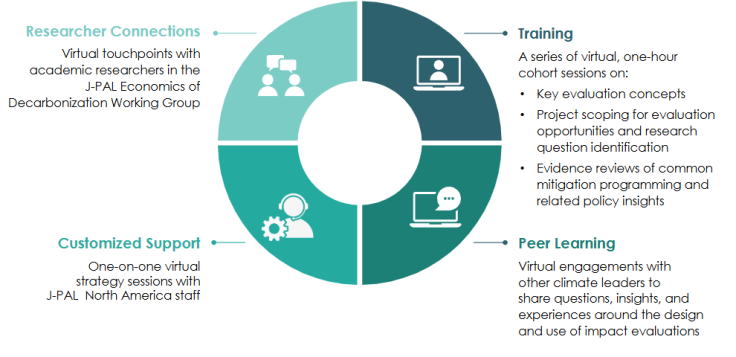
Learning Lab participants can expect to:
- Complete an evidence and evaluation playbook that includes:
- Relevant insights from the existing climate evidence base and considerations on the generalizability of insights to local contexts
- A set of prioritized research questions to guide the design and implementation of the participant’s climate mitigation and adaptation program(s), accompanied by a shortlist of projects with high evaluation potential (if applicable)
- A strategic evaluation plan for a priority research question, articulated through a theory of change and measurement strategy
- Key information and design considerations for a potential randomized evaluation (if applicable)
- Deliver a presentation on their organization’s priority research questions and strategic evaluation plan at a final virtual summit in August
- Receive public recognition as a champion for evidence use in climate action
Phase Two
Ongoing from September 2026
Anticipated time commitment: ~1 hour per quarter
Learning Lab participants will engage in the following offerings:
- Engage in an ongoing quarterly community of practice with members from the first and second Learning Lab cohorts, as well as other climate leaders pursuing evaluations.
- Select participants will also be matched with researchers from the J-PAL network to design a randomized evaluation of their policy or program and will receive continued, tailored support from J-PAL staff. These research teams will have the opportunity to apply for up to $400,000 in J-PAL funding to implement their randomized evaluation.
Frequently Asked Questions
Why does the Climate Action Learning Lab focus on randomized evaluation?
Randomized evaluations, also called randomized controlled trials (RCTs), are one type of impact evaluation method. J-PAL focuses on randomized evaluations due to their unique ability to measure impact in policy research. In a randomized evaluation, study participants are randomly assigned to one or more groups that receive (different types of) an intervention, known as the treatment group(s), and a comparison group that does not receive the intervention (or receives care as usual). Researchers then measure the outcomes of interest in the treatment and comparison groups. Randomized evaluations make it possible to obtain a rigorous estimate of the causal impact of an intervention. In other words, they tell us whether certain changes in participants’ lives can be attributed to the program. Participants do not need to have experience with this evaluation design in order to participate in the Climate Action Learning Lab. If you are interested in learning more about randomized evaluations, you can review J-PAL’s research resources.
When can I apply?
The Learning Lab application will be live from January 22 - March 27, 2026.
Who can apply?
The Climate Action Learning Lab welcomes applications from state and local government agencies, nonprofit organizations, and industry leaders (such as utility providers and tech companies) in the US that are committed to advancing effective solutions to climate mitigation and adaptation. We are seeking leaders who are motivated to harness data and evaluation to understand program impacts and identify the most effective solutions to scale. In particular, we are targeting:
- Jurisdictions launching a Climate Action Plan or a broader set of programs in the coming six months to two years and who wish to develop a learning agenda and assess the evaluation readiness of their projects.
- Grant recipients who have a climate adaptation or mitigation program that will launch in the coming six months to two years and are interested in building out an evaluation to inform their new program.
- Public and nonprofit groups planning to apply for grant funding for climate adaptation and mitigation strategies who would like to build an evaluation into their proposal to strengthen it.
- Climate sector leaders representing utility companies or green technology innovations who seek to understand and validate their approach to mitigation or adaptation in US communities.
Which team members should participate, and is there a limit on how many members can participate from one agency/organization?
Jurisdictions and organizations who are accepted into the Learning Lab are encouraged to include at least two, and up to five, staff members from transportation, climate/sustainability, energy, or related agencies or teams to participate in the virtual programming.
J-PAL North America strongly encourages program directors, managers, implementers, and data/evaluation team members, to be prioritized for participation. We also welcome collaborations with local utility providers who have direct access to important climate data.
Why does the Learning Lab focus on behavior change? What kind of programs, policies, and technologies will the Learning Lab target?
Individual behavior change, at scale, plays a critical role in reducing emissions and adapting to climate related hazards. However, there is still much to be learned about how to most effectively structure and target these programs to bring about the intended behavior change (e.g., how to structure and target rebates so people take them up). It is critical to evaluate these programs to guide further investments in strategies that are effective.
Example policy questions include:
- How do different densities of nearby electric vehicle charging stations affect people’s decisions to switch to electric vehicles?
- Do contractor education campaigns have any effect on increasing adoption of heat pump water heaters?
- Does providing information to homeowners in high-risk wildfire areas encourage take up of wildfire prevention strategies?
- What levels of subsidies lead to more low-income households adopting green technologies?
Learn More
Office Hours
Sign up to chat with J-PAL staff in office hours.
Evidence for Climate Action newsletter
To receive emails about engagement opportunities and register for upcoming programming, sign up for Environment, Energy, and Climate Change and North America updates via J-PAL's newsletters.
Reach out directly to [email protected].
2025 Climate Action Learning Lab resources
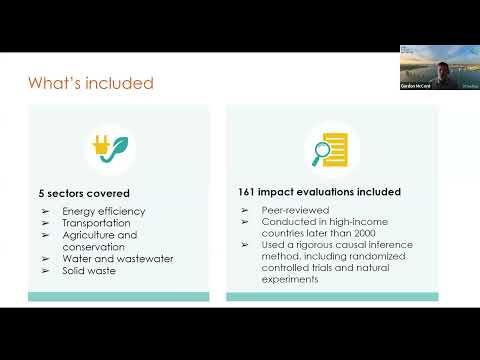
Learn more about the Learning Lab through our 2025 informational webinars, which explore how we use rigorous evidence in climate work and highlight completed and ongoing randomized evaluations of transportation and energy efficiency programs. You can also read about our inaugural engagement in an MIT News feature.