


J-PAL North America Medicaid Learning Lab

Credit: Shutterstock
The Medicaid Learning Lab supports Medicaid agency leaders in building capacity to use evidence in their decision-making and, when conditions are right, generate new evidence through structured test-and-learn models.
|
| 
|
Medicaid and CHIP together cover more than 74 million people. Medicaid alone accounts for roughly thirty percent of average total state spending, including both state and federal dollars. Significant cuts and new implementation requirements are intensifying pressure on state leaders to improve health outcomes while controlling costs. This moment creates a clear opportunity for agencies to use rigorous evidence to determine what works, make informed tradeoffs, and direct resources toward programs with proven impact.
Yet persistent barriers prevent many agencies from effectively leveraging evidence to make better decisions through test-and-learn models—evaluating a program, using results to improve it, and then re-evaluating to continuously identify how best to improve outcomes and reduce costs. Medicaid leaders often lack internal frameworks for determining when and how to evaluate, face structural disincentives to invest in evidence-building, and lack access to researcher partnerships needed to translate a policy question into a well-designed study.
This matters beyond any one state. When agencies invest in rigorous evaluations, the findings contribute to a shared body of knowledge that can help all states identify what works, improve what does not, and allocate resources more effectively for their beneficiaries.
The Medicaid Learning Lab (MLL) addresses this need by building the “test-and-learn” capacity of state Medicaid agencies to use evidence for real decisions and generate actionable evidence. Developed by J-PAL North America in collaboration with the Yale School of Public Health's SCALE lab, the MLL connects rigorous research methods with the practical realities of Medicaid administration. J-PAL affiliate Jacob Wallace, Faculty Co-Director of SCALE, serves as Scientific Advisor.
"My hope is that the Learning Lab will foster new partnerships between researchers and policymakers and guide them toward co-created research that addresses today's policy needs or tackles the enduring questions facing the safety net."
Jacob Wallace, Medicaid Learning Lab Scientific Advisor and Faculty Co-Director of SCALE at the Yale School of Public Health
Program Offerings
The Medicaid Learning Lab engages participating Medicaid agencies through a comprehensive curriculum that guides them from foundational learning on evidence and evaluation to ongoing peer learning and engagement with the J-PAL research network. All program elements are provided at no cost to participating agencies.
The program supports a cohort of state Medicaid agency teams through a customized curriculum aligned with participants' evaluation needs. Participants will engage in operationally-focused workshops and researcher-led sessions grounded in real-world randomized evaluations.
Agencies interested in exploring evaluation opportunities will also receive individualized, structured technical assistance from J-PAL to identify actionable evaluation ideas and develop preliminary randomized evaluation designs.
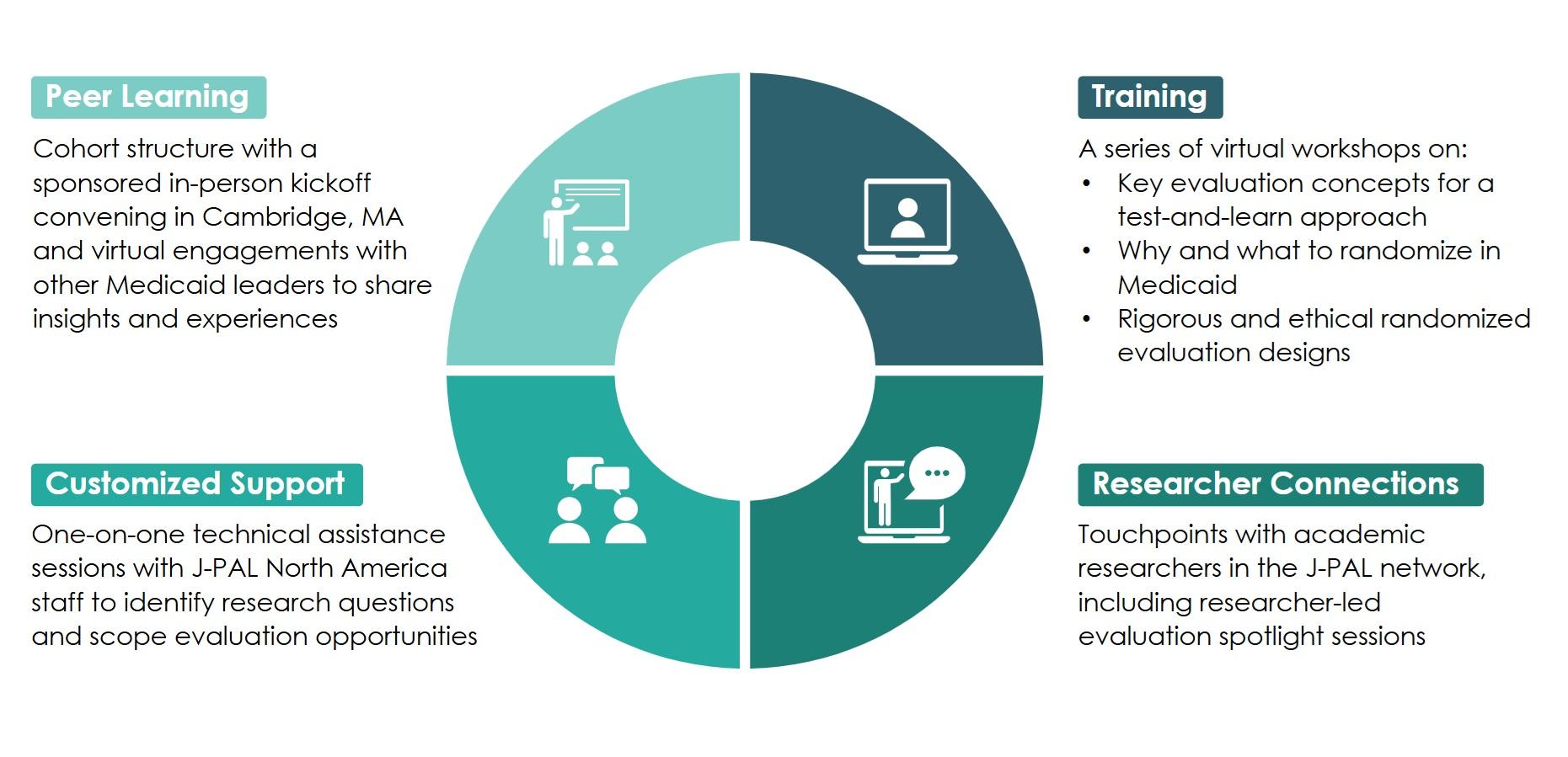
Agencies with strong evaluation opportunities will be connected to researchers from the J-PAL network with relevant subject-matter expertise. Together, they may co-develop a randomized evaluation concept for submission to J-PAL's Health Care Delivery Initiative Request for Proposals, with awards of up to $400,000.
Peer Learning Community: All participants will join a growing practitioner network of Medicaid agency leaders and staff, equipped to assess evidence quality, champion its use internally, and identify concrete evaluation opportunities. Network members continue to have access to J-PAL resources and peer learning.

“Working with J-PAL North America transformed our early work with Connecticut Medicaid programs. They provided the tools to design rigorous evaluations while upholding person-centered principles. Their responsiveness and ability to communicate complex ideas clearly made them an exceptional partner, helping us strengthen evidence-based decision-making in social service programs.”
Michael Smith, SCALE Senior Data Scientist, working as embedded staff at the Connecticut Department of Social Services (DSS)
Frequently Asked Questions
What is test-and-learn, and why does it matter?
Test-and-learn strategies provide a way for Medicaid agencies to evaluate a program, use the results to tweak and improve it, and continuously re-evaluate to identify the most effective ways to improve health care delivery. To learn more, read this Health Affairs article by Gui Woolston, former director of Connecticut Medicaid, and Amy Finkelstein, J-PAL North America's Scientific Director.
How can I participate in the Medicaid Learning Lab?
Please reach out to us to learn more about the application process.
Who should attend the Medicaid Learning Lab?
Participating agencies will designate staff members to participate in the program offerings. Teams will typically include staff from the following areas:
- Data, analytics, and evaluation team members
- Policy or program leaders or managers
- Operations or implementation staff
Ideal participants work for a state Medicaid agency or help implement or evaluate state Medicaid programs. They should have authority over, or close proximity to, Medicaid program decision-making.
How much time will I need for the Medicaid Learning Lab?
Participating agencies will be invited to an in-person convening at MIT in fall 2026, followed by a series of monthly online sessions through spring 2027. The anticipated time commitment is 1 to 2 hours per week, including a monthly online session and personalized technical assistance calls from J-PAL staff.
Learn More
Email: Reach out directly to [email protected]
Mailing list: Subscribe to our mailing list to receive emails about future opportunities and programming.