Policy Brief: Emergency Financial Assistance (EFA) programs in North America
Housing instability, which can encompass difficulty paying rent, frequent moves, overcrowding, and eviction, impacts the health and well-being of millions of US households. Eviction, in particular, has been found to reduce earnings and lead to higher rates of homelessness and hospitalization. One-time and short-term emergency financial assistance (EFA) programs have emerged as a key strategy for preventing evictions and supporting both renters and landlords. Sometimes referred to as emergency rental assistance, these programs cover arrears, future rent, utility bills, or other housing costs.
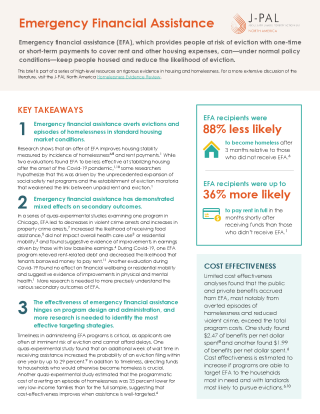
This brief synthesizes results from rigorous experimental and quasi-experimental evaluations of EFA programs in the United States, finding that EFA averts evictions and episodes of homelessness in standard housing market conditions. The effectiveness of EFA hinges on program design and administration, and more research is needed to identify the most effective targeting strategies.
This brief is designed to be concise and summarize high-level findings from the research. For a more extensive discussion on the evidence base in homelessness and housing, visit J-PAL North America's Homelessness Evidence Review.