J-PAL J-PAL
The Abdul Latif Jameel Poverty Action Lab
  • About
    • Overview
    • People
    • Strengthening Our Work
    • Code of Conduct
    • Initiatives
    • Events
    • Blog
    • News
    • Press Room
  • Offices
    • Overview
    • Global
    • Africa
    • Europe
    • Latin America and the Caribbean
    • Middle East and North Africa
    • North America
    • South Asia
    • Southeast Asia
  • Sectors
    • Overview
    • Agriculture
    • Crime, Violence, and Conflict
    • Education
    • Environment, Energy, and Climate Change
    • Finance
    • Firms
    • Gender
    • Health
    • Labor Markets
    • Political Economy and Governance
    • Social Protection
  • Evaluations
  • Research Resources
    • About Us
    • Our Work
    • Join ASPIRE
    • Newsroom
  • Policy Insights
  • Evidence to Policy
    • Pathways and Case Studies
    • The Evidence Effect
  • Blog
  • Careers
  • Courses
  • For Affiliates
  • Support J-PAL

Utility menu

  • Blog
  • Careers
  • Courses
  • For Affiliates
  • Support J-PAL

Quick links

  • Evaluations
  • Research Resources
  • Policy Insights
  • Evidence to Policy
    • Pathways and Case Studies
    • The Evidence Effect
  • About

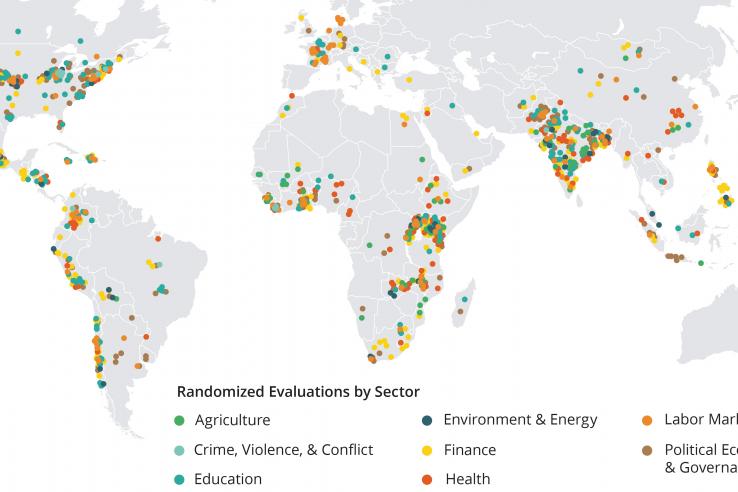
    The Abdul Latif Jameel Poverty Action Lab (J-PAL) is a global research center working to reduce poverty by ensuring that policy is informed by scientific evidence. Anchored by a network of more than 1,100 researchers at universities around the world, J-PAL conducts randomized impact evaluations to answer critical questions in the fight against poverty.

    • Overview

      The Abdul Latif Jameel Poverty Action Lab (J-PAL) is a global research center working to reduce poverty by ensuring that policy is informed by scientific evidence. Anchored by a network of more than 1,100 researchers at universities around the world, J-PAL conducts randomized impact evaluations to answer critical questions in the fight against poverty.

      • Affiliated Professors

        Our affiliated professors are based at over 130 universities and conduct randomized evaluations around the world to design, evaluate, and improve programs and policies aimed at reducing poverty. They set their own research agendas, raise funds to support their evaluations, and work with J-PAL staff on research, policy outreach, and training.

      • Invited Researchers
      • J-PAL Scholars
      • Board
        Our Board of Directors, which is composed of J-PAL affiliated professors and senior management, provides overall strategic guidance to J-PAL, our sector programs, and regional offices.
      • Staff
    • Strengthening Our Work

      Our research, policy, and training work is fundamentally better when it is informed by a broad range of perspectives.

    • Code of Conduct
    • Initiatives
      J-PAL initiatives concentrate funding and other resources around priority topics for which rigorous policy-relevant research is urgently needed.
    • Events
      We host events around the world and online to share results and policy lessons from randomized evaluations, to build new partnerships between researchers and practitioners, and to train organizations on how to design and conduct randomized evaluations, and use evidence from impact evaluations.
    • Blog
      News, ideas, and analysis from J-PAL staff and affiliated professors.
    • News
      Browse news articles about J-PAL and our affiliated professors, read our press releases and monthly global and research newsletters, and connect with us for media inquiries.
    • Press Room
      Based at leading universities around the world, our experts are economists who use randomized evaluations to answer critical questions in the fight against poverty. Connect with us for all media inquiries and we'll help you find the right person to shed insight on your story.
  • Offices
    J-PAL is based at MIT in Cambridge, MA and has seven regional offices at leading universities in Africa, Europe, Latin America and the Caribbean, Middle East and North Africa, North America, South Asia, and Southeast Asia.
    • Overview
      J-PAL is based at MIT in Cambridge, MA and has seven regional offices at leading universities in Africa, Europe, Latin America and the Caribbean, Middle East and North Africa, North America, South Asia, and Southeast Asia.
    • Global
      Our global office is based at the Department of Economics at the Massachusetts Institute of Technology. It serves as the head office for our network of seven independent regional offices.
    • Africa
    • Europe
    • Latin America and the Caribbean
    • Middle East and North Africa
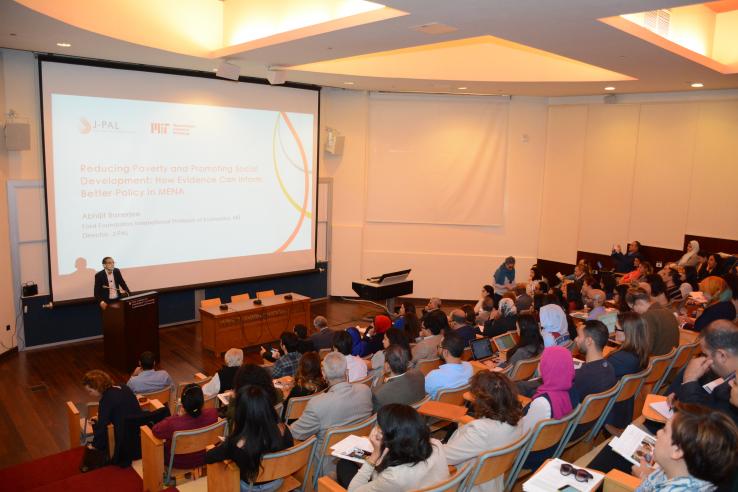
      J-PAL MENA is based at the American University in Cairo, Egypt.
    • North America
    • South Asia
    • Southeast Asia
  • Sectors
    Led by affiliated professors, J-PAL sectors guide our research and policy work by conducting literature reviews; by managing research initiatives that promote the rigorous evaluation of innovative interventions by affiliates; and by summarizing findings and lessons from randomized evaluations and producing cost-effectiveness analyses to help inform relevant policy debates.
    • Overview
      Led by affiliated professors, J-PAL sectors guide our research and policy work by conducting literature reviews; by managing research initiatives that promote the rigorous evaluation of innovative interventions by affiliates; and by summarizing findings and lessons from randomized evaluations and producing cost-effectiveness analyses to help inform relevant policy debates.
    • Agriculture
      How can we encourage small farmers to adopt proven agricultural practices and improve their yields and profitability?
    • Crime, Violence, and Conflict
      What are the causes and consequences of crime, violence, and conflict and how can policy responses improve outcomes for those affected?
    • Education
      How can students receive high-quality schooling that will help them, their families, and their communities truly realize the promise of education?
    • Environment, Energy, and Climate Change
      How can we increase access to energy, reduce pollution, and mitigate and build resilience to climate change?
    • Finance
      How can financial products and services be more affordable, appropriate, and accessible to underserved households and businesses?
    • Firms
      How do policies affecting private sector firms impact productivity gaps between higher-income and lower-income countries? How do firms’ own policies impact economic growth and worker welfare?
    • Gender
      How can we reduce gender inequality and ensure that social programs are sensitive to existing gender dynamics?
    • Health
      How can we increase access to and delivery of quality health care services and effectively promote healthy behaviors?
    • Labor Markets
      How can we help people find and keep work, particularly young people entering the workforce?
    • Political Economy and Governance
      What are the causes and consequences of poor governance and how can policy improve public service delivery?
    • Social Protection
      How can we identify effective policies and programs in low- and middle-income countries that provide financial assistance to low-income families, insuring against shocks and breaking poverty traps?
Displaying 3496 - 3510 of 8338
Research Paper
File: Research paper

The Role of Behavioral Frictions in Health Insurance Marketplace Enrollment and Risk: Evidence from a Field Experiment

Police officers in the U.S. complete training
Policy Publication
File: Policy publication

A Cognitive Training to Improve Police Decision-Making

Adverse policing practices such as excessive use of force and unnecessary arrests, can be harmful to individuals and community members, and erode the public’s trust in police. To address this, researchers partnered with the Chicago Police Department to evaluate the impact of a new cognitive police...
Three people stand at corrugated tin stand advertising mobile services in a field in Kenya
Evidence to Policy Case Study
Case study

Giving directly to support poor households

GiveDirectly has expanded its cash transfer program, which was found in a randomized evaluation to have improved economic and psychological well-being in Kenya, to reach over 1.6 million people in Bangladesh, DRC, Kenya, Liberia, Malawi, Mozambique, Rwanda, and the United States.
Research Paper
File: Research paper

Property Rights and Social Institutions in Urban Africa: Experimental Evidence from a Land Formalization Program in the DRC

Resource
Basic page

Recruitment Timeline

While the J-PAL network fills positions on a rolling basis throughout the year, the bulk of positions are filled during our annual recruitment drives. If you are interested in working for J-PAL or its partner organizations, applying during the annual recruitment drive maximizes your chances of...
Beautiful green farm land
Evaluation

Community-Based Forestry Management to Improve Natural Resource Management and Farming Productivity in Ethiopia

researchers are evaluating the impact of CBFM on farmers’ agricultural productivity, adoption of modern technology, rural livelihoods, and forest conservation.
Research Paper
File: Research paper

RCT Ideas for Science in LMICs

Sector

Environment & Energy

workers stand behind large piles of coal at an industrial plant
Evidence to Policy Case Study
Case study

Emissions markets to reduce air pollution

A market for designed to cut air pollution was scaled to reach over 15 million people with cleaner air in Gujarat, India.
A student at a school solving math problems in Udaipur, India
Blog

Researcher Spotlight: Harini Kannan on partnering with government to scale evidence-informed programs across India

In this episode of the Researcher Spotlight Series, host Sambhav Choudhury speaks with Harini Kannan, research scientist at J-PAL South Asia. Harini shares her journey from being inspired by budget speeches as a child to pursuing a career in development economics.
 Enumerator administering a child verification survey
Blog

Researcher Spotlight: Ariel Zucker on applying economic theory to real-world solutions

In this episode of the Researcher Spotlight Series, host Sambhav Choudhury speaks with Ariel Zucker, assistant professor of economics at UC Santa Cruz. Ariel discusses her journey from an early interest in global health disparities to becoming a development economist specializing in experimental...
A man walks through arid land carrying buckets filled with small plants
Update
J-PAL Updates

August 2025 Global Monthly Newsletter

In the August edition of our newsletter, we share the latest from The Evidence Effect on taking action in conflict and crisis and effective policies in high-income countries, an opportunity to lead J-PAL Africa as Executive Director, and a new podcast series from J-PAL South Asia on research in...
Student in a classroom
Blog

Researcher Spotlight: Shobhini Mukerji on her journey into development economics

In this episode of The Evidence Effect, host Sambhav Choudhury speaks with Shobhini Mukerji, Executive Director of J-PAL South Asia. From her transformative summer internship with education nonprofit Pratham to becoming a principal investigator on groundbreaking research, Shobhini shares her journey...
Kohlipura village, India. GOTN: The survey team debriefing after a long day of work.
Blog

Researcher Spotlight: Gautam Rao on co-producing evidence with policymakers

In this episode of the Researcher Spotlight Series, host Sambhav Choudhury speaks with Gautam Rao, associate professor of economics at UC Berkeley. From his unconventional journey from electronics engineering to economics, Gautam shares insights on his behavioral economics and mental health research...
Madhya Pradesh_Women's Help Desks_Intervention in progress _officer hearing out a complainant in Morena district.jpg(941.18 KB)
Blog

Researcher Spotlight: Sandip Sukhtankar on his work in India

In this episode of the Researcher Spotlight Conversation Series, host Sambhav Choudhury speaks with Sandip Sukhtankar, Professor of Economics at the University of Virginia. He discusses the unique challenges and rewards of conducting research with law enforcement agencies, offers practical...

Pagination

  • First page « First
  • Previous page ‹
  • …
  • Page 232
  • Page 233
  • Current page 234
  • Page 235
  • Page 236
  • …
  • Next page ›
  • Last page Last »
J-PAL

J-PAL

400 Main Street

E19-201

Cambridge, MA 02142

USA

Contact

+1 617 324 6566

[email protected]


Press Room

Stay Informed

Receive our newsletters

Subscribe


Privacy Policy

Accessibility

MIT