J-PAL J-PAL
The Abdul Latif Jameel Poverty Action Lab
  • About
    • Overview
    • People
      • Affiliated Professors
      • Invited Researchers
      • J-PAL Scholars
      • Board
      • Leadership
      • Staff
    • Strengthening Our Work
    • Code of Conduct
    • Initiatives
    • Events
    • Blog
    • News
    • Press Room
  • Offices
    • Overview
    • Global
    • Africa
    • Europe
    • Latin America and the Caribbean
      • Growing Futures
    • Middle East and North Africa
    • North America
    • South Asia
    • Southeast Asia
  • Sectors
    • Overview
    • Agriculture
    • Crime, Violence, and Conflict
    • Education
    • Environment, Energy, and Climate Change
    • Finance
    • Firms
    • Gender
    • Health
    • Labor Markets
    • Political Economy and Governance
    • Social Protection
  • Evaluations
  • Research Resources
    • About Us
    • Our Work
    • Join ASPIRE
    • Newsroom
  • Policy Insights
  • Evidence to Policy
    • Pathways and Case Studies
    • The Evidence Effect
  • Blog
  • Careers
  • Courses
  • For Affiliates
  • Support J-PAL

Utility menu

  • Blog
  • Careers
  • Courses
  • For Affiliates
  • Support J-PAL

Quick links

  • Evaluations
  • Research Resources
  • Policy Insights
  • Evidence to Policy
    • Pathways and Case Studies
    • The Evidence Effect
  • About

    The Abdul Latif Jameel Poverty Action Lab (J-PAL) is a global research center working to reduce poverty by ensuring that policy is informed by scientific evidence. Anchored by a network of more than 1,100 researchers at universities around the world, J-PAL conducts randomized impact evaluations to answer critical questions in the fight against poverty.

    • Overview

      The Abdul Latif Jameel Poverty Action Lab (J-PAL) is a global research center working to reduce poverty by ensuring that policy is informed by scientific evidence. Anchored by a network of more than 1,100 researchers at universities around the world, J-PAL conducts randomized impact evaluations to answer critical questions in the fight against poverty.

      • Affiliated Professors

        Our affiliated professors are based at over 130 universities and conduct randomized evaluations around the world to design, evaluate, and improve programs and policies aimed at reducing poverty. They set their own research agendas, raise funds to support their evaluations, and work with J-PAL staff on research, policy outreach, and training.

      • Invited Researchers
      • J-PAL Scholars
      • Board
        Our Board of Directors, which is composed of J-PAL affiliated professors and senior management, provides overall strategic guidance to J-PAL, our sector programs, and regional offices.
      • Leadership
      • Staff
    • Strengthening Our Work

      Our research, policy, and training work is fundamentally better when it is informed by a broad range of perspectives.

    • Code of Conduct
    • Initiatives
      J-PAL initiatives concentrate funding and other resources around priority topics for which rigorous policy-relevant research is urgently needed.
    • Events
      We host events around the world and online to share results and policy lessons from randomized evaluations, to build new partnerships between researchers and practitioners, and to train organizations on how to design and conduct randomized evaluations, and use evidence from impact evaluations.
    • Blog
      News, ideas, and analysis from J-PAL staff and affiliated professors.
    • News
      Browse news articles about J-PAL and our affiliated professors, read our press releases and monthly global and research newsletters, and connect with us for media inquiries.
    • Press Room
      Based at leading universities around the world, our experts are economists who use randomized evaluations to answer critical questions in the fight against poverty. Connect with us for all media inquiries and we'll help you find the right person to shed insight on your story.
  • Offices
    J-PAL is based at MIT in Cambridge, MA and has seven regional offices at leading universities in Africa, Europe, Latin America and the Caribbean, Middle East and North Africa, North America, South Asia, and Southeast Asia.
    • Overview
      J-PAL is based at MIT in Cambridge, MA and has seven regional offices at leading universities in Africa, Europe, Latin America and the Caribbean, Middle East and North Africa, North America, South Asia, and Southeast Asia.
    • Global
      Our global office is based at the Department of Economics at the Massachusetts Institute of Technology. It serves as the head office for our network of seven independent regional offices.
    • Africa
    • Europe
    • Latin America and the Caribbean
    • Middle East and North Africa
    • North America
    • South Asia
    • Southeast Asia
  • Sectors
    Led by affiliated professors, J-PAL sectors guide our research and policy work by conducting literature reviews; by managing research initiatives that promote the rigorous evaluation of innovative interventions by affiliates; and by summarizing findings and lessons from randomized evaluations and producing cost-effectiveness analyses to help inform relevant policy debates.
    • Overview
      Led by affiliated professors, J-PAL sectors guide our research and policy work by conducting literature reviews; by managing research initiatives that promote the rigorous evaluation of innovative interventions by affiliates; and by summarizing findings and lessons from randomized evaluations and producing cost-effectiveness analyses to help inform relevant policy debates.
    • Agriculture
      How can we encourage small farmers to adopt proven agricultural practices and improve their yields and profitability?
    • Crime, Violence, and Conflict
      What are the causes and consequences of crime, violence, and conflict and how can policy responses improve outcomes for those affected?
    • Education
      How can students receive high-quality schooling that will help them, their families, and their communities truly realize the promise of education?
    • Environment, Energy, and Climate Change
      How can we increase access to energy, reduce pollution, and mitigate and build resilience to climate change?
    • Finance
      How can financial products and services be more affordable, appropriate, and accessible to underserved households and businesses?
    • Firms
      How do policies affecting private sector firms impact productivity gaps between higher-income and lower-income countries? How do firms’ own policies impact economic growth and worker welfare?
    • Gender
      How can we reduce gender inequality and ensure that social programs are sensitive to existing gender dynamics?
    • Health
      How can we increase access to and delivery of quality health care services and effectively promote healthy behaviors?
    • Labor Markets
      How can we help people find and keep work, particularly young people entering the workforce?
    • Political Economy and Governance
      What are the causes and consequences of poor governance and how can policy improve public service delivery?
    • Social Protection
      How can we identify effective policies and programs in low- and middle-income countries that provide financial assistance to low-income families, insuring against shocks and breaking poverty traps?
Displaying 3676 - 3690 of 7150
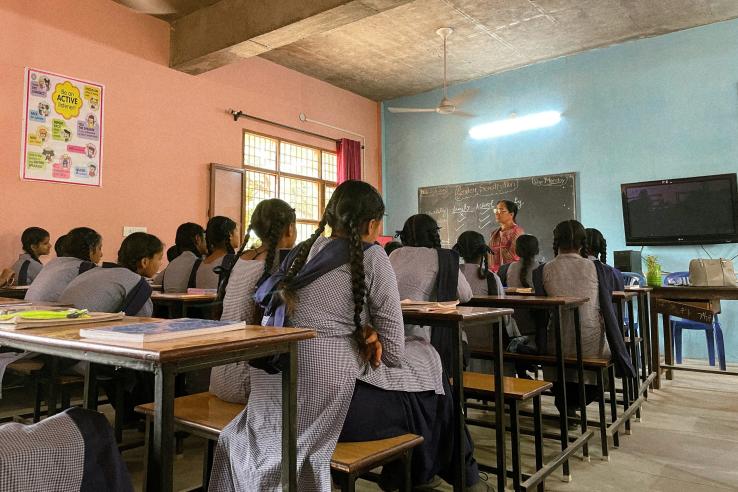
School children in Indonesia
Blog

Informing shifts in policy: Reflections on a long-run impact evaluation of a community block grant program in Indonesia

Creating good policies is a complex and dynamic process. A program can be evaluated, found to improve people’s lives, and be scaled up. However, in the longer run, these programs interact with other policies, contexts change, and policymakers are in constant need of new information and evidence to...
Photo of person presenting in front of a white board that has written words on it.
Blog

"Unlocking the file drawer" to ensure research results—even null results—are shared

When a study is not published in an academic journal, how can we ensure its results, even null results, are still reported—instead of remaining inaccessible in a (metaphorical) file drawer?
2019 Nobel laureates in Economics
Blog

Recapping Nobel Week 2019

Our co-founders Abhijit Banerjee and Esther Duflo, with longtime J-PAL affiliate Michael Kremer, were awarded the 2019 Nobel Prize in Economic Sciences on December 10, 2019. In the week leading up to the award ceremony, the laureates delivered lectures on their award-winning research and...
digital finance
Blog

J-PAL Meluncurkan Inisiatif Inovasi Keuangan Inklusif di Asia Tenggara

Nilai ekonomi digital Indonesia tercatat mencapai USD 40 miliar pada tahun 2019 – empat kali lipat jika dibandingkan dengan tahun 2015. Pertumbuhan yang pesat ini sebagian besar didorong oleh sektor niaga-el (e-commerce) yang tumbuh sebesar 88 persen, dari USD 1.7 miliar pada tahun 2015 menjadi USD...
Event

J-PAL Africa Launch Conference

Event

Coming apart? Lives of the rich and poor over time in the United States

Income inequality in the United States has increased consistently since the 1980s, but has this growing economic gap led to larger cultural distances between socioeconomic groups? Join us today, Thursday, September 28 at 3 pm EDT for the next D²P²: Data, Decisions, Public Policy lecture featuring J...
A boy pauses in thought while working on his schoolwork
Event

Teaching at the Right Level Webinar Series: Session 1 - What is Teaching at the Right Level

Person

Oriana Bandiera

Oriana Bandiera is the Sir Anthony Atkinson Professor of Economics at the London School of Economics and Political Science and editor for Microeconomic Insights.
Event

Evaluasi Program Sosial - Banda Aceh (Evaluating Social Programs)

Event

Evaluasi Program Sosial - Makassar (Evaluating Social Programs)

A teacher assists student in reading the alphabet
Event

Teaching at the Right Level Webinar Series: Session 2 - Assessment

Please join us on October 27 for the second in a series of webinars about Pratham’s teaching at the right level (TaRL), a methodology that has been shown, through rigorous evaluations, to consistently improve basic reading and numeracy skills. This session will focus on Assessment, with...
Event

Video: Design and Effectiveness of Public Health Subsidies in Less Developed Countries

Although coverage rates and health outcomes are improving, many poor people around the world still do not benefit from essential health products. Join Pascaline Dupas live today at 11am via webinar or in person on MIT's campus to learn about how the design of subsidies matter for maximizing coverage...
Event

J-PAL State and Local Innovation Initiative: Year 2 Participant Convening

A teacher gives a lively lecture to students
Event

Teaching at the Right Level Webinar Series: Session 3 - Monitoring and Mentoring

Join us on Thursday, 7 December, for a Monitoring and Mentoring webinar as part of the Teaching at the Right Level (TaRL) Webinar Series. Devyani Pershad from Pratham will discuss the role of monitors and mentors in TaRL programs. Benjamin Piper from RTI will share research on teacher coaching and...
Event

State and Local Innovation Initiative Webinar

Pagination

  • First page « First
  • Previous page ‹
  • …
  • Page 244
  • Page 245
  • Current page 246
  • Page 247
  • Page 248
  • …
  • Next page ›
  • Last page Last »
J-PAL

J-PAL

400 Main Street

E19-201

Cambridge, MA 02142

USA

Contact

+1 617 324 6566

[email protected]


Press Room

Stay Informed

Receive our newsletters

Subscribe


Privacy Policy

Accessibility

MIT