

December 2025 Global Monthly Newsletter
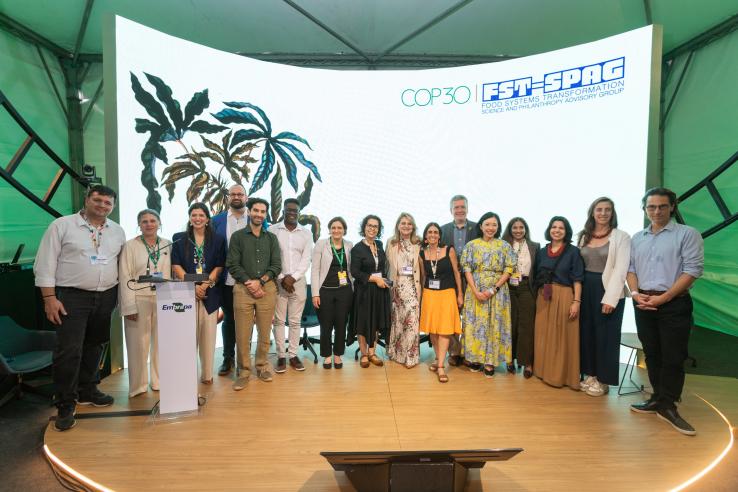
Contributing to global climate dialogues at COP30
Climate change is not just an environmental crisis—it is a development crisis. People in low- and middle-income countries are disproportionately affected by climate shocks, from crop failures to floods and heatwaves, threatening hard-won gains against poverty. This is why we joined COP30, a global conference where diverse sectors, from government to civil society and business, come together to exchange ideas and form partnerships for ambitious climate action.
This year, COP30 took place in the Amazon region in Belém, Brazil, which brought a strong focus on the intersection of livelihoods and environmental sustainability. We presented on the latest evidence, including conditional cash transfers to protect nature and climate-resilient agriculture, and Esther Duflo (MIT; Director, J-PAL; Scientific Director, J-PAL South Asia) met with indigenous leaders, shared evidence on adaptation, and discussed what the private sector can do to advance climate solutions.
AI for social good: An evidence-informed research agenda
Catch up on new posts in our AI blog series launched last month:
How can AI support both businesses and workers in low- and middle-income countries? Promising AI tools are helping improve worker performance, match workers to better jobs, and grow businesses—but if not designed and monitored with care, some tools risk exacerbating inequalities. Read more »
Health systems around the world are overburdened, with an estimated shortage of up to 11 million health workers by 2030. AI has the potential to improve care by reducing the cost of training health workers, enabling better diagnoses, and offering personalized guidance to patients—but with lives at stake, rigorous evaluation is essential. Read more »
A new weekly evidence series from J-PAL Africa
The Africa Evidence Effect, a new LinkedIn series, showcases evidence-informed interventions from the region—many of which have scaled up across multiple countries, like Teaching at the Right Level and free preventive health products. In each post, we break down what the program is, how it works, and why it matters for today’s policy debates. For new themes every Tuesday, follow J-PAL Africa on LinkedIn »
Scaling smarter: How 12 simple A/B tests transformed Youth Impact's tutoring program
In Botswana, the NGO Youth Impact ran twelve rapid iterative A/B tests to make scaling a phone-based tutoring program more effective. Simple changes, like inviting caregivers to join calls, more than doubled effectiveness at no extra cost. Seven total tweaks made the program notably more cost-effective, showing that real-time testing and adjustments can turn scaling into an opportunity to strengthen programs. Read the guest post on the J-PAL blog »
EVIDENCE-INFORMED DECISION-MAKING
Scaling women’s help desks in police stations for survivors of gender-based violence
📍India
Following promising results from a randomized evaluation, the Madhya Pradesh Police Department (MPP) scaled up women’s help desks in police stations statewide, making it easier for survivors of gender-based violence (GBV) to report crimes and seek assistance.
Policy issue: In India, police are often not trained or equipped to handle reports of GBV and enforce related laws, leading to underregistration of reported cases. This denies women access to justice and possibly leads them to underreport crimes.
Evaluation: The MPP worked with J-PAL affiliated researchers and J-PAL South Asia to introduce women’s help desks in police stations across the state and evaluate their impacts. These desks offer private spaces for women to meet with officers trained in gender awareness and how to register GBV cases.
Results: The randomized evaluation, funded by J-PAL’s Crime and Violence Initiative, found that police stations with help desks registered more cases of crimes against women and domestic violence, especially when staffed by women officers. Women officers also became more likely to believe claims of GBV.
Research in action: Following the evaluation, the MPP scaled up help desks to 950 police stations across the state, with training and monitoring support from the research team funded by J-PAL’s Innovations in Government Initiative. As other Indian states consider women’s help desks, J-PAL South Asia has developed an implementation guide to help police departments adapt the model to their context. Read more »
Research by: Gabrielle Kruks-Wisner (University of Virginia), Akshay Mangla (University of Oxford), Sandip Sukhtankar (University of Virginia)
FEATURED BLOGS
Indonesia’s faith-based charity organizations explore the Graduation approach for poverty alleviation
In Indonesia, zakat management organizations play a vital role in managing faith-based charitable funds that support low-income households. These funds complement the Indonesian government’s broader poverty reduction efforts by supporting programs that provide access to capital and entrepreneurship training.
J-PAL Southeast Asia convened zakat organizations to explore how they can work with each other and with government social protection programs to deliver a more comprehensive Graduation approach that helps families move from short-term relief to lasting self-reliance. The workshop surfaced strong interest in piloting Graduation-style collaborations and impact evaluations in low-income communities. Read more »
The impacts of cash transfers on child poverty and family life in the United States
In a study funded by J-PAL North America, J-PAL affiliated researcher Lisa Gennetian (Duke University) and co-author Katherine Magnuson (University of Wisconsin-Madison) found that the Baby’s First Years program, which provided mothers $333 per month for the first six years of their child’s life, increased the time and amount of money families spent on their children, but did not change the observed quality of mother-child interactions or other measures of family wellbeing.
In this blog, the researchers discuss what this teaches us about people experiencing poverty and the impacts of extra financial resources on family activities. The authors reflect on how they interpret these results and the study’s contributions to a broader body of literature on cash transfers in the United States. Read more »
Empowering rural entrepreneurs in Chile
Can business training programs help rural microentrepreneurs thrive? A new evaluation of Trafkintunkim, a rural entrepreneurship training program in Chile, finds that participants briefly improved their business practices, but average sales and profits did not change. Yet household incomes rose over time, driven by other family members starting new income-generating activities—suggesting training may shift household decisions. Gains were strongest for women and for entrepreneurs with younger, better-positioned businesses, underscoring the importance of targeting training to those who are most likely to benefit. Read more »
FEATURED BLOGS
Strengthening early childhood outcomes by building on existing systems in Indonesia
Read more »
Moving from convenings to classroom change in partner preschool networks
Read more »
Supporting early career research staff in the United States
Read more »
WELCOMING OUR NEW AFFILIATED PROFESSORS
This summer, we welcomed 29 talented researchers to the J-PAL network. We will feature a few of them here each month.
Shyamal Chowdhury
Australian National University
Teevrat Garg
University of California, San Diego
Matthew Kraft
Brown University
📺 FEATURED MULTIMEDIA
WATCH: Esther Duflo's keynote speech at a COP30 side event
At COP30, Esther Duflo (MIT; Director, J-PAL; Scientific Director, J-PAL South Asia) announced the launch of the Food Systems Transformation Science and Philanthropy Advisory Group, which will bring together scientific researchers and private sector actors to invest in climate-resilient food systems. The group aims to mobilize over $500M in investments to support rigorously tested policies like climate-resilient crops, improved soil and fertilizer use, and more sustainable livestock systems. In her keynote, Esther emphasized that these policies work best when they work together to confront the complex challenges that food systems face. Watch her remarks »
WATCH: Unlocking potential: How loans and grants can transform microenterprises in Egypt
Do some kinds of financial assistance work better than others to help small businesses grow—and who benefits most from this support? Researchers tested the impact of providing loans, cash grants, or in-kind grants to over 3,000 microentrepreneurs in Qena, Egypt.
All three types of capital improved business and economic outcomes, especially for women. But most gains came from the highest-earning entrepreneurs, who shared similar traits like age, education, marital status, and household income. Watch the video to learn more »
FEATURED EVENTS
Watch the livestream: Global Impact Evaluation Forum
🗓️ December 11
This week, world leaders, researchers, and NGOs gather at the World Food Programme’s Global Impact Evaluation Forum in Rome to explore how scientifically-backed programs, from anticipatory cash transfers to school meals, can help families adapt to complex crises. In remarks at the event on Thursday, Abhijit Banerjee (MIT; Director, J‑PAL; Scientific Director, J-PAL Europe) will discuss the future of humanitarian interventions and pathways to long-term recovery. Register to watch the livestream »
Webinar series: Egypt and Indonesia on including informal workers in the health care system
Earlier this year, the Egypt Impact Lab at J-PAL Middle East and North Africa, in collaboration with the Universal Health Insurance Authority and the World Health Organization in Egypt, launched a webinar series to foster cross-country knowledge sharing and strengthen the role of evidence in driving health reforms.
Drawing on Indonesia’s experience, as well as insights from Indonesia’s national public health insurance agency, participants in this third session of the series explored practical strategies to enhance enrollment, affordability, and sustainability to ensure health coverage includes informal workers. Watch the recording »
UJALA at the CGIAR Gender Conference: Evidence for gender-responsive agricultural development
📍South Africa
In October, the UM6P-J-PAL Applied Lab for Agriculture (UJALA) participated in the CGIAR Gender Conference to discuss strategies to drive gender equity in agriculture. Malik Abaddi (Policy Manager and Delivery Lead, UJALA) joined a panel to share insights on measuring impact on gender equity and social inclusion in agri-food systems. Jamal Mohammed (Koforidua Technical University) presented findings from his J-PAL Digital Agricultural Innovations and Services Initiative (DAISI)-funded project on digital solutions for smallholder farmers in Ghana. Discussions highlighted the urgent need to tackle barriers women face in accessing land, finance, and information. Read the blog post »
FEATURED TRAININGS
New French-language online course: Esther Duflo on fighting poverty through more effective public policy
The online open course “Lutter contre la pauvreté – de la science aux politiques publiques” (“Fighting Poverty – From Science to Public Policy”), developed by J-PAL Europe and presented by Esther Duflo (MIT; Director, J-PAL; Scientific Director, J-PAL South Asia), explores how research in development economics can inform more effective public policies to reduce poverty. The course covers themes such as education, health, gender, labor and migration, social protection, and the environment. Enroll today »
DEDP enrollment open: Start the new year with fresh insights into poverty alleviation
🗓️ Courses start January 20
Kick off 2026 by building a strong foundation in economic thinking with J-PAL’s online graduate-level Data, Economics, and Design of Policy (DEDP) MicroMasters program available on MIT Open Learning. New this term:
- Energy Economics and Policy examines how global energy markets interact with policy, technology, and sustainability goals, equipping learners to analyze challenges in climate and development.
- Microeconomics introduces core microeconomic concepts and analysis, and their applications to real-world policy challenges.
- Good Economics for Hard Times, based on the book by Nobel laureates and J-PAL co-founders Abhijit Banerjee and Esther Duflo , explores pressing global issues—from migration and trade to inequality—through the lens of rigorous economic research.
Courses are taught by MIT faculty and are free to audit, with the option to pay for a certificate. Learners who complete the full credential (five courses) can apply to MIT’s residential master’s DEDP program, one of several pathway universities, or ADEPT university programs. Enroll today »
Make Measurement Matter: Designing Surveys for Better Evidence
🗓️ Apply by January 6, 2026 | New Delhi, India
Building on J-PAL South Asia’s flagship Measurement & Survey Design Course, this in-person course from February 17–19, 2026 covers brand new modules on data use, visualization, impact communication, and practical field trade-offs. This is an application-oriented course focused on survey design for practitioners building or strengthening measurement systems. Enroll today »
🗞️ MEDIA HIGHLIGHTS
Punjab police launches ambitious state-wide training project for mainstreaming women police
Punjab Newsline
Abhijit Banerjee, Subbarao among experts in Telangana Rising 2047 advisory panel
The Times of India
WISE 12 ends with commitments to human-centred education
Qatar Tribune
Sheikha Moza awards WISE Prize for Education winners as WISE 12 concludes
Gulf Times
Introducing the MIT-GE Vernova Climate and Energy Alliance
MIT News
📄 NEW RESEARCH PAPERS
The Illusion of Time: Gender Gaps in Job Search and Employment
Oriana Bandiera, Amen Jalal, and Nina Roussille
Polarization and Exposure to Cross-Partisan Media in an Electoral Autocracy
Jeremy Bowles, Horacio Larreguy, Shelley Liu, and Ahmet Akbiyik
Eliminating Fares to Expand Opportunities: Experimental Evidence on the Impacts of Free Public Transportation on Economic and Social Disparities
Rebecca Brough, Matthew Freedman, and David C. Phillips
Gendered Networks and Demand for an Agricultural Technology in India
Kajal Gulati, Nicholas Magnan, Travis J. Lybbert, and David J. Spielman