

December 2025 North America Newsletter
The evidence-based policy movement has faced real headwinds this year, from funding and staffing cuts to a national policymaking environment often driven more by ideology than evidence. This has challenged assumptions about how to elevate the role of evidence in decision-making. Yet, amid these obstacles, I’m continually inspired by the many leaders—government, nonprofit, and philanthropic—who remain committed to building and using evidence to improve lives. Just last month, I witnessed this dedication at our Evidence Matters event (hosted by J-PAL North America, King County, Washington and the Wilson Sheehan Lab for Economic Opportunities) in Seattle, where nearly 200 people came together to share concrete examples of how they are using evidence to make better policy decisions. Moments like these reaffirm J-PAL North America’s deep commitment to supporting this community and strengthening the partnerships that help drive evidence-informed policy.
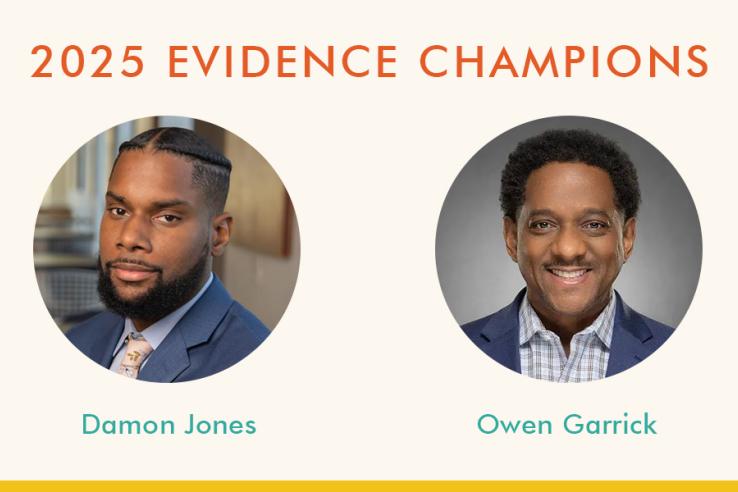
One way J-PAL North America uplifts the evidence community is by spotlighting leaders who go above and beyond. This month, we are proud to announce our third annual Evidence Champions recognition: an award that celebrates partners and researchers in our network who have made extraordinary contributions to their field. This year, we are recognizing Damon Jones, J-PAL affiliated professor and Scientific Advisor on racial equity, and Dr. Owen Garrick, a leader in clinical research who is motivated to find solutions to ongoing health disparities in the United States. The evidence-based policymaking movement is driven in large part by leaders like Damon and Owen, and we are proud to recognize their inspiring work to position racial equity as a central consideration in evidence-based policymaking. I encourage you to read about their incredible contributions in our featured videos and blog posts below.
As we enter the new year, we must ensure that evidence continues to have a seat at the table, amid declining federal support for policy research. A key question is how to communicate about the value of research and amplify relevant findings, beyond the usual academic and evidence circles. Moving forward, we at J-PAL North America are eager to explore new models for how we discuss evidence to make it more compelling, relevant, and widespread. If you have strategies or examples to share, we would be excited to hear your ideas.
Wishing you a restful holiday season,
Vincent Quan
Co-Executive Director, J-PAL North America
Recognizing J-PAL North America's 2025 Evidence Champions
Our third annual Evidence Champion awards celebrate two individuals who have made extraordinary contributions to the field of evidence-based policymaking. This year’s Evidence Champions are Damon Jones, as our researcher recipient, and Dr. Owen Garrick, as our partner recipient. Read more about Damon’s work to make racial equity research more rigorous and inclusive, and Dr. Garrick’s efforts to implement bold, actionable, evidence-driven health care solutions across the United States.
J-PAL North America’s 2025 year in review
As this year comes to a close, we are reflecting on the ways J-PAL North America has contributed to the evidence-based policymaking movement throughout 2025. In a new post on the J-PAL blog, we share some of our key accomplishments to help leaders generate and use evidence, support new research, and engage in policy discussions to elevate programs worth investing in. Read the post »
Opinion: Using evidence to combat poverty, one community at a time
Nearly 36 million people in the United States are living in poverty. Experts warn that big cuts to government programs meant to help struggling families could push even more people into hardship. In a new opinion piece in Governing Magazine, Vincent Quan, J-PAL North America Co-Executive Director, discusses how state and local governments can continue to be engines for progress during this tumultuous time, delivering results for their communities by investing in evidence-informed programs. Read the article »
Featured Evaluation Summary
The impact of free tuition program design on college applications and enrollment in the United States
Does including a high degree of certainty in free tuition offers have an impact on application to and enrollment in college? High tuition costs, coupled with complexity and uncertainty in the financial aid process, are major barriers to low-income students’ applications to and enrollment in higher education. Free tuition programs can alleviate these burdens, but there are many ways to structure these programs. Researchers investigated how two different free tuition programs for low-income students affected application and enrollment to the University of Michigan. Read more about the findings »
Featured Research Resource
Grant and budget management
This J-PAL research resource covers practical advice on grant management for principal investigators and research staff. We include overarching tips to help ensure smooth grant management throughout the project, define and explain common terms and conditions, discuss final deadlines and no-cost extensions, and include guidance on managing multiple grants simultaneously.