

Image

The evidence-based policy movement has encountered significant challenges this year, including reductions in funding and staffing, as well as a policymaking environment where beliefs and values often took precedence over evidence. Despite this, our practitioners, partners, and researchers across the country remained fiercely committed to improving lives and communities with rigorous research this year.
At J-PAL North America, we launched new initiatives, models, and projects to advance the generation and use of evidence in the North America region. As we continue to adapt to a rapidly evolving policy landscape, we’re taking a moment to reflect on this year’s progress and chart a course for growth over the next year.
In 2025, J-PAL North America expanded our efforts to equip policymakers, practitioners, and researchers with the tools to generate and use evidence that transforms communities and changes lives.
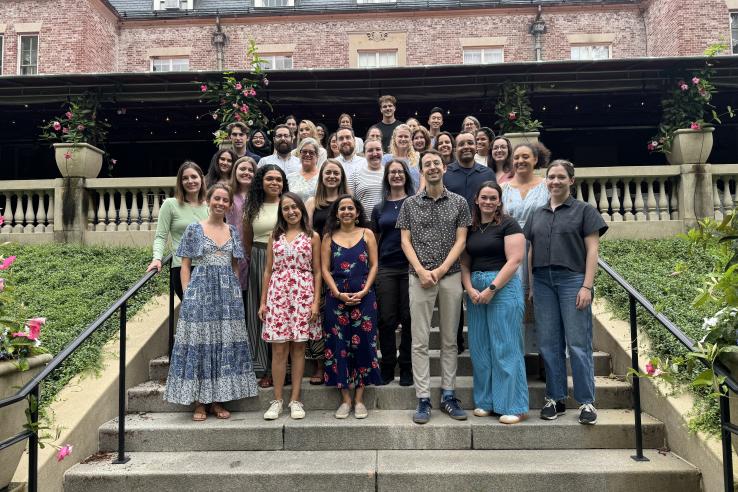
In August, we hosted our first in person Research Staff Training since 2019, an immersive, three day program in Massachusetts that covers the essentials for research staff working on randomized evaluations.
We also launched our inaugural Climate Action Learning Lab, a new model for helping state and local governments test and strengthen climate programs through evidence. Over 25 representatives from 6 US jurisdictions joined custom trainings tailored to climate programming, met one-on-one with J-PAL staff to identify evaluation opportunities, connected with leading J-PAL climate researchers, and convened in Cambridge for a Climate Action summit.
In Puerto Rico, we deepened our partnerships with local nonprofit and government organizations. This included a custom Spanish-language training designed for the island’s unique policy context and the November launch of our Puerto Rico AprendeLab, a six month program designed to support organizations on the island embed data and evaluation.
And last month, we brought together nearly 190 members of the evidence-based policy community in Seattle, co-hosting an Evidence Matters event with the Wilson Sheehan Lab for Economic Opportunities and our longstanding partners at King County, Washington. This day of collaboration showcased how local governments such as King County are leveraging research and data to make better decisions, improve services, and drive meaningful change.
In 2025, we continued to support our partners and affiliated researchers in generating evidence by funding and running new studies focused on policy-relevant questions.
This year, J-PAL North America launched the Initiative for Effective US Crime Policy to support randomized evaluations aimed at improving public safety and addressing disparities in the US criminal legal system.
Alongside this new initiative, we funded over thirty new research projects through our biannual Request for Proposals (RFP). Topics included mobile vans for treating opioid use disorders, reducing energy insecurity through self-managed energy assistance, shelter diversion programs, among others.
As part of our regular Request for Proposals, we also hosted a Special Topic RFP focused on racial equity, which supported studies investigating and addressing the underlying causes of racial and ethnic inequities. Funded projects included quantifying the discrimination present in K-12 school admissions and how information about a college majors’ expected earnings might affect students’ borrowing decisions.
2025 also marked our third year participating in the Learning Engineering Virtual Institute (LEVI), where we continue to support different teams in evaluating AI Ed-tech tools to improve math gains for students from low-income households.
In 2025, J-PAL affiliated researchers published groundbreaking new study results from randomized evaluations. We are excited to see how innovative research is continuing to inform critical questions and policy areas.
Examining health care within the criminal legal system, a new paper from J-PAL affiliated researchers Marcella Alsan and Crystal Yang concluded that jail health care accreditation reduced mortality for people in jail, improved coordination between health and custody staff, and increased compliance with quality standards.
J-PAL affiliated researcher Rebecca Myerson and coauthors also released a new working paper on increasing Medicaid renewals through different outreach methods, such as text messages and pre-recorded calls. Pre-recorded calls offering free one-on-one help from health insurance navigators increased Medicaid renewal by 1 percentage point (a 1.5 percent increase). These insights are especially important, as states consider major changes to Medicaid in light of the federal H.R.1 bill.
New results from the Baby’s First Years study, now in its fourth year, found that a monthly cash transfer of US$333 to mothers had no impact on different children’s developmental outcomes. Baby’s First Years principal investigator and J-PAL affiliated researcher Lisa Gennetian, alongside coauthor Katherine Magnuson, reflected on these findings on the J-PAL blog, noting that more research is needed to understand the impact of cash transfers on children.
A new randomized evaluation from J-PAL affiliated researcher Oeindrila Dube and coauthors, in partnership with the Chicago Police Department, evaluated the impact of cognitive training on how police officers handle high-stress situations. The training led to reductions in the use of force, discretionary arrests, and arrests of Black civilians. As a result, the state of Ohio has adopted this training.
Amid reduced public funding and polarized policy debates, grounding decisions in credible evidence is more essential than ever. J-PAL North America is ensuring that investments—both public and philanthropic—go toward programs proven to make a difference.
Throughout this year, our leadership team engaged directly in national policy conversations, sharing insights from rigorous research to help decision-makers allocate resources to where they’ll have the greatest impact. We elevated evidence on the effectiveness of sectoral employment training programs, discussed the policy implications of null results in research on Medicaid, shared actionable insights on Housing First programs, and reinforced the broader value of rigorous evidence in shaping equitable, efficient policy.
We also helped translate research into action by supporting an implementation manual for Summer Youth Employment Programs, for jurisdictions interested in building similar programs to strengthen opportunities for young people.
J-PAL North America is excited to continue this work and build momentum into 2026 by focusing on: