

Government of Bihar, JEEViKA and J-PAL South Asia present impact evaluation findings from Satat Jeevikoparjan Yojana (SJY)
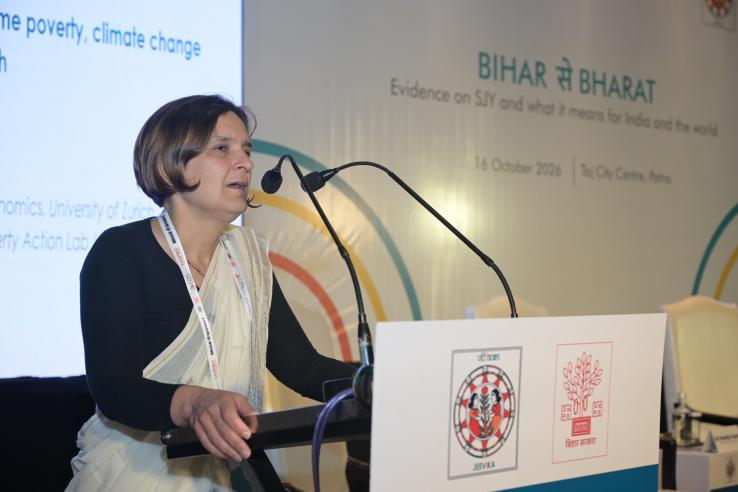
Evaluation finds that the Satat Jeevikoparjan Yojana substantially raised incomes, consumption, and assets, and enhanced women’s empowerment among extremely vulnerable households in Bihar.
Patna, 16th October 2026: The Government of Bihar, JEEViKA and J-PAL South Asia presented findings from a randomised evaluation of the Satat Jeevikoparjan Yojana (SJY) on 16 October 2026 at Taj City Centre, Patna. Launched in 2018, SJY is one of the largest government-led scale-ups of the Graduation Approach.
As of April 2026, SJY has reached 210,218 households across all 38 districts of Bihar, with 183,000 households having graduated from the programme.
The impact evaluation found substantial gains among SJY participants relative to comparable non-SJY households across a range of outcomes, including 2X higher monthly household income (₹10,701), 8X higher monthly business revenue (₹6,558), and 11X higher bank savings deposits (₹3,486).
Dr. Jyoti Mukhopadhyay, Principal Investigator of the SJY impact evaluation and Associate Professor of Economics at IFMR Graduate School of Business, Krea University, said, “What we found is that even in the follow-up survey conducted a year later, these impacts were still lasting. Whether we look at business growth, consumption, earnings, SHG savings or food adequacy, the impacts are sustained. This is a very promising and remarkable result, and it gives us a lot of hope for the future.”
Dr. M.R. Sharan, Principal Investigator of the SJY impact evaluation and Assistant Professor, Department of Agricultural and Resource Economics, University of Maryland. added, “What we are seeing in the Graduation programme is truly remarkable, because Bihar is showing that a sustainable model run through JEEViKA can result in impacts that are comparable to, if not larger than, those seen in NGO-run programmes across the world.”
A holistic support package
The SJY programme builds on the Graduation Approach, where extremely vulnerable households are identified and provided a livelihood package of sequential components starting with a productive asset, training on its use, regular coaching, access to savings and consumption support, delivered over 18 to 24 months. The programme aims to help these households graduate from extreme poverty by building more secure and sustainable livelihoods over time.
Developed by BRAC, the Graduation Approach was piloted in Bihar by Bandhan-Konnagar and JEEViKA with women-led households between 2014 and 2017. These pilots generated important lessons on how the approach could work within Bihar's existing delivery systems and community institutions.
Following this, the SJY programme was launched in 2018, through JEEViKA, with Bandhan-Konnagar as the technical advisor and J-PAL South Asia as the knowledge and learning partner.
The Ministry of Rural Development is now adapting the Graduation Approach across more than 12 states through Samaveshi Aajeevika Yojana under DAY-NRLM, with J-PAL South Asia as a knowledge partner. Findings from Bihar can inform how the approach is adapted to different implementation contexts.
Reflecting on the programme's implementation, Shri Arvind Kumar Chaudhary, Additional Chief Secretary, Cabinet Secretariat Department, Government of Bihar, said, “Designing social programmes requires continuously learning and improvising as you go along. For SJY, the entire design was to communitise the programme: village organisations took the lead, supported by Master Resource Persons (MRPs) and cluster-level federations. That community ownership was central to making the programme work at scale.”
What do the results show?
This RCT was conducted across 129 Gram Panchayats of 9 blocks in 3 districts (Saharsa, Purnia, and Siwan) that were chosen as representative of poor, medium and well-off districts. All households were measured for a baseline between October 2021 and May 2022, with two endline surveys taking place after – the first conducted approximately two years after the asset transfer (June-September 2024) and the second one year after the programme participation ended for beneficiaries (Oct-Dec 2025).
These are the results of the first survey:
Viewed against comparable non-SJY households, our results showed that programme participants spent, per capita:
Financial Gains
2x more (₹10,701) in monthly household income, a substantial increase in relation to comparable non-SJY households that had earned ₹4,839 in that period.
8X more (₹6,558) in monthly business revenue, a nearly 10x increase relative to comparable non-SJY households who earned ₹858 in the same period.
6% more (₹595) in self-help group savings balances.
This was a substantial improvement for women who were previously unable to afford the monthly ₹100 compulsory to participate in the SHG savings programme.
11X more (₹3,486) monthly bank savings deposits.
With more money in the bank, this amount grew, ensuring participants who had more money would make more money.
Consumption
According to research by James Sullivan and Bruce Meyer, consumption is one of the most direct and accurate measures of material well-being, because it goes beyond the numbers. It paints a picture not just of how much more money is available to participants, but of how they make use of the money to improve their lives.
In comparison to comparable non-SJY households, our results showed that programme participants spent, per capita:
SJY participants showed*:
27% more (₹461) in total, every month, confirming that these gains were lasting and resilient.
14% more (₹156) on food consumption, mainly on milk, fruits, nuts and eggs – a move toward a diversified diet, with more protein and nutrients.
43% more on non-food items (₹316), including tuition, school books, light and fuel
- 1.4X more on durable goods, including jewellery, vehicles, furniture and home repair.
*INR Values shown are raw sample averages, not regression-adjusted estimates.
About the evaluation
The evaluation was conducted by principal investigators Dr. M.R. Sharan (University of Maryland), Dr. Jyoti Mukhopadhyay (IFMR Graduate School of Business, Krea University) and Dr. Shagun Sabarwal (Co-Impact).
Professor Esther Duflo, Nobel Laureate, Co-Founder of J-PAL and Scientific Director of J-PAL South Asia, said, “A revolution against extreme poverty is possible. Eliminating extreme poverty is possible, and therefore, it is definitely a duty. What Bihar has demonstrated is that this can be done at scale, and it can be done again and again.”
Dr. Shagun Sabarwal, Principal Investigator of the SJY impact evaluation and Vice President, Programs at Co-Impact, highlighted the importance of understanding whether the Graduation Approach could deliver lasting results at government scale. “What’s most important is that whatever we are doing should endure over time, and that these households should not fall back into this state of vulnerability. What we did not have was whether this can work at scale when it’s implemented by a government system, and that is why these findings are so important.”
What do these results mean for poverty alleviation?
Discussions highlighted the role of institutional partnerships in implementing the Graduation Approach at scale. In Bihar, JEEViKA led implementation through its established network of community-based organisations and self-help groups, enabling the programme to identify and support some of the state's most vulnerable households.
The event also examined the national expansion of the Graduation Approach through Samaveshi Aajeevika Yojana (SAY) under DAY-NRLM. The Ministry of Rural Development is adapting the approach across more than 12 states, with lessons from Bihar informing how the model can be tailored to different institutional and implementation contexts.
Shri Himanshu Sharma, Chief Executive Officer, JEEVika added, “When evidence showed that the poorest households were still being left out, Bihar took the difficult step of adapting lessons from earlier Graduation programmes and introducing a grant-based approach within JEEViKA’s existing loan-based ecosystem. The results are now before us, and it is a matter of great pride that an approach taken up in Bihar is being carried forward nationally.”
The event also examined the national expansion of the Graduation Approach through Samaveshi Aajeevika Yojana (SAY) under DAY-NRLM. The Ministry of Rural Development is adapting the approach across more than 12 states, with lessons from Bihar informing how the model can be tailored to different institutional and implementation contexts.
Reflecting on the lessons from Bihar for national scale-up, Shri Rohit Kansal, Secretary, Ministry of Rural Development, Government of India, said, “If there is one lesson we should take from SJY, it is the ability to adopt, adapt and amalgamate. Public systems bring scale, community institutions bring trust and local knowledge, and research and technical partners bring evidence and specialised capabilities. Together, they create the capacity not just to adopt an approach, but to adapt and improve it as it scales.”
For any media enquiries or requests, contact:
Shreya Saxena, Lead, Communications, J-PAL South Asia; [email protected] | 8826012534