

From Innovation to Impact: India–France dialogue explores how evidence can help scale promising solutions
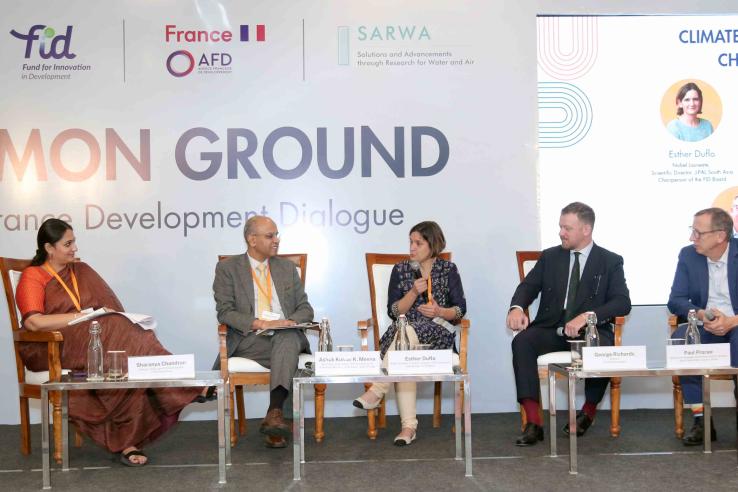
NEW DELHI, October 15, 2026: The Fund for Innovation in Development (FID), Agence Française de Développement (AFD), and J-PAL South Asia convened Common Ground: India–France Development Dialogue in New Delhi as part of the India–France Year of Innovation 2026. The dialogue brought together policymakers, researchers, practitioners and funders to explore how promising innovations can be tested, strengthened through evidence and adapted for wider use in public systems.
Discussions across education, gender, health and climate examined what it takes to move from promising ideas to effective implementation. The convening also marked a new five-year partnership between J-PAL South Asia and the Brevo Foundation to advance evidence on poverty reduction and the role of social connections in development.
Opening the dialogue, Lisa Amon, Deputy Head of Mission, French Embassy in India, highlighted the potential of the India-France partnership to advance development innovation through evidence, research and collaboration. She noted that India’s dynamic research ecosystem, capacity for innovation and extensive development experience offer significant opportunities for mutual learning, particularly as both countries explore how proven solutions can reach more people.
“Innovation achieves its full potential when it moves beyond experimentation and translates into lasting, tangible improvements in people’s lives,” Amon said. “As we celebrate the India–France Year of Innovation, the dialogue paves the way for turning our shared ambition into concrete cooperation, to exchange knowledge, build new partnerships and help proven solutions reach a greater number of people.”
In her keynote address, Professor Esther Duflo, Nobel Laureate in Economics and Co-founder of J-PAL and Chair of the FID Board, examined the role of science and innovation in global development, and how evidence can help identify which ideas work, for whom, and at what cost.
“When governments, implementers, researchers, and funders work together, the evidence can turn promising ideas into better policies and better lives. Governments create the conditions for scale and embed proven solutions in public systems”, Duflo said.
She also highlighted the importance of recognising failure as part of the innovation process, noting that rigorous testing helps distinguish among promising ideas those that deliver ideas from those that deliver meaningful results and identifies solutions that can be adapted and scaled through public systems.
The J-PAL x FID Investments Showcase featured four projects spanning women’s financial independence by Inclusion Economics India Centre, student well-being by Labhya Foundation, gender-based violence training for police officers by Development Impact, World Bank and efforts to reduce drug use among young people by J-PAL South Asia. The projects illustrated different stages of the journey from innovation to evidence, including testing new approaches, evaluating their impact and understanding the conditions under which they could be taken further. The showcase was followed by a cross-sectoral discussion on what innovation looks like in practice and what it takes to embed evidence in public systems and take promising approaches to scale. The discussion highlighted that scaling evidence-based innovations requires more than demonstrating impact. It calls for government ownership, context-specific adaptation, alignment among researchers, funders and implementers, and sustained investment in evidence and learning to embed effective approaches in public systems.
The dialogue also turned to climate and resilience, with discussion spanning water, air, heat, and energy, and the role that rigorous evidence can play in shaping India’s climate adaptation response. The session, “Climate and Resilience in a Changing World,” featured Esther Duflo, Ashok K.K. Meena, IAS, Secretary, Department of Drinking Water and Sanitation, Ministry of Jal Shakti, Government of India; George Richards, Director, Community Jameel; and Paul Procee, Operations Manager and Acting Country Director, World Bank India Country Office; moderated by Sharanya Chandran, Director, Policy and Communications, J-PAL South Asia. The discussion explored how evidence, research, and cross-sectoral partnerships can inform responses to interconnected climate and resilience challenges, highlighting the importance of linking innovative approaches to the institutions and systems needed to implement them effectively and at scale.
Emphasising the need to build water systems that can anticipate and withstand risks to be scaled to withstand changing climate conditions, Ashoka K K Meena said, “The tap arriving at the household does not mean that water has arrived at the household. For villages and households that have received tap connections, the issue of climate resilience boils down to a very simple concept: water has to come to me every day.”
The day concluded with the announcement that the Brevo Foundation has committed approximately €786,000 over five years to a partnership with J-PAL South Asia. The partnership will focus on two priorities : supporting the scale-up of the Graduation Approach to strengthen pathways out of extreme poverty, and generating evidence on how social connections shape development outcomes.
Closing the dialogue alongside the FID and J-PAL, Virginie Dago, Country Director, Agence Française de Développement (AFD), India, emphasised that innovation must be supported by evidence and partnerships to translate into lasting development outcomes. She highlighted the potential of Indo-French collaboration to connect research, development finance and public policy, helping effective and adaptable solutions to reach more people.
“One key message stands out: innovation is essential, but innovation alone is not enough. We need evidence to understand what works, for whom, and under what conditions, and we need partnerships to turn that knowledge into lasting impact”, Dago added.
The event reflected a broader ambition to deepen Indo-French collaboration around innovation for public good, bringing together complementary perspectives from research, development finance, government and implementation. The dialogue highlighted the importance of institutions that can continuously test, learn, adapt and scale what works as governments respond to interconnected challenges across development and climate.
About FID
The Fund for Innovation in Development (FID) is an innovative mechanism, created by Esther Duflo, dedicated to financing social, technological, or organizational innovation in the fight against poverty and inequality. At the heart of its approach: fostering dialogue between innovation and research teams to steer, test, and evaluate the impact of projects using rigorous scientific methods. FID's ambition is to ultimately contribute to improving public policy by supporting the scale-up of innovations whose effectiveness has been proven.
About Agence Française de Développement
AFD Group contributes to the implementation of France’s policies for sustainable development and international solidarity. The Group includes Agence Française de Développement (AFD), which finances the public sector, NGOs, research and training; its subsidiary Proparco, which is dedicated to the private sector; and Expertise France, a technical cooperation agency. The Group finances, supports and accelerates the transitions needed for a fairer, more resilient world”.
About J-PAL South Asia
The Abdul Latif Jameel Poverty Action Lab (J-PAL) is a global research centre working to reduce poverty by ensuring that policy is informed by scientific evidence. Anchored by a network of over 1300 affiliated researchers at universities around the world, J-PAL conducts randomized impact evaluations to answer critical questions in the fight against poverty. J-PAL South Asia is hosted by the Institute for Financial Management and Research (IFMR).
For any media enquiries or requests, contact:
- Shreya Saxena
J-PAL South Asia
[email protected] | 8826012534 - Laetitia Chadenat
FID
[email protected]