

March 2026 Global Monthly Newsletter
Our new AI Evidence Playbook: How to adopt AI for social good
How can we know which AI investments will actually improve outcomes—and change people's lives for the better? The AI Evidence Playbook combines evidence from randomized evaluations of AI-enabled programs with decades of evidence on human behavior and earlier technologies. The Playbook helps policymakers, practitioners, and donors prioritize AI-enabled programs with the highest potential to improve lives, and provides guidance on evaluating their real-world impacts. Read more about the Playbook »
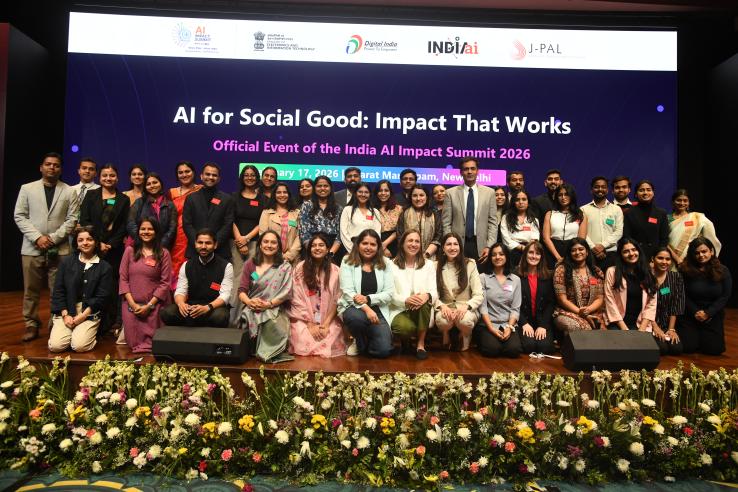
We launched the Playbook at the India AI Impact Summit last month, where we organized a day-long seminar and participated in events organized by Data.org, Google.org, OpenAI, and the World Bank. The J-PAL seminar brought together leaders from government, global tech companies, nonprofits, and key funders—alongside several thousand attendees—to chart a path toward an AI ecosystem that maximizes social good by placing rigorous evaluation at the center. Read more about the event »
Launching the Evidence for AI in Health initiative
🗓️ Proposals due April 1
At the AI Impact Summit, J-PAL was also part of the launch of the Evidence for AI in Health (EVAH) initiative, a joint investment by Wellcome Trust, the Gates Foundation, and the Novo Nordisk Foundation and delivered in partnership with J-PAL and the African Population and Health Research Center.
EVAH will fund evaluations to help policymakers, providers, and developers understand which AI tools work, where they add value, and how they can be used responsibly within health systems in low- and middle-income countries. EVAH’s first round of funding will support research on AI-enabled clinical decision support tools used by primary and community health care workers in sub‑Saharan Africa, South Asia, and Southeast Asia. Read more and apply »
Celebrating International Women's Day: Stories from gender research
We’re spotlighting stories of impact from randomized evaluations of programs designed to improve gender equity and women’s empowerment—from financial incentives that reduce child marriage to programs addressing menstrual stigma to gender-sensitive policing. Read more »
Planting the future: School gardens and climate education in France
Can a school garden change how children think about nature? Early findings from a randomized evaluation in French primary schools suggest that more time spent in garden-based activities increases ecological awareness and connection to nature.
A new photo essay shot by J-PAL Europe team members Zahra Boudalaoui-Buresi and Mariajose Silva-Vargas, along with colleagues from partner organizations, take readers inside classrooms and school gardens to see how teachers and pupils bring the program to life. See the photos »
NEW POLICY INSIGHT
How can policymakers leverage financial tools to help farmers increase their profits?
In a new J-PAL Policy Insight, we highlight lessons from 23 randomized evaluations of financial tools like credit and grants designed to support farmers’ profits.
Policy issue: Farmers need capital to invest in their farms and grow their businesses. However, traditional microcredit repayment schedules often don’t align with farmers’ seasonal incomes. Because farmers earn most of their income after harvest and very little during the planting season when they need to invest in inputs, they may be unable to access credit when they need it the most.
Findings: When credit was tailored to farmers’ seasonal income, farmers invested more in their farms, and often increased their yields and revenues—but not their profits. Similarly, when farmers were offered cash grants or subsidized inputs, they increased their productivity but not profits.
This suggests that financial constraints are not farmers’ only barrier to improving their businesses. When credit or grants are bundled with complementary services like information or market access programs, farmers are better able to take up the bundled input program and, in turn, see improvements in their profits. Read more »
NEW PUBLICATION
Reviewing the impact and cost-effectiveness of local climate action in the United States
Reducing greenhouse gas emissions and responding to climate hazards isn’t just a national responsibility. Across the United States, state and local governments are adopting Climate Action Plans to scope specific actions they can take to reduce greenhouse gas emissions and adapt to climate change-related hazards.
A new J-PAL North America evidence review summarizes key policy insights from a white paper on local climate action across five sectors: energy, transportation, solid waste, water and wastewater, and agriculture and conservation. The review, based on research from the J-PAL network, also presents key gaps in the evidence base and outlines important considerations for measuring climate policy impact.
Research by: Matthew Burditt (California State Auditor), Shelah Ott (California Air Resources Board), Gordon McCord (UC San Diego), and Teevrat Garg (UC San Diego)
FEATURED BLOGS
Discussing the future of education research in Africa with Alex Eble
Columbia University Associate Professor Alex Eble is the new Scientific Advisor for J-PAL Africa’s Education portfolio. In this interview, Alex discusses how his experience as both a development practitioner and an economist guides his approach to research priorities and scaling decisions. His focus is on evidence that is useful to decision-makers and responsive to local priorities. Read more »
New blog series: Expert perspectives on what’s next for inclusive finance
In 2025, J-PAL convened researchers working on inclusive finance in Nairobi, Kenya to discuss the frontiers of the field. A new blog series will highlight the key takeaways and emerging research priorities. The first post examines how African countries are moving beyond mobile money to integrate AI into their financial systems, unlocking new forms of lending, credit scoring, insurance, and cross-border payments. We look at real-world applications of AI in African financial systems, and highlight urgent questions about trust, costs, and design. Read more »
FEATURED RESEARCHER
“Policymakers are eager to incorporate evidence into their decision-making, but the available research does not always align with the specific, time-sensitive questions that must be considered in program design and implementation.”
Jacob Wallace on strengthening Medicaid through evidence use and generation
Yale University Associate Professor Jacob Wallace’s work focuses on helping Medicaid agencies conduct evaluations and use evidence to improve programs. In a new affiliate spotlight, he reflects on his time in government, his research on Medicaid, and how he envisions researchers and agencies working together to improve programs in the forthcoming Medicaid Learning Lab and beyond. Read more »
WELCOMING OUR NEW AFFILIATED PROFESSORS
In summer 2025, we welcomed 29 talented researchers to the J-PAL network. We feature a few of them here each month.
Fiona Burlig, University of Chicago
Nathan Fiala, University of Connecticut
Robert Lensink, University of Groningen
FEATURED TRAININGS
ADEPT partnership spotlight: Accelerate your path to a master’s degree at the Bordeaux School of Economics
🗓️ Apply by March 16
Calling all francophone learners: The Bordeaux School of Economics (BxSE) is now an Alliance for Data, Evaluation, and Training (ADEPT) pathway university. Apply with your Data, Economics, and Design of Policy (DEDP) MicroMasters credential to waive the entire first semester of BxSE’s two-year Master’s in Development Economics (EADD track) program. Learn more »
Apply today to J-PAL North America's Climate Action Learning Lab
🗓️ Apply by March 27
This summer, the Climate Action Learning Lab will provide participants with evaluation training, connections to researchers, and a peer group to share ideas—all for free. If you are a leader from a United States government agency, nonprofit organization, or industry interested in identifying and scaling effective and equitable climate solutions, this program is for you. Learn more »
Applications open: J-PAL Africa’s Evaluating Social Programs Course
🗓️ Apply by April 30
Applications are now open for J-PAL Africa’s five-day Evaluating Social Programs course, taking place June 22–26, 2026 at Strathmore University in Nairobi, Kenya. The course provides practical training on how to design and use randomized evaluations to measure social impact and inform policy decisions, through lectures, real-world case studies from Africa, and interactive group work. Learn more »
🗞️ MEDIA HIGHLIGHTS
Good intentions alone won’t empower Indian women
Hindustan Times
AI tools that actually do something — beyond the hype and 'sales pitch.'
Devex
Special edition: The global south demands a voice on AI at India summit
Devex
India’s AI summit draws global leaders, big pledges, and chaos
NBC News
Feel-good vs do-good AI: J-PAL director calls for reality check on AI tools
Hindustan Times
New J-PAL research and policy initiative to test and scale AI innovations to fight poverty
MIT News
📄 NEW RESEARCH PAPERS
Psychological Barriers to Participation in the Labor Market: Evidence from Rural Ghana
Leandro Carvalho, Damien de Walque, Crick Lund, Heather Schofield, Vincent Somville, and Jingyao Wei
Chat Over Coffee? Diffusion of Agronomic Practices and Market Spillovers in Rwanda
Esther Duflo, Daniel Keniston, Tavneet Suri, and Céline Zipfel
The Lasting Effects of Working while in School: A Long-Term Follow-Up
Mery Ferrando, Noemí Katzkowicz, Thomas Le Barbanchon, and Diego Ubfal
Navigating Ambiguity: Imprecise Probabilities and the Updating of Disease Risk Beliefs
Jason T. Kerwin and Divya Pandey