Image

In our work across rural West Africa, we often encounter a paradox. Farmers need inputs like seed and fertilizer to grow crops. Ag-dealers want to sell seed and fertilizer. Yet markets connecting the two are missing. In Mali, for example, 70 percent of farmers had to travel outside of their village to purchase inputs. So, why don’t markets form if demand and supply side actors have incentives to transact?
As researchers interested in expanding agricultural markets, we went to Mail to explore this question. Conversations with farmers and ag-dealers surfaced four themes that shaped both our research agenda and our thinking about how to scale what works: time, place, commitment, and trust.
We began with a simple model: Village Input Fairs (VIFs). VIFs are one day agricultural markets organized in remote villages during the post harvest season (time + place), where farmers pay a deposit and place orders for agricultural inputs to be delivered at planting time where they are verified (commitment + trust). With support from J-PAL and the Center for Effective Global Action’s Agricultural Technology Adoption Initiative (ATAI), we tested six variations of VIFs in Mali to see which market characteristics encourage farmers to purchase inputs. We found that when input markets are organized in the post-harvest season with a commitment of a 10 percent deposit, farmers demand the most inputs.
This led us to consider, would increased farmer demand be enough to incentivize ag-dealers to sell inputs during a village input fair? To answer this, we decided to measure ag-dealers willingness to pay for licenses to participate in the VIF by organizing auctions. For each village, two licenses were made available to ensure that ag-dealers could profit, while ensuring farmers benefited from price competition and a diverse inventory of products. The auction system confirmed that ag-dealers would be willing to pay for licenses. It also helped us resolve a key implementation challenge: deciding which ag-dealers should supply each village.

With support from USAID’s former Development Innovation Ventures program, we initially tested and expanded VIFs with this auction model by working with existing local enterprises and testing a “let a thousand flowers bloom” strategy—that is, running business competitions to identify businesses willing to adopt VIFs and make them their own. Unfortunately, these local enterprises had little incentive to market the fairs properly or hold them at the agreed upon times with all actors present. They saw themselves as contractors, rather than businesses for scaling VIFs. These issues led farmers to lose confidence in the fairs, so farmer attendance and purchases were often low.
Based on these experiences, we decided to try a new approach: a social enterprise model. Although the auction identifies which input dealers are most committed and willing to pay for market access, we lacked a neutral and reliable ‘market maker’ to organize farmers and the winning ag-dealers. A social enterprise could fill this role by reducing the coordination costs that typically keep private dealers from reaching rural villages and ensuring that farmers were ready to purchase on the day of the village input fair. To create a sustainable revenue stream, the social enterprise would collect licensing fees from the auction and also take a percentage commission on sales to fund its operations based on total market sales. This would create a lasting market-based solution in which the social enterprise serves as an essential bridge between farmers and agricultural input dealers.
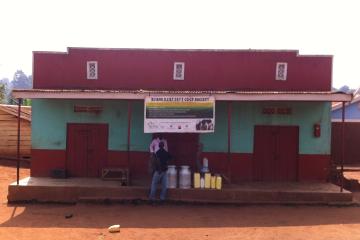
We launched our first social enterprise, Sene Sugu Folo, in Mali in 2025 and are launching a new social enterprise in northern Ghana in 2026. We are also exploring opportunities in Senegal and Cote d’Ivoire in partnership with J-PAL and OCP Africa as we build out the evidence base in new countries. All of our social enterprises are supported by a global non-profit we created and call the Village Input Fair Fund (VIFF).
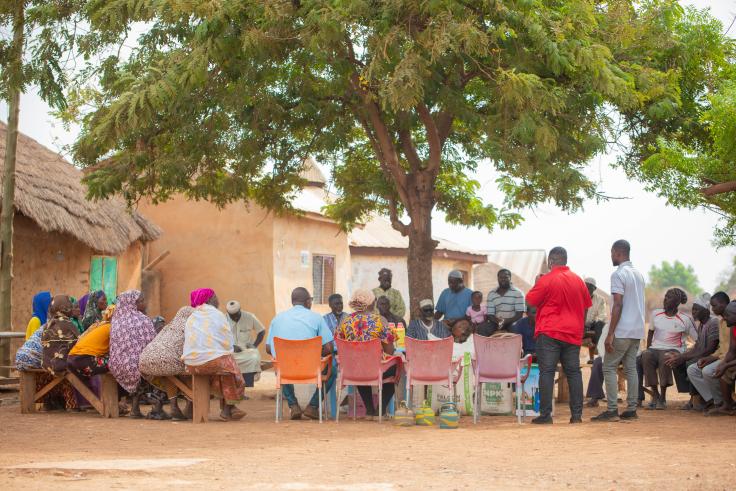
A primary lesson from our journey is that traditional NGO distribution models often bypass local private actors, creating parallel systems that collapse when funding ends. By concentrating dozens or hundreds of potential customers in one location on a specific day, VIFs allows agro-dealers to serve rural communities profitably despite transportation costs. However, scaling this model is challenging as a central ‘market-maker’ is missing. A social enterprise can play this role to reduce coordination costs until markets can form and operate sustainably on their own. Organizing farmers to purchase agricultural inputs in their villages, standardizing contracts, and establishing a licensing system for ag-dealers, the social enterprise replaces ad-hoc interactions with a reliable market intermediary.
Through a combination of rigorous evidence, including on market and auction design, and experimentation with private sector scaling strategies, like letting a thousand flowers bloom or social enterprises, we are proud ‘economic plumbers’, tinkering to find what works and why.