Using insurance and climate-smart technologies to help farmers cope with weather-based risk
Worsening droughts, more frequent and severe floods, erratic temperatures, and unpredictable seasons: these are just some of the disastrous consequences of climate change that wreak havoc on agriculture. Small-scale farmers in low- and middle-income countries (LMICs) typically have limited social safety nets to protect them against the growing threat of weather-based shocks. An urgent policy priority, both to increase farmers’ own productivity and profits and to contribute to stabilizing food security throughout these regions, is to provide accessible forms of risk protection. J-PAL’s updated Policy Insight reviews 23 randomized evaluations on common interventions intended to boost farmers’ risk protection and help them make optimal farming decisions.
Agricultural decisions in the face of weather-based risk
Farmers are faced with many decisions at the beginning of the agricultural season, including which crops or seed varieties to plant, how much to spend on inputs like fertilizer, and how much land to plant. Higher upfront investments in productive agricultural technologies like fertilizer, seeds, and pesticide can increase yields and profits at the end of the season. However, choosing to make these investments may seem unwise if there’s a chance they will not pay off due to an unexpected extreme weather episode. This uncertainty leads to a cycle of underinvestment and low productivity that can trap small-scale farmers in poverty.
One common tool to protect against risk is agricultural insurance, which typically pays farmers back for their recorded crop losses due to an adverse weather event. Weather index insurance is an innovation developed to reach small-scale farmers in LMICs by basing payouts on an easily observable variable, like rainfall at a local weather station, which is compared against historical norms and used as a sliding-scale index of farmers’ anticipated crop loss.
Insurance can protect farmers against shocks—but most are not willing to buy it
Overall, studies showed that farmers purchase index insurance at such low rates that insurance is often not profitable for lenders, inhibiting the growth of self-sustaining markets. However, overcoming learning, trust, or credit constraints can help boost take-up in some cases.
When insured farmers receive a payout or see their peers benefit from insurance, they are more willing to buy it the following season—but these effects dissipate if farmers pay for insurance and do not later receive a payout. Social learning and financial literacy trainings can boost insurance take-up, but their effects similarly do not always persist over time. Tailoring insurance to farmers’ unique seasonal incomes is also key, since farmers have limited cash on hand at the beginning of the season when they have to pay for insurance. While pairing insurance and credit products has not been shown to increase take-up in most cases, offering farmers flexibility to repay insurance after harvest time is a promising alternative, particularly for the least wealthy farmers.
When insurance is both appropriately tailored to farmers’ local contexts and is heavily subsidized, farmers do purchase it. In these cases, insurance is effective in helping farmers cope after a shock, and this protection also incentivizes farmers to shift their production decisions to higher risk and higher reward choices, like weather-sensitive cash crops. With this added benefit of boosting investments in both good and bad weather years, when insurance is designed in accordance with farmers’ local contexts, it may be an effective form of social protection targeted at small-scale farmers.
Insurance is just one tool to protect against risk: The role of risk-mitigating technologies
New agricultural technologies like drought- and flood-tolerant seeds and climate-smart practices such as rainwater harvesting can help make production itself more resilient to risk, rather than allowing damages to occur and compensating for them with insurance payouts. Pairing insurance and climate-smart technologies may also provide additional benefits than offering them on their own. While improved seed varieties help lower crop losses during moderate weather events, farmers are more willing to make risky production decisions with the addition of insurance.
Looking forward: Crowding in research on innovative technologies
While risk-mitigating technologies are promising complements to insurance to provide comprehensive protection that both lowers farmers’ risk exposure and helps them bounce back after a shock, more research is needed on how to bundle these strategies effectively. The Digital Agricultural Innovations and Services Initiative (DAISI), jointly managed by J-PAL and the Center for Effective Global Action and generously supported by the Bill and Melinda Gates Foundation, was launched in 2021 to shed light on digitally-enabled, bundled agricultural services for small-scale farmers. A core component of DAISI’s research agenda is to disentangle which elements of a bundled service are key to its success—and how to design bundled services to effectively alleviate small-scale farmers’ productivity constraints.
Small-scale farmers are at the forefront of global food security, and their livelihoods are also uniquely vulnerable to the effects of climate change as the intensity of weather shocks accelerates globally. As world leaders emerge from COP28, policymakers should continue to prioritize identifying and scaling evidence-based solutions tailored to farmers’ local contexts to boost global food security and protect farmers’ livelihoods.
On October 10, J-PAL in partnership with University Mohammed VI Polytechnic launched the UM6P-J-PAL Agricultural Lab for Africa. Chaired by Tavneet Suri (MIT, J-PAL Agriculture sector Co-Chair), the lab will be hosted at University Mohammed VI Polytechnic (UM6P) in Rabat, Morocco, with the goal of designing and funding rigorous impact evaluations of private sector programs that improve small-scale farmers’ food security, productivity, and profitability in sub-Saharan Africa.
The lab was announced during this year’s Spring Annual Meetings of the World Bank Group and International Monetary Fund in Marrakech, Morocco, as part of UM6P’s “the Voice of Africa” side event panel discussions on food security and sustainability. Participants heard from Tavneet Suri on her vision for the lab as academic chair, Iqbal Dhaliwal (MIT; J-PAL Executive Director) on expanding J-PAL’s portfolio of work in agriculture with the private sector, and Hicham El Habti (UM6P President) on the importance of partnership to achieve broad development of the agriculture sector in sub-Saharan Africa.
Tackling food insecurity through agricultural value chains
Small-scale farmers face numerous decision points throughout the production cycle, such as how much fertilizer to apply, what mixture of fertilizer is best for their soil and crop, where to sell their output for the highest possible price, among many others.
In recent years, the factors that affect small-scale agriculture in sub-Saharan Africa have become more complicated. Specifically, the world has experienced a rise in global food insecurity, resulting from changes in international market structures and regulation, trade disruptions under Covid-19 protocols and geo-political conflict, climate change, and other political and economic dynamics. Understanding how to improve food systems is, therefore, an essential step along the path to reducing poverty and securing livelihoods for rural communities across sub-Saharan Africa.
In response to this growing uncertainty, clear policies and programs that support farmers to invest in higher-yielding, more profitable, tailored, and innovative technologies are essential. However, there are still a number of policy questions yet to be answered to inform large-scale improvements in agricultural systems. As many agricultural supply chains and systems work across countries, markets, and stakeholders, it is imperative to build this evidence base to inform decision-making with NGOs and governments as well as the private sector, which has an outsized opportunity to affect change in agricultural markets and value chains.
Conducting research on scalable programs with the private sector
With an initial grant from OCP Foundation, UJALA will fund innovative research over the course of three years and six RFPs that rigorously evaluate these critical questions and challenges. UJALA will generate research and actionable policy lessons in five key areas:
- Designing and delivering effective food and agricultural subsidies
- Assessing the value of fertilizer customization to crop needs and soil nutrients
- Reducing low-income households’ reliance on imported food
- Alleviating farmers’ constraints to adopting and maintaining new agricultural technologies and practices
- Connecting farmers to markets that sell at competitive prices.
As a lab, UJALA will work in close collaboration with private sector partners in sub-Saharan Africa to conduct randomized evaluations of their services for small-scale farmers. The partners UJALA works with will be selected based on scale of operations, relevance to the research agenda, and interest in learning about their business models and impacts from rigorous, quantitative research. UJALA will have the express goal to disseminate research results to relevant public and private sector actors and support the scale up of effective programs and services with partners.
To achieve these goals, UJALA will work along the research life-cycle from conceptualizing evaluations to disseminating results and facilitating discussions on how to scale effective programs and services. Specifically, UJALA aims to:
- Identify programs delivered by our private sector partners with the potential to answer open questions related to agricultural technology adoption in Africa
- Connect partners with researchers in the J-PAL network to facilitate multi-stakeholder research partnerships
- Fund randomized evaluations to build an evidence base on increasing small-scale farmers’ productivity and profitability through the uptake of improved and accessible agricultural technologies
- Summarize and synthesize available results to address and answer outstanding questions relevant to policy and practice
- Disseminate the evidence to inform relevant agricultural development strategies across the African continent.
Looking ahead
Through strong partnerships with the private sector and researchers in the J-PAL network, UJALA will support the generation of new evidence and evidence-based decision-making among private sector partners. As a result of their operational scale and incentives to quickly respond to market changes, the private sector is uniquely positioned to tackle the looming challenges of climate change, market instability, and food insecurity and to improve the lives of thousands of small-scale farmers across sub-Saharan Africa.
If you are a researcher interested in learning more and getting involved, please reach out to [email protected].
J-PAL’s updated Policy Insight reviews strategies to improve information dissemination to help farmers make optimal production decisions and investments to improve their livelihoods.
The climate crisis is one of the many factors contributing to rising global food insecurity and threatening farmer livelihoods. To complicate matters, farmers are also faced with navigating changes such as innovations in technology, evolving market structures, and new food standards. As such, they may no longer be able to rely on the same tools, knowledge, or experience that previously worked in their contexts. They need updated information that is accurate, tailored, easily accessible, and that aligns with their business priorities. J-PAL’s updated Policy Insight reviews strategies to improve information dissemination to help farmers make optimal production decisions and investments to improve their livelihoods.
Challenges in reaching farmers with information
Farmers access production information from many different sources, but information has traditionally been shared with farmers through government-led agricultural extension programs. These services, typically organized by agricultural ministries, consist of delivering trainings, field visits, or farmer field schools to large groups of farmers in rural areas with the goal to encourage them to adopt technologies and optimize their production practices. However, many extension systems face challenges with staff capacity and accountability to reach all farmers reliably. In addition, extension programs are designed to make recommendations that maximize yields. They often base their recommendations about which technologies to use on experimental evidence from tests of technologies under relatively controlled environments rather than under a variety of real-world conditions. As such, these recommendations do not often reflect farmers’ incentives to maximize profits, as many of the practices designed to increase productivity require upfront costs that are not always recouped when farmers sell their crops at harvest.
This mismatch in priorities results in low uptake of recommended technologies and highlights the urgency to better tailor extension services to farmers’ actual needs and local conditions, particularly in rapidly changing environments where best practices are evolving.
The Agricultural Technology Adoption Initiative (ATAI) is a joint research initiative with J-PAL and the Center for Effective Global Action, funded by the Bill & Melinda Gates Foundation and the UK Foreign, Commonwealth, & Development Office. Since 2009, ATAI-funded research has shown that despite the promise of agricultural technology to boost productivity and transform agricultural livelihoods, adoption of technology remains low. One such barrier farmers face in deciding whether to adopt a new practice or technology is a lack of access to timely and relevant information on how to best utilize and reap the greatest benefit from the technology in question.
New insights on how to better tailor and deliver information to help farmers adopt productive technologies
J-PAL affiliated researchers have tested interventions that help farmers better access information to assess the suitability of new technologies and make optimal farming decisions. In our updated Policy Insight, we reviewed 41 randomized evaluations—eighteen of which were funded by ATAI—that showed that the content, frequency, and channel by which information is disseminated plays an important role in a farmer’s decision to adopt a new technology. Providing farmers with information through extension services does help farmers make informed decisions about what technology to adopt, but these services do not always reach all farmers or do not deliver information that has been tailored to local contexts or production requirements. Strategies like harnessing a farmers’ local network, incorporating simple tools, and leveraging information and communication technologies (ICTs), can improve the effectiveness of information dissemination.
Peer farmers, who serve as role models and can draw on local knowledge to tailor extension messaging, can encourage farmers to adopt new or improved technologies. They are particularly effective when extension agents face low capacity and when trust in recommendations from more formal channels is low.
Providing farmers with tools that simplify the use of complex technologies, like pit planting, charts to monitor plant needs through leaf color tracking, or a spoon to measure the optimal fertilizer amount, are another effective strategy to increase the uptake of improved farming practices.
Incorporating ICTs, such as SMS, into extension services can help organizations deliver frequent reminders and tailored information to farmers at particular points during production and harvest. Videos are another innovative tool to deliver technical information consistently and in a digestible manner, especially in areas where literacy rates are low.
While farmers seem to learn from information and adjust their production decisions accordingly, this does not consistently lead to improvements in their yields or profits. This may be because the information originally shared with them was irrelevant, the technology promoted was ill suited for the farmers targeted, or the recommendations shared prioritized increasing yields over profits. As such, policymakers should do more to ensure that the technologies selected, the information defined, and the delivery mechanisms are relevant and well-aligned with local conditions and farmer priorities.
Timely, relevant, and accurate information is key
As climate change and other factors accelerate the development of innovative technology and practices, it is critical that farmers know what tools are available to them, how to best use them, and what benefits or costs they should expect from adoption. With better access to timely, relevant, and accurate information farmers in low- and middle-income countries will be better equipped to combat rising food insecurity across the globe.
Today, ATAI launched a new open data platform to bring together the best evidence from ATAI-funded research in a single portal, making it easily accessible to researchers and policymakers alike. The initiative aims to foster collaboration and evidence-informed decision-making in the agricultural sector, ultimately contributing to the advancement of the most effective agricultural practices and improving farmer welfare.
This piece was originally published by the Center for Effective Global Action (CEGA).
A new open data platform will accelerate robust and comprehensive research in the agricultural sector
Since 2009, the Agricultural Technology Adoption Initiative (ATAI), co-managed by CEGA and J-PAL, has generated robust evidence of the impacts of agricultural technologies, such as stress-tolerant rice or mobile-phone based agricultural extension, on small-scale farmer welfare. Today, ATAI launched a new open data platform to bring together the best evidence from ATAI-funded research in a single portal, making it easily accessible to researchers and policymakers alike. The initiative aims to foster collaboration and evidence-informed decision-making in the agricultural sector, ultimately contributing to the advancement of the most effective agricultural practices and improving farmer welfare.
Why make data open?
Access to high-quality data has long been recognized as a significant obstacle in social science research. To address this issue, data repositories like the J-PAL Dataverse have emerged, making it easier for researchers, policymakers, and others to access and utilize data from completed research studies. In recent times, the effectiveness of these data repositories has been bolstered by data sharing policies put into place by funders, journals, and research organizations. UC Berkeley's Initiative for Transparency in the Social Sciences (BITSS)—incubated at CEGA—champions these and other open data approaches as a standard practice that promotes transparency and reproducibility of evidence, strengthening the scientific ecosystem and bolstering the credibility of research findings.
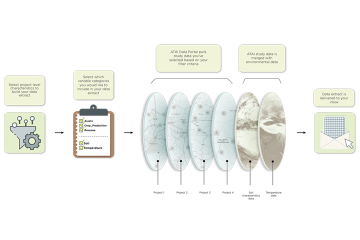
The ATAI Data Portal goes beyond the principles of open data by incorporating data harmonization. Data harmonization involves the collection of data from various sources or, in the case of ATAI, a research portfolio, in a manner that ensures users have a comprehensive and comparable view of the information.
Harmonized data holds tremendous value for researchers aiming to extract insights from multiple studies. In the past, researchers had to collect datasets from various sources, investing valuable time in cleaning and integrating the data. Often, the unavailability of raw data hindered such comparisons, and the resulting publicly available data lacked sufficient information for meaningful analyses. However, researchers now have a powerful tool at their disposal. With the ATAI Data Portal, they can access harmonized data, enabling them to conduct meta-analyses and explore the external validity and generalizability of research results more efficiently and effectively. This transformative platform opens up new avenues for robust and comprehensive research in the agricultural sector.
The ATAI Data Portal also improves the richness and quality of datasets from ATAI-funded projects in several ways. For instance, a number of ATAI-funded studies contain geo-referencing, or latitude and longitude coordinates for agricultural fields, households, or study administrative boundaries. When geographic coordinates are available, the ATAI Data Portal overlays the project dataset with environmental variables—such as temperature, precipitation, night lights, and forest cover–-to expand the richness and utility of the data. (Many predictive models rely on this kind of information as ground truth data).
To maintain the anonymity of the surveyed population, the data linkage employs industry-standard geo-masking techniques. By implementing these measures, the ATAI Data portal ensures that the privacy and confidentiality of the participants are preserved while providing valuable insights into the relationships between agricultural practices and environmental factors.
During the data harmonization process, meticulous data cleaning is carried out to ensure data integrity. This includes harmonizing units, eliminating negative values, and removing duplicate records as part of the harmonization effort. These measures contribute to the overall reliability and consistency of the data made available through the ATAI Data portal, fostering more robust and trustworthy research outcomes.
Thus, the ATAI Data Portal offers a novel approach in that it features high-quality, harmonized data integrated with environmental variables in an open and accessible format.
“This portal is a first step in an effort to allow datasets from randomized controlled trials to be put to a broader set of uses. By harmonizing core agricultural variables to the fullest extent possible as well as providing broad access to raw data, the portal will allow the research community to aggregate across studies and geographies in a way not possible in any single study.”
- Craig McIntosh, ATAI Co-Chair and Professor of Economics at UCSD
ATAI-data.org launched with seventeen datasets based in Bangladesh, Ghana, Ethiopia, India, Kenya, Mozambique, Uganda, and Zambia. The portal will continue to grow as more research teams complete and submit their datasets to ATAI.
What comes next?
The ATAI Data Portal is a public good that will increase in volume and value over time as more open datasets from ATAI become available and more researchers make use of it. The ATAI Data Portal is open-source and freely available.
ATAI has seized an opportunity to institutionalize harmonized, open data and further standardize data collection for agricultural randomized evaluations—making every research step count. We hope that this model is an encouraging approach and tool for researchers working to evaluate the effectiveness of agricultural development programs.
For more information and for portal documentation, please visit atai-data.org.